Best AI Keynote Speakers for Healthcare Events (Hospital Boards to HIMSS)
By 2024, 66% of U.S. physicians were using AI tools in practice, up from 38% a year earlier. That is close to a doubling in twelve months (American Medical Association, 2025). Over the same stretch, 71% of nonfederal acute care hospitals reported using predictive AI built into their electronic health records (ONC / HealthIT.gov, 2024). For anyone programming a healthcare event in 2026, that changes the assignment. Your audience is no longer asking whether AI is coming to medicine. They are asking how to adopt it safely, how to prove it works, and how to pay for it. The answer they need depends on who is sitting in the room.
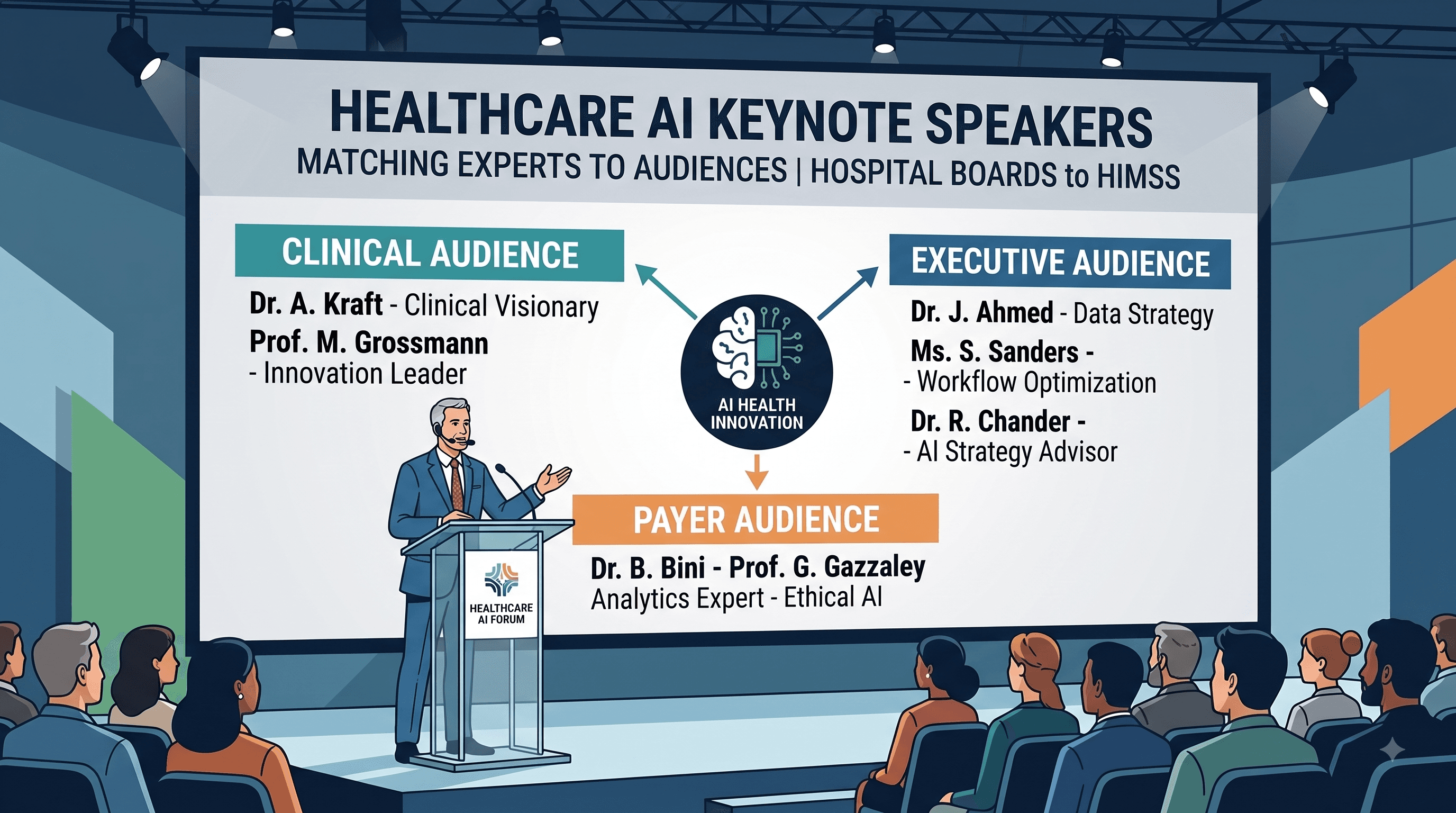
That is where most healthcare event programs go wrong. They book one "AI in healthcare" name and send that person in front of every audience, from the surgical staff meeting to the hospital board to the payer strategy summit. But a trauma surgeon showing AI at the bedside and a health policy scholar mapping the reimbursement landscape are answering very different questions for very different people. The best healthcare AI keynote is the one matched to the decision the audience actually has to make. What follows is the deepest bench on the Speak About AI roster, organized around exactly that.
For Clinical Audiences: Speakers Who Earn the Room's Trust
Clinical audiences are the toughest room in healthcare. Surgeons, physicians, nurses, and care teams at grand rounds, medical staff meetings, and the clinical tracks at HIMSS will fact check a claim in real time, and they trust peers who have actually used the technology on a patient over consultants describing it from the outside.
Dr. Rafael Grossmann is a full time general and trauma surgeon, and one of the field's genuine firsts. In 2013 he became the first surgeon to perform a live operation using Google Glass. He talks to clinicians as a clinician, framing AI as a way to support the physician rather than replace one. He shows how it can cut medical errors, ease provider burnout, and fit large language models into the actual workflow. That makes him especially effective with audiences that are excited about the technology but wary of the hype.
Professor Shafi Ahmed is a cancer surgeon at The Royal London Hospital, the CEO of Medical Realities, and a faculty member at Harvard Medical School and Imperial College London. He is a global pioneer in surgical education who has used virtual and augmented reality to broadcast operations to trainees around the world, and he brings that same forward lean to AI in surgery and medical training. Listed at £20,000 to £25,000, he is a marquee draw for surgical, medical education, and innovation focused clinical audiences.
Dr. Stefano Bini works in both the operating room and the engineering lab. He is an orthopedic surgeon, the Maria Manetti Shrem Endowed Professor at UCSF, and the Chief Technology Officer for the UCSF Orthopedics Department. He also founded the Digital Orthopaedics Conference and runs a digital orthopaedics research lab. For clinical audiences who want AI and medical robotics grounded in surgical reality rather than slideware, he speaks with rare operational authority.
For Executive and Board Audiences: Speakers Who See the Whole System
Hospital boards, health system executives, and leadership tracks are asking a different question. Where is medicine going, what should we invest in, and how do we lead our institution through a transformation none of us has managed before? These audiences need altitude, a credible map of the future they can make capital decisions against.
Dr. Daniel Kraft is the definitive choice here. He is a Stanford and Harvard trained physician and scientist, an inventor, and one of the most sought after voices on the future of medicine. He pulls the whole arc of exponential healthcare, including AI, sensors, robotics, and personalized medicine, into a strategic narrative that helps leadership teams see around the corner. Listed at $25,000 to $65,000, he is the speaker health systems book when the goal is to align a board around a bold, informed vision.
Dr. Adam Gazzaley shows executives what genuinely new categories of medicine look like. He is a UCSF neuroscientist and the founder of Neuroscape, and he cofounded Akili, the company behind the first FDA cleared video game prescribed as a medical treatment. It is a concrete example of experiential medicine, of AI creating therapies that did not exist before. For leadership audiences weighing digital therapeutics and the next wave of care models, he makes the abstract future tangible.
Dr. Divya Chander is a neuroscientist and anesthesiologist applying AI to cognitive longevity and the frontiers of the brain. Also listed at $25,000 to $65,000, she brings a futurist's imagination anchored in hard science. Executive audiences that want to be provoked and inspired about where human health and machine intelligence are converging tend to respond to her.
For Payer, Policy, and Population Health Audiences: Speakers Who Follow the Money and the Rules
Payers, policy leaders, and population health teams work where clinical promise meets reimbursement, regulation, and equity. This audience needs someone fluent in evidence, policy, and the systems that decide what actually gets paid for and deployed at scale.
Dr. Lee Sanders is the standout voice for this room. He is a Stanford Professor of Pediatrics and Health Policy, the Chief of the Division of General Pediatrics, and the director of the Stanford Health Literacy Lab. He designs AI driven behavioral interventions and advises the NIH, CDC, FDA, and the American Academy of Pediatrics on medical AI policy. He connects AI to the questions payers and policymakers actually lose sleep over, including health equity, health literacy, evidence standards, and whether an intervention improves outcomes at the population level. For value based care, policy, and population health programs, he is exactly the right fit.
Payer and policy audiences also gain from crossover perspectives. Daniel Kraft's work on prevention and exponential medicine speaks directly to the long term economics of value based care, and Adam Gazzaley's FDA cleared digital therapeutics are a real case study in how new treatments navigate the regulatory and reimbursement path. Pairing a policy expert like Sanders with one of these visionaries gives a payer audience both the map and the destination.
Match the Speaker to the Decision in the Room
The strength of a specialized bench is that you never have to compromise. A surgical audience gets a surgeon. A board gets someone who can see the whole system. A payer summit gets a health policy scholar who knows the reimbursement rules. Each one is credible to the specific people who have to act on what they hear. That matching is the whole point of working with a bureau built around a single domain instead of a general roster where healthcare AI is one tag among thousands.
Every speaker here pairs real medical credentials with genuine AI expertise. That combination is what healthcare audiences demand, and it is one most speaker rosters cannot supply. You can see the full bench, with each expert's focus areas and formats, on the Speak About AI healthcare speakers page.
Healthcare event planners who want a speaker matched precisely to their audience, whether clinical, executive, or payer, can reach the Speak About AI curation team at speakabout.ai. Tell us who is in the room and what decision they are facing, and the first conversation is about fit, not availability. You can also browse the full AI speakers roster to see how audience based curation works across every industry.
The healthcare organizations getting the most from their AI programming in 2026 are not booking the most famous name and hoping it lands. They match the right expert to the right audience, one booking at a time. With a bench this deep, that is a choice you never have to give up.
Frequently Asked Questions
Who are the best AI keynote speakers for healthcare events?
It depends on the audience. For clinical rooms: surgeons Rafael Grossmann, Shafi Ahmed, and Stefano Bini. For hospital boards and executives: Daniel Kraft, Adam Gazzaley, and Divya Chander. For payer, policy, and population health audiences: Stanford health policy professor Lee Sanders.
How much does a healthcare AI keynote speaker cost?
Marquee healthcare AI speakers such as Daniel Kraft and Divya Chander list at $25,000 to $65,000, and Shafi Ahmed at £20,000 to £25,000. Strong clinical and policy voices are available below that range, in line with the broader AI speaker market of $15,000 to $65,000.
Why do healthcare audiences need medically credentialed AI speakers?
Clinical audiences fact-check claims in real time and trust peers who have used the technology on patients. Every speaker on this list pairs real medical credentials (practicing surgeons, physicians, professors) with genuine AI expertise, a combination most general speaker rosters cannot supply.