Boost SKO Revenue: Practical AI Speaker Tactics, Briefings, and ROI Measurement
That feeling is starting to set in. The annual Sales Kick-Off (SKO) is on the horizon, and the pressure is on to deliver an event that’s more than just a costly reunion. You need to arm your sales team with something tangible, something that will actually move the needle on their quota this year. The default option is often a motivational speaker—someone to deliver a jolt of energy and a compelling story. But inspiration fades. By the second week of Q1, the "rah-rah" wears off, and your reps are back to facing the same old prospecting grind and deal friction.
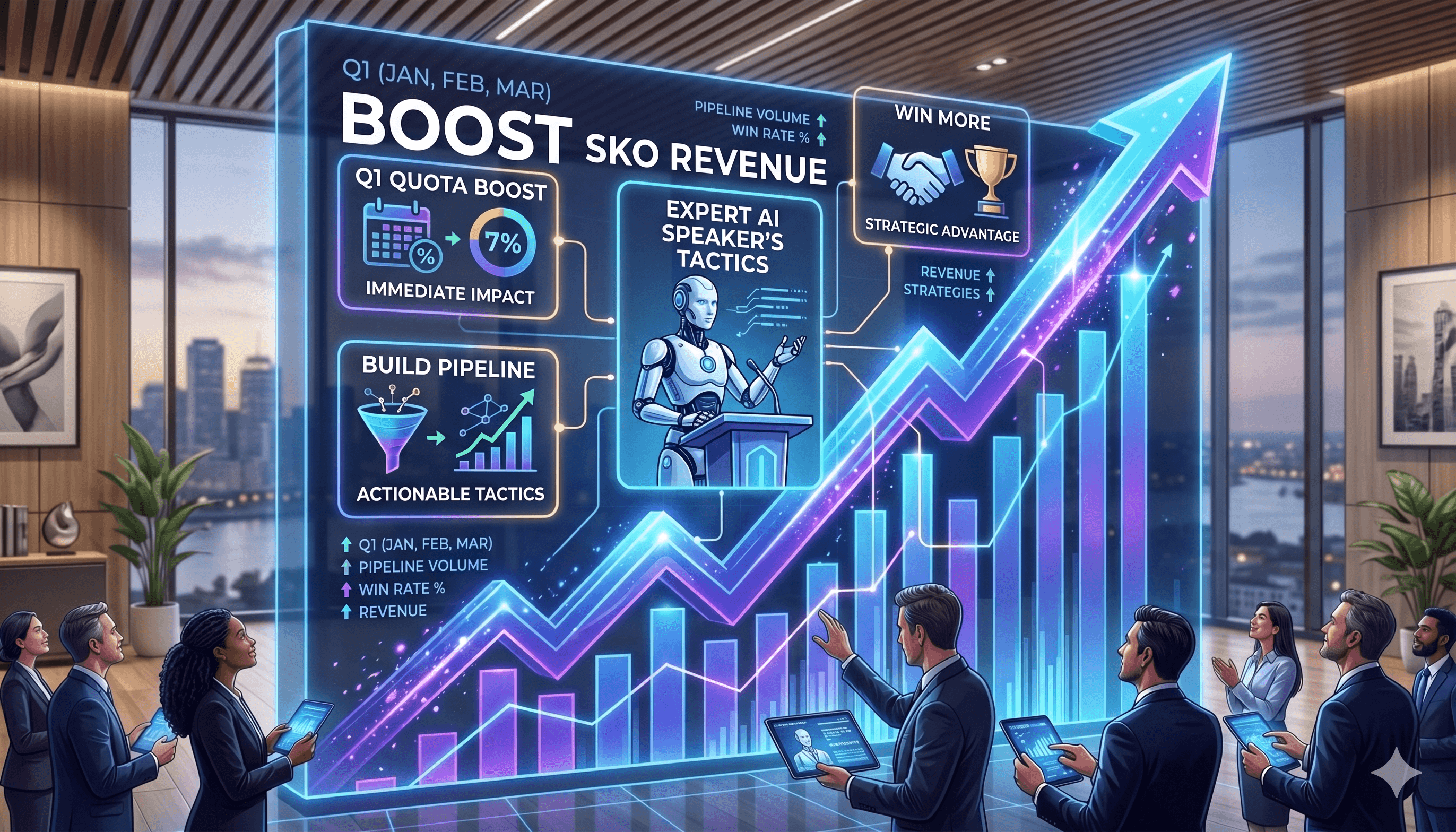
This year, there’s a better way to invest that mainstage budget. Instead of focusing solely on the why, you can equip your team with the how. An expert AI speaker doesn't just talk about the future of sales; they deliver practical, ready-to-use tactics that your reps can implement the very next day to build pipeline, accelerate deals, and win more effectively. It’s the difference between a sugar rush and a nutrient-dense meal for your revenue engine.
Beyond the Hype: What an AI Speaker Delivers That a Motivational Speaker Can't
Motivational speakers are masters of emotion. They tell stories of overcoming adversity that light a fire in the belly. That's valuable, but it doesn't solve a rep's problem of staring at a blank screen trying to write a compelling cold email to a C-level executive.
An AI speaker, on the other hand, is a master of application. They bridge the gap between abstract technology and the daily workflow of a sales professional. The goal is to move from inspiration to implementation.
Here’s what that looks like in practice:
- Hyper-Personalization at Scale: Instead of just telling your team to "do more research," an AI speaker shows them how to use AI tools to scan a prospect’s recent LinkedIn activity, podcast appearances, and company earnings calls to generate three highly relevant talking points in under 60 seconds. They can demonstrate how to craft a prompt that turns a generic outreach template into a message that feels like it was written for an audience of one.
- Intelligent Deal Management: A motivational speaker might talk about "crushing your goals." An AI speaker will show your team how to use conversation intelligence tools (like Gong or Chorus) not just for recording calls, but for using AI to automatically identify key objections, competitor mentions, and customer pain points. They can provide frameworks for using AI to summarize a 45-minute discovery call into a crisp, actionable follow-up email that keeps momentum high.
- De-Risking the Pipeline: Every sales leader has been burned by "happy ears" and overly optimistic forecasting. An AI speaker can introduce your team to AI-powered pipeline analysis concepts. They can demonstrate how certain tools can analyze deal engagement data—email response rates, calendar invites accepted, documents viewed—to provide an objective "deal health" score, helping reps focus their energy on the opportunities that are most likely to close, not just the ones they feel good about.
The key difference is the takeaway. Your team leaves a motivational talk feeling energized. They leave a practical AI session feeling empowered, armed with specific new skills they can immediately apply to their most pressing challenges.
The Briefing Document: Setting Your AI Speaker Up for Success
You wouldn't ask a chef to cook a meal without telling them about your guests' dietary restrictions or preferences. Similarly, dropping an AI speaker onto your SKO stage without a thorough briefing is a recipe for a generic, forgettable session. To get a talk that feels like it was built from the ground up for your team, you need to provide the right ingredients.
The better the brief, the more targeted the talk. A great speaker will insist on this. Here’s what your briefing document should include:
Your Sales Reality
- The Tech Stack: What CRM, sales engagement, and conversation intelligence tools does your team live in every day? (e.g., Salesforce, Outreach, Gong, Salesloft). A great speaker will tailor their examples to the software your team actually uses.
- A "Day in the Life": What is the #1 most time-consuming, non-selling task your reps complain about? Is it logging notes, pre-call research, or building account plans? This is gold for a speaker looking for relatable pain points.
- The Sales Motion: Are your reps running a high-velocity transactional sales cycle or a complex, multi-threaded enterprise sale? The AI tactics for a 30-day SMB deal are vastly different from those for a 9-month enterprise slog.
Your Industry and Customers
- Industry Nuances: What are the specific challenges of selling in your vertical? (e.g., "We sell to hospital administrators, who are incredibly risk-averse and require extensive social proof.")
- The "Enemy": Who are your top 2-3 competitors? What are their key differentiators, and what FUD (Fear, Uncertainty, and Doubt) do they spread about you in the market? A sharp speaker can suggest AI-powered research tactics to proactively counter these claims.
- The Desired Outcome: What is the single most important action you want your team to take after the session? Be specific. "Start using AI for pre-call prep" is better than "Be more innovative." "We want every BDR to use Perplexity to generate 3 account-specific talking points before every cold call next week" is even better.
Vetting Your Shortlist: Key Questions to Ask the Bureau
Once you start exploring options, you’ll find the "AI speaker" category is broad. It includes everyone from academic futurists to hands-on practitioners. Your job is to find the latter. When you talk to a bureau like ours, push beyond the speaker's bio and sizzle reel.
Here are the questions that will help you separate the theorists from the tacticians:
- *"Can they go beyond the what and teach the how?"*
This is the most important question. Ask for examples of specific, actionable takeaways a sales team would get from their session. If the answer is about "the paradigm shift of generative AI," be wary. If it’s about "a 3-step prompt formula for handling pricing objections," you’re on the right track.
- "How do they customize their content for a sales audience versus a general business audience?"
A sales team has a low tolerance for abstract theory. They need to know how this helps them hit their number. Look for a speaker who talks less about Large Language Models and more about building pipeline and shortening sales cycles.
- "What is their real-world experience with sales or revenue teams?"
Have they ever carried a bag? Managed a sales team? Worked in a sales-ops or enablement role? A speaker with direct experience in the revenue world will have a level of credibility and understanding that a pure technologist simply can't match.
- "Can we see a clip of them handling audience Q&A?"
A pre-scripted keynote is one thing. The ability to think on your feet and answer a tough, specific question from a skeptical Account Executive is another. This is where true expertise is revealed.
Choosing the Right Format for Maximum Impact
The traditional 60-minute keynote isn't your only option. Depending on your SKO's goals, a different format might deliver more value.
The Vision-Setting Keynote
This is the classic mainstage format. It’s perfect for opening the SKO, generating excitement, and painting a picture of what the "AI-augmented seller" looks like. A great keynote will blend high-level inspiration with a handful of powerful, memorable tactics that set the tone for the entire event.
The Interactive Panel Discussion
A panel can bring the topic of AI down to earth. Consider a moderator with an AI speaker, one of your top-performing reps, and your head of sales operations. This creates a dynamic conversation about not just the potential of AI, but the practical realities of implementation, adoption, and how it fits into your existing workflows. It feels less like a lecture and more like a collaborative problem-solving session.
The Deep-Dive Workshop or Fireside Chat
If your primary goal is skill-building, a smaller, more intimate format is ideal. A 90-minute workshop on "AI-Powered Prospecting" or a fireside chat focused entirely on Q&A allows reps to get into the weeds. This is where they can ask hyper-specific questions about their accounts and get hands-on guidance. These sessions often have the most lasting impact on day-to-day behavior.
Measuring the ROI: From Standing Ovation to Pipeline Creation
The session is over. The speaker got a standing ovation. The "happy sheets" are glowing. But your CFO doesn't care about applause; they care about pipeline. Measuring the true ROI of an SKO speaker requires looking beyond immediate feedback.
Here’s a practical, three-tiered framework for measuring impact:
- Immediate (1-2 Weeks Post-SKO): Adoption Metrics
The goal here is to see if the ideas stuck. Don't ask "Did you enjoy the session?" Ask: "What one AI tactic from the session did you try this week?" Use a simple survey or a dedicated Slack channel. If the speaker recommended a specific tool, track the number of sign-ups or logins from your team. This is your earliest indicator of engagement.
- Mid-Term (30-60 Days Post-SKO): Efficiency & Activity Metrics
Now, you’re looking for changes in behavior. Work with your sales-ops team to track relevant metrics. Has the average time spent on pre-call research decreased? Is the volume of personalized outbound emails increasing? Are you seeing a higher meeting-booked rate on cold outreach? Is the quality of call notes and CRM updates improving? This data shows whether the new skills are becoming habits.
- Long-Term (90-180 Days Post-SKO): Revenue Metrics
This is the ultimate test. While it's hard to draw a direct causal line from one speaker to a closed deal, you can look for powerful correlations. Compare a cohort of reps who actively adopted the AI tactics against those who didn't. Are you seeing: A higher win rate? A shorter sales cycle? A larger average deal size?*
When you can show your leadership that the reps who embraced the new AI workflows saw a 10% faster deal velocity in Q2, you’ve more than justified the investment. You've demonstrated that you didn't just host an event; you invested in a competitive advantage that directly impacts the bottom line.