
Micro-Event Speaker Selection Requires a Framework Large Conferences Cannot Provide
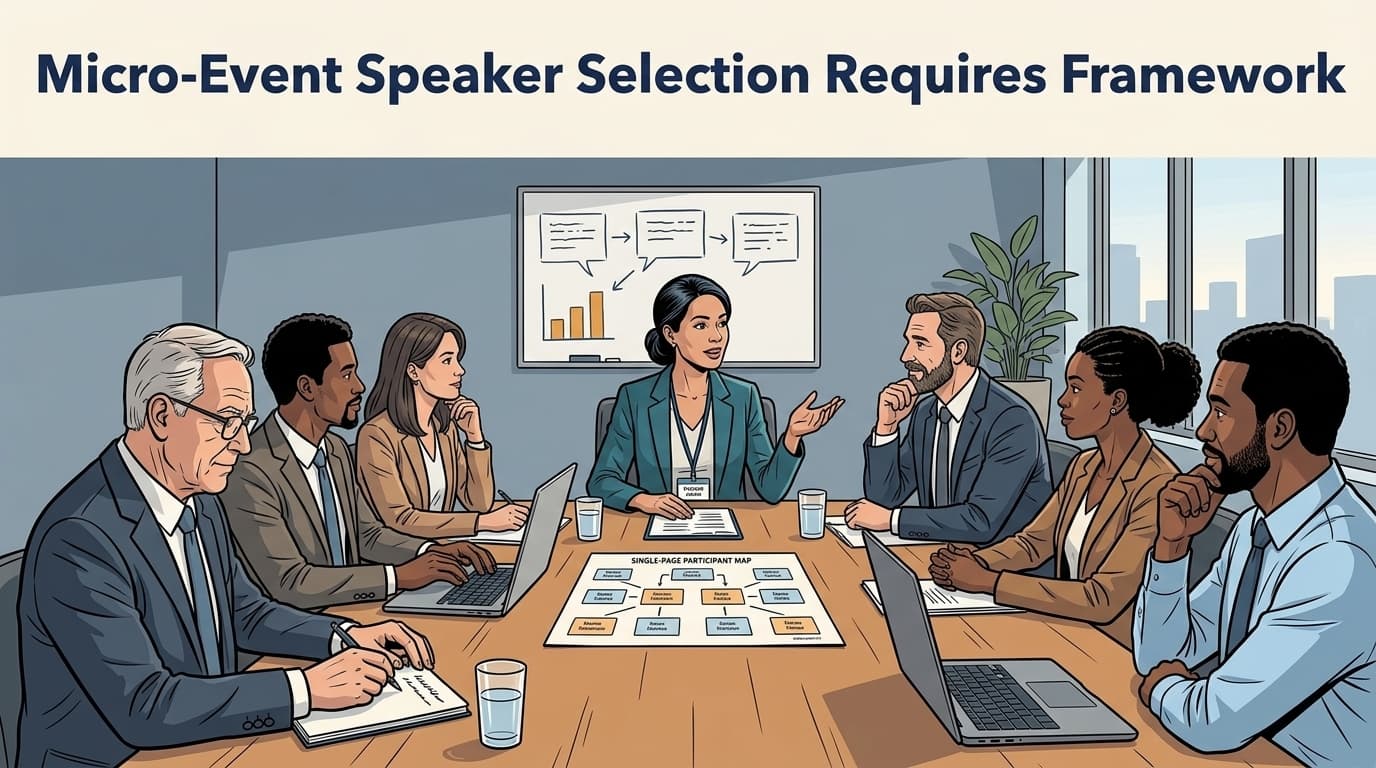
The planner who books a nationally recognized innovation speaker for a 28-person executive strategy offsite has not made a speaker selection error. They have made a format selection error, and they will not fully understand the difference until twenty minutes into a session where three senior leaders are quietly checking their phones while a polished 75-minute narrative plays out in a room designed for conversation.
This is the defining planning blind spot of 2026. The corporate events industry is moving decisively toward smaller, more intentional gatherings. According to PCMA 2026 research, more than three-quarters of organizers who offer micro-events report a positive registration impact, and 63% of organizers report growing demand for smaller, more focused events as companies prioritize high-impact experiences over large-scale attendance. In 2024, 54% of planners most frequently booked events of 250 people or fewer. The micro-event is no longer a supplementary format. For the highest-stakes organizational conversations, it is becoming the primary one.
The speaker selection framework has not kept pace with that shift.
Why the Large-Conference Speaker Framework Fails in Small Rooms
The large-conference keynote speaker is a specific performance profile. They command a room through narrative drive, physical presence, and energy management calibrated for a cold, diverse audience of hundreds. They have refined a single polished arc and can deliver it consistently. These are genuine, difficult-to-develop skills, and they are exactly the wrong skills for a 40-person executive roundtable.
The speaker who excels in front of 500 people is operating a completely different capability set from the speaker who can hold a 35-person senior leadership table through intellectual depth, genuine dialogue, and adaptive facilitation. These capabilities are not the same, and they are not reliably present in the same person.
The failure mode is predictable. A speaker whose delivery architecture is built around one-directional narrative, minimal interaction, and escalating energy for a large, anonymous audience will produce a session that feels performative and disconnected in an intimate setting where participants can see the speaker's face and expect to be in a genuine exchange. Post-event feedback from senior audiences in this scenario consistently uses the word "presentation" as a criticism, not a compliment.
Professional audiences in 2026 expect tailored agendas, purposeful connections, and content that adapts to their interests in real time. In a micro-event, that expectation is not just about topic relevance. It is about the speaker's ability to respond to the room, incorporate participant perspectives, and make the session feel like a collaborative conversation rather than a curated performance.
The planner who applies large-conference selection logic to a micro-event format has not adapted their framework to the format. They have applied the wrong tool to a new problem, and the cost of that mismatch is the most expensive form of disengagement in corporate events: a senior audience that is physically present and mentally absent.
The Four Criteria That Micro-Event Speaker Selection Requires
Micro-event speaker selection works when it is organized around four variables that large-conference vetting does not prioritize.
Criterion 1: Facilitation capability as a primary filter. A micro-event speaker is not delivering content to an audience. They are leading a structured conversation with participants who have their own expertise, perspectives, and agendas. The speaker who cannot genuinely facilitate that conversation, who cannot hold space for disagreement, surface insight from the room, and synthesize what they hear in real time, is not the right profile for an intimate format regardless of their stage credentials.
The vetting question that surfaces this capability most reliably: describe the last time a participant in a small-group session challenged your framework directly, and walk me through how you responded. The answer reveals whether the speaker treats participant challenge as a disruption to manage or as raw material to work with.
Criterion 2: Intellectual depth under direct questioning. In a 40-person executive roundtable, every participant is within conversational range of the speaker. Senior leaders will ask hard, specific questions. A speaker whose content depth extends twenty minutes beyond their opening framework will be visibly exposed in a 90-minute small-group session in ways they would never be exposed in a 60-minute large-stage keynote followed by a managed Q&A.
The three-video vetting standard, reviewing a full-length keynote, a spontaneous Q&A segment, and a virtual engagement, is even more critical for micro-event selection than for large-conference selection. The Q&A footage is the direct proxy for the small-room experience, and it is the footage most speakers hope you will not request.
Criterion 3: Content adaptability in real time. Large-stage keynotes reward speakers who have refined a single narrative arc and deliver it consistently. Micro-events reward speakers who can read the specific energy, expertise level, and live concerns of the room within the first ten minutes and adjust accordingly. A speaker who arrives at a 30-person sales leadership offsite and delivers the same session they delivered at the previous three engagements has failed the micro-event format before the session ends, regardless of how well-received those prior sessions were.
Criterion 4: Dialogue architecture. The best micro-event speakers design their content with deliberate dialogue windows rather than treating Q&A as an afterthought appended to a presentation. A speaker who can describe specifically how they structure participant engagement within a 90-minute session, what questions they use to open dialogue, how they manage participants who dominate, and how they synthesize group insights into a shared takeaway, is a speaker with genuine small-room capability.
A speaker who describes their approach as "I leave plenty of time for questions" is a speaker whose dialogue architecture is improvised rather than designed.
Speaker Profiles Built for Intimate Formats
Four speaker profiles consistently outperform in micro-event contexts, and each serves a distinct session objective.
The strategic facilitator is best suited for executive strategy sessions, leadership team alignments, and organizational decision-making offsites where the goal is to surface and structure the group's collective thinking rather than introduce external frameworks. Selection for this profile centers on facilitation credentials and track record with comparable senior audiences, not stage presence or published thought leadership.
The subject-matter practitioner is best suited for small-group deep dives where the audience needs a credible expert who has done the work, not just studied it. For a 50-person AI implementation team, a speaker who has led an enterprise AI deployment at a comparable organization and can speak to specific technical and cultural challenges is more valuable than a celebrated futurist whose credibility is observational rather than operational.
The executive advisor is best suited for board-level sessions, C-suite strategy conversations, and senior leadership retreats where the audience's primary need is a thought partner who can engage as a peer rather than a presenter. This profile requires the highest intellectual depth and the lowest performance orientation of any micro-event speaker type. It is also the profile most frequently misidentified during selection, because its credentials look similar to the large-stage keynote speaker on paper while the actual capability required is entirely different.
The workshop architect is best suited for skill-building offsites, team capability sessions, and problem-solving workshops where the goal is applied learning rather than inspiration or information delivery. The vetting process for this profile should center on reviewing the specific workshop design the speaker would bring to the engagement, not their keynote reel.
Speak About AI's curated speaker roster is organized by session format, audience profile, and facilitation capability, which means you can move from event objective to matched speaker profile without sorting through large-stage credentials that are irrelevant to your format.
Briefing the Micro-Event Speaker: What Standard Briefs Omit
The briefing difference is the highest-leverage planning variable in micro-event programming. A large-conference speaker brief describes the audience and the event theme. A micro-event speaker brief describes the specific participants by name and role, the organizational context that makes this session necessary, the interpersonal dynamics and known areas of disagreement within the group, and the specific output the event is designed to produce.
A micro-event brief must include five elements that standard conference briefs rarely address.
A participant map covers the names, roles, and relevant organizational context of each participant, including known areas of expertise, potential resistance, and interpersonal dynamics that will shape the room's energy.
Organizational history with the topic tells the speaker what the group has already tried, decided, or failed at in relation to the session's subject matter, so the speaker does not cover ground the audience has already traversed.
The specific output the session is designed to produce, framed as a concrete deliverable rather than a general learning objective.
The emotional tone the session needs to achieve, described in terms of the audience's current state, whether skeptical, fatigued, politically divided, or energized, and the state the session needs to move them toward.
Facilitation boundaries clarify which topics are productive to open and which are organizational minefields the speaker should navigate around rather than into.
In a large-conference context, a speaker conducting two or three pre-event executive interviews is delivering above the standard. In a micro-event context, a speaker who does not conduct pre-event conversations with at least two or three key participants is not prepared for the format. The pre-event interview is not a courtesy in a small-room setting. It is the primary source of contextual intelligence the speaker needs to serve the room.
The practical result of this briefing discipline is significant. An L&D leader at a 35-person regional sales leadership offsite who provides the speaker with a participant map including each person's tenure, their most recent performance quarter, and their known position on the adoption initiative the offsite is designed to advance gives the speaker the material to design three specific dialogue windows that surface and address the room's actual resistance patterns. The session produces a group commitment document that participants describe as the most useful structured business conversation they have had in two years.
Measuring Micro-Event ROI With the Right Tool
The standard post-event satisfaction survey is designed for large, diverse audiences where aggregate scores provide meaningful signal. In a 30-person micro-event, a single disengaged participant can move the aggregate score by three percentage points, and a session that produced a genuine strategic breakthrough may score lower than a session that was entertaining but inconsequential.
Only 36% of planners currently use ROI measurement tools, according to the AmEx GBT 2026 Global Meetings and Events Forecast, and leadership scrutiny on event spend is not fading. In a micro-event context where the per-attendee investment is significantly higher than a large conference, the absence of a rigorous output measurement framework is a budget credibility problem that compounds with every event cycle.
The output-anchored measurement framework captures what satisfaction surveys cannot. Before the event, define the specific decision or output the session is designed to produce. Immediately after, document the group's specific commitments, action owners, and timelines before the room disperses. At 24 hours and at 30 days, measure the degree of alignment among participants on the session's key conclusions and the organizational actions taken that can be directly attributed to the session.
The contrast is stark. A consumer goods company runs two micro-events with comparable audiences and comparable topics in the same quarter. The first uses a standard post-event satisfaction survey and produces a score of 4.3 out of 5 with no documented organizational output. The second uses an output-anchored framework and produces a specific decision document, three action owners, and a 30-day pulse survey showing 71% of participants have taken the committed action. The second event's ROI case is presented to the CFO. The first event's is not.
A speaker who closes a micro-event session with a structured decision capture exercise is producing an organizational artifact that extends the session's value into the 30-day implementation period. This deliverable should be negotiated into the speaker's contract before the engagement is confirmed.
Building a Micro-Event Speaker Roster for Organizations Running Multiple Small Gatherings
For organizations running five or more small-group events per year, the micro-event speaker roster is an institutional planning asset. Rather than approaching each engagement as a standalone booking decision, a planner who maintains a vetted roster of three to five speakers with confirmed small-room capability can move from event objective to speaker selection in days rather than weeks.
The roster works best in three tiers. Tier 1 covers strategic facilitators and workshop architects appropriate for internal organizational sessions where the output is a decision, an alignment, or a capability. Tier 2 covers subject-matter practitioners appropriate for team deep dives and implementation-focused sessions. Tier 3 covers executive advisor profiles appropriate for senior leadership and board-level sessions.
Booking a speaker for a series of three events over a 12-month period can reduce the per-event fee by up to 20% while simultaneously deepening the speaker's organizational knowledge with each engagement. A speaker who has delivered three sessions for the same organization across 12 months has accumulated institutional context that a first-time booking cannot replicate. A professional services firm that builds this model consistently finds that by the third engagement, the speaker's accumulated institutional knowledge produces a session the firm's Chief People Officer describes as indistinguishable from an internal strategic planning session, at a fraction of the cost of an external consulting engagement.
The question to ask a bureau in a micro-event context is not which speakers are most popular or most booked. It is which speakers have documented track records of producing measurable outputs in small-group settings with senior audiences. That distinction is the difference between a speaker who is good and a speaker who is right for your format.
The planner building a micro-event speaker program should begin with a single pilot engagement using the four-criteria selection framework described here, brief the speaker using the five-element micro-event brief, measure using the output-anchored framework, and use the post-event data to build the first entry in the institutional speaker file that will anchor the roster over time. One well-designed micro-event engagement, measured rigorously, produces more planning intelligence than a year of large-conference post-event surveys.
Start your micro-event speaker search with a format-specific, audience-matched recommendation through the Speak About AI booking inquiry page, where every recommendation is filtered by small-room facilitation capability and verified post-event performance data from comparable intimate formats.
---
Frequently Asked Questions
What is the primary difference between booking a speaker for a micro-event versus a large conference?
The primary difference is the performance skill set required. A large-conference keynote rewards narrative drive, stage presence, and energy management for a cold, diverse audience. A micro-event rewards facilitation capability, intellectual depth under direct questioning, and real-time content adaptability for a small, senior audience that expects dialogue rather than performance. These are distinct capabilities that are not reliably present in the same speaker, and the selection framework must evaluate them separately.
How far in advance should I book a speaker for a corporate micro-event?
For most micro-event formats, a three to six month lead time is sufficient for speakers in the practitioner and workshop architect profiles. Executive advisor profiles who are in high demand for board-level and C-suite sessions may require six to nine months. The lead time matters not just for availability but for the pre-event briefing and session design review process that a well-designed micro-event engagement requires.
Can I use the same speaker for both a large conference keynote and a micro-event format?
Some speakers have genuine capability across both formats, but this should be verified rather than assumed. A speaker who excels on a large stage does not automatically possess the facilitation depth and real-time adaptability that a small-room executive session requires. Request specific small-room performance references from comparable audience profiles before booking a large-stage speaker for a micro-event context.
How do I measure ROI for a micro-event speaker investment?
Replace the standard satisfaction survey with an output-anchored measurement framework. Before the event, define the specific decision or output the session is designed to produce. Immediately after the event, document the group's specific commitments and action owners. At 30 days, run a brief pulse survey measuring the degree to which those commitments have been acted on. This framework captures organizational value that satisfaction scores cannot measure and produces the CFO-ready data that justifies the investment.