
The Attendee Experience Gap: Why Speaker-Centric Conference Design Fails Modern Attendees
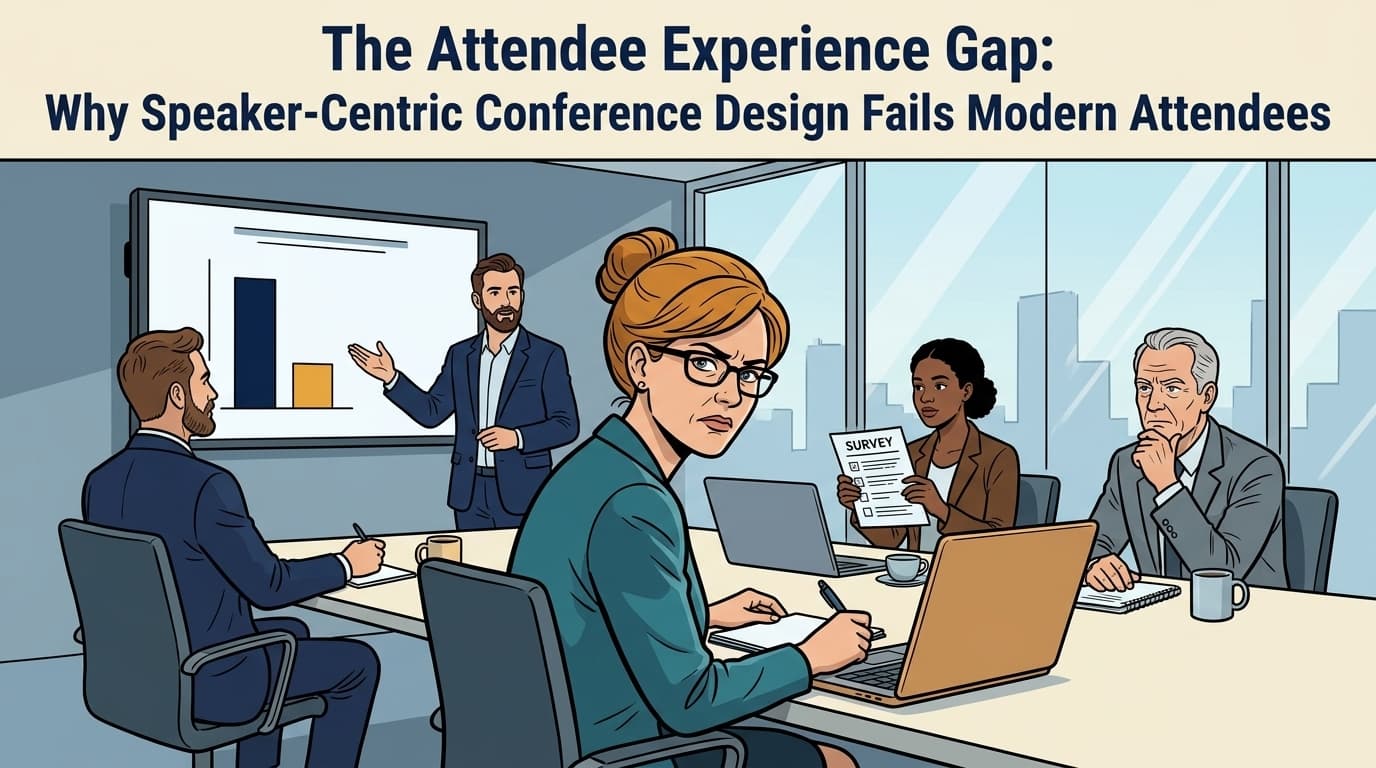
You booked a respected keynote speaker. You invested in production. You built a full agenda. And then the post-event survey came back with comments like "great speakers, but it felt like a long day of presentations" and "I'm not sure it was worth the travel." If that feedback sounds familiar, the problem is not your speaker. The problem is the design philosophy that treated the speaker as the product and everything else as the packaging.
According to Freeman's 2026 research, 78% of organizers believe they delivered a standout, memorable event, while 60% of attendees say they did not feel that same level of engagement. That 38-percentage-point gap is not a production quality problem. It is a design philosophy problem, and it is the most expensive measurement blind spot in corporate event planning today.
The Engagement Gap and What It Actually Measures
The Freeman data does not describe a bad event. It describes a well-produced event that was designed for the wrong outcome. Planners who optimize for the speaker program and treat the surrounding experience as logistical scaffolding are building for their own perception of quality, not for the attendee's experience of it.
The GoGather 2026 data makes this more urgent. Event satisfaction fell 8% from 2024 to 2025, across an industry where two-thirds of planners are working with flat or reduced budgets while suppliers continue raising prices. The satisfaction gap is widening at precisely the moment when the investment case for events is under the most scrutiny it has faced in years.
The structural context matters here. Attendees in 2026 are more selective. Travel, registration fees, and time away from work are real costs that a full agenda and a well-known keynote can no longer justify on their own. A conference that does not deliver a meaningfully different experience from the prior year is not just underperforming. It is actively competing against the attendee's decision not to attend at all.
The Amex GBT 2026 data confirms this is not a niche concern. Thirty-one percent of meeting professionals cite designing events that meet the needs of today's attendees as their top challenge for 2026. Thirty-three percent say improving the attendee experience with more memorable events is their top priority. And yet 20% of attendees report that their objectives are not being met at the events they attend.
The attendee experience is not the backdrop for the speaker program. It is the product. The planner who designs a conference as a speaker delivery mechanism is building the wrong product for the 2026 attendee, and the satisfaction data is the proof.
The Four Experience Layers Most Planners Underdesign
Most conference design begins with the opening keynote. The four layers that determine whether the conference actually works begin much earlier and extend much further.
Layer 1: The pre-arrival experience. The 30 to 60 days before the event are not a marketing function. They are an experience design function. A pre-event communication strategy that introduces the speaker's framework, surfaces the event's thematic arc, and gives attendees a specific reason to arrive prepared determines the quality of the audience the speaker walks out to on day one. An attendee who arrives with context and anticipation is a fundamentally different participant than one who arrived because it was on the calendar.
Layer 2: The networking architecture. Blackthorn's 2026 research shows that 75% of attendees want connections that broaden their perspective, 63% value direct access to subject-matter experts, and 51% say strong networking alone is reason enough to attend. And yet only 15% of organizers rate their networking experiences as very effective, according to Bizzabo 2026 data. That gap is not a resource problem. It is a design priority problem.
Consider a 400-person leadership summit that invests heavily in a headline speaker and high-production AV while leaving the networking format to three unstructured coffee breaks and an open cocktail hour. Post-event survey: 71% of attendees describe networking as the weakest element. Follow-up analysis: 82% of attendees spent their networking time with people they already knew. The networking investment was not zero. The networking design was.
Layer 3: The session pacing and format architecture. Research consistently shows that sessions of 20 to 30 minutes outperform longer formats for attendee engagement and retention. The traditional 90-minute keynote is an increasingly difficult format to sustain across a full-day or multi-day conference. The planner who programs a sequence of 60 to 90 minute sessions with 15-minute coffee breaks is not respecting the attendee's attention cycle. They are fighting it.
Layer 4: The between-session experience. The conversations that happen between sessions are frequently what attendees describe as the most valuable part of the conference. At the best-designed events, these moments are not accidental. They are engineered through seating arrangements that prevent attendees from self-sorting into familiar groups, facilitated lunch formats that create cross-functional connections, and physical space configurations that make conversation the path of least resistance.
The contrast is instructive. A national professional services conference programs three 75-minute keynote sessions with 20-minute breaks and a 90-minute networking lunch where attendees self-select seating. Post-event feedback praises the speakers individually and describes the event as a long day of presentations. A comparable conference programs the same speaker content in 40-minute formats with structured 30-minute peer discussion sessions after each keynote and a facilitated lunch using a simple conversation prompt to connect attendees across practice areas. The second conference receives identical speaker quality ratings and significantly higher overall experience scores. The architecture around the speakers amplified their impact rather than diluting it.
Designing for Interactivity: What 92% of Attendees Are Actually Asking For
The most specific and actionable signal in 2026 attendee research is this: 92% of attendees prefer interactive experiences over traditional presentations, and 67% specifically favor sessions that include live Q&A features, according to vFairs 2026 data. This is not a preference for entertainment over substance. It is a preference for participation over passive receipt.
Corporate events are increasingly guiding speakers toward 20-minute or shorter presentations with intentional audience engagement built into the format rather than appended at the end. The planner who books a 60-minute keynote and allocates the final 10 minutes to Q&A is not designing for interactivity. They are designing a presentation with a brief question period, which is a format the majority of attendees have already indicated they prefer less.
The interaction design brief is a planner responsibility, not a speaker responsibility. Most planners brief speakers on content, audience profile, and event theme. Very few brief speakers on the specific interaction architecture the session needs: which polling tools will be active, which questions will be seeded in advance, which moments are designed for audience response, and how the speaker's content connects to the peer discussion session that follows. The speaker who is not briefed on the interaction architecture cannot design for it.
For planners building this interaction architecture into their briefing process, Speak About AI's curated roster of vetted keynote speakers is organized by session format and audience interaction capability, making it a practical starting point for matching speaker selection to the experiential outcomes the session needs to produce. The speaker briefing and vetting resources available through Speak About AI extend this framework into the selection and briefing process itself.
The physical environment is also an interactivity enabler or inhibitor. Theater-style seating facing a stage is physically designed for one-directional communication. Round tables, flexible seating clusters, and cabaret-style arrangements are physically designed for conversation. The planner who selects a venue configuration without considering how it enables or inhibits the interaction format attendees are asking for is making an experience design decision by default, and the default is the passive one.
Bizzabo's 2026 research adds a useful frame: 95% of organizers say incorporating experiential learning is important, and 75% say immersive experiences that allow attendees to disconnect are important. These two data points define the 2026 attendee expectation: immersive enough to create genuine presence, structured enough to produce specific learning. Designing for experiential learning rather than content delivery meets both expectations simultaneously.
The Venue as an Experience Design Variable
The venue selection decision is an experience design decision that most planners treat as a logistics decision. The venue determines the physical architecture of every attendee interaction: how people move between sessions, where they gather between talks, whether the keynote stage creates distance or intimacy, and whether the physical environment signals that the event is a routine corporate function or something worth the attendee's time.
Forty-eight percent of planners were looking for venues outside hotels in 2025, according to Amex GBT 2026 data. The motivation is not novelty. An attendee who walks into a converted industrial space or a cultural institution is in a different psychological state from one who walks into a hotel ballroom they have sat in a dozen times before. The environment signals the quality of what is about to happen before the first session begins.
A financial services firm selected a hotel ballroom for a 150-person senior leadership summit because it was the venue they had used for three consecutive years. Senior attendees described the event as indistinguishable from the prior year. The following year, the same organization moved the event to a private club with flexible floor plans, curated table arrangements, and a facilitated dinner format. Return attendance increased 22%. The speaker program was identical. The venue experience was not.
Building a Post-Event Experience That Extends the Conference Value
The standard post-event workflow is a satisfaction survey, a thank-you email, and a transition to planning the next event. The attendee experience design framework treats the 30 days after the conference as a deliberate extension of the conference itself.
A technology company built a post-event content package that included the keynote recording distributed within 24 hours, a manager communication kit delivered to all people leaders within 48 hours, and a curated resource list connected to the speaker's framework distributed at day seven. At 30 days, a pulse survey showed that 61% of attendees had shared at least one element of the package with a direct report. The keynote's organizational reach was triple the in-room audience without a single additional speaker booking.
Each of these components requires planning before the event, including the recording rights negotiation that must happen before the contract is signed. The post-event experience that closes the objective gap identified by Freeman does not begin after the event ends. It begins in the pre-event communication that defines what the event is designed to help attendees achieve.
The connections made at a conference have a half-life directly proportional to the follow-up infrastructure that supports them. A conference that introduces attendees through a structured networking format and then provides a post-event digital community or a structured follow-up prompt is extending the conference's networking value into the weeks that follow. A conference that introduces attendees and then sends a generic thank-you email is allowing the networking investment to dissolve on the drive home.
The Practical Experience Design Framework: From Brief to Debrief
The planner building an attendee-experience-first conference design capability needs five design questions answered before a single session is programmed.
- What specific objective is each attendee segment attending to achieve, and how does the conference design serve that objective?
- What is the emotional arc of the event from arrival to departure, and what specific design decisions produce each emotional state?
- Where are the highest-value interaction opportunities in the conference, and what physical and programmatic design enables them?
- What format variation across sessions serves the attendee's attention cycle across the full event duration?
- What post-event design extends the conference's value into the 30 days that follow?
The practical tool that makes this framework actionable is the attendee journey map: a visual representation of every touchpoint in the attendee experience from pre-event communication through post-event follow-up, annotated with the designed emotional state at each touchpoint and the specific design decision that produces it. This is not a logistics checklist. It is an experience design document that makes intentions explicit and reviewable before the event rather than discoverable only in the post-event satisfaction data.
The investment case for this approach is strong. Sixty-nine percent of high-performing companies have increased their spending on corporate offsites and events since 2019, per Emburse 2025 data, with organizations now averaging 2.6 corporate offsite events annually. The planner who can connect the attendee experience design framework to the business outcomes that justify this investment is not just producing better events. They are building the internal credibility that makes every subsequent budget request easier to approve.
The planner who is building this capability for the first time should begin with a single design question applied to their next event: what is the one thing every attendee should feel at the moment they leave the closing session, and what specific design decisions produce that feeling? Answering this question before programming a single session changes the sequence of every decision that follows, because it anchors speaker selection, venue choice, networking format, and post-event follow-up to a single, measurable experiential outcome rather than a collection of individually optimized components.
The organizations closing the engagement gap in 2026 are not spending more on speakers or production. They are redesigning the architecture of the attendee experience itself, and the satisfaction data is beginning to reflect it.
---
Frequently Asked Questions
Why do corporate events score well on individual sessions but still receive poor overall experience ratings?
The most common cause is that the conference is designed around the speaker program and leaves the surrounding experience, including networking format, session pacing, between-session flow, and post-event follow-up, as logistical defaults rather than deliberate design decisions. Attendees evaluate the conference as a whole, not as a collection of individual sessions. A strong speaker in a poorly designed experiential architecture produces a strong session rating and a weak overall event rating. Designing the full attendee journey, not just the session program, closes this gap.
How do I redesign the networking experience at a corporate conference without significantly increasing the budget?
The highest-impact networking design changes require design investment, not budget investment. Structured conversation prompts at lunch tables, cabaret-style seating that prevents self-sorting into known groups, and a simple facilitated introduction format at the opening session all produce measurably better networking outcomes than an open cocktail hour at a fraction of the cost. The research consistently shows that 51% of attendees say strong networking is reason enough to attend, which means the return on networking design investment is among the highest available in conference planning.
What is the most important thing to change if attendees say the conference feels like a long day of presentations?
The format architecture. Sessions of 20 to 30 minutes consistently outperform longer formats for engagement and retention, and intentional audience interaction built into each session rather than appended as Q&A at the end is the specific design change that moves the conference from a presentation format to an interactive one. The speaker briefing must include specific interaction design requirements, including which polling tools will be active, which dialogue windows are built into the session, and how the speaker's content connects to the peer discussion that follows, because interaction architecture that is not briefed is not delivered.
How do I measure the quality of the attendee experience beyond the post-event satisfaction survey?
Three measurement instruments provide the most complete picture: Net Promoter Score (would you recommend this event to a colleague?), return attendance rate (did attendees register for the following year's event?), and 30-day behavioral change data (are attendees applying what they experienced at the conference?). These three measures together capture the full value of the attendee experience in ways that a satisfaction survey score cannot, and they build a compounding evidence base that makes the next event's design stronger and the next budget's approval faster.
---
Ready to build your speaker program around the attendee experience rather than the other way around? Start your speaker search with Speak About AI and get recommendations built around your attendees' objectives from the first conversation.