
The Conference Emcee: Your Most Underestimated Programming Decision
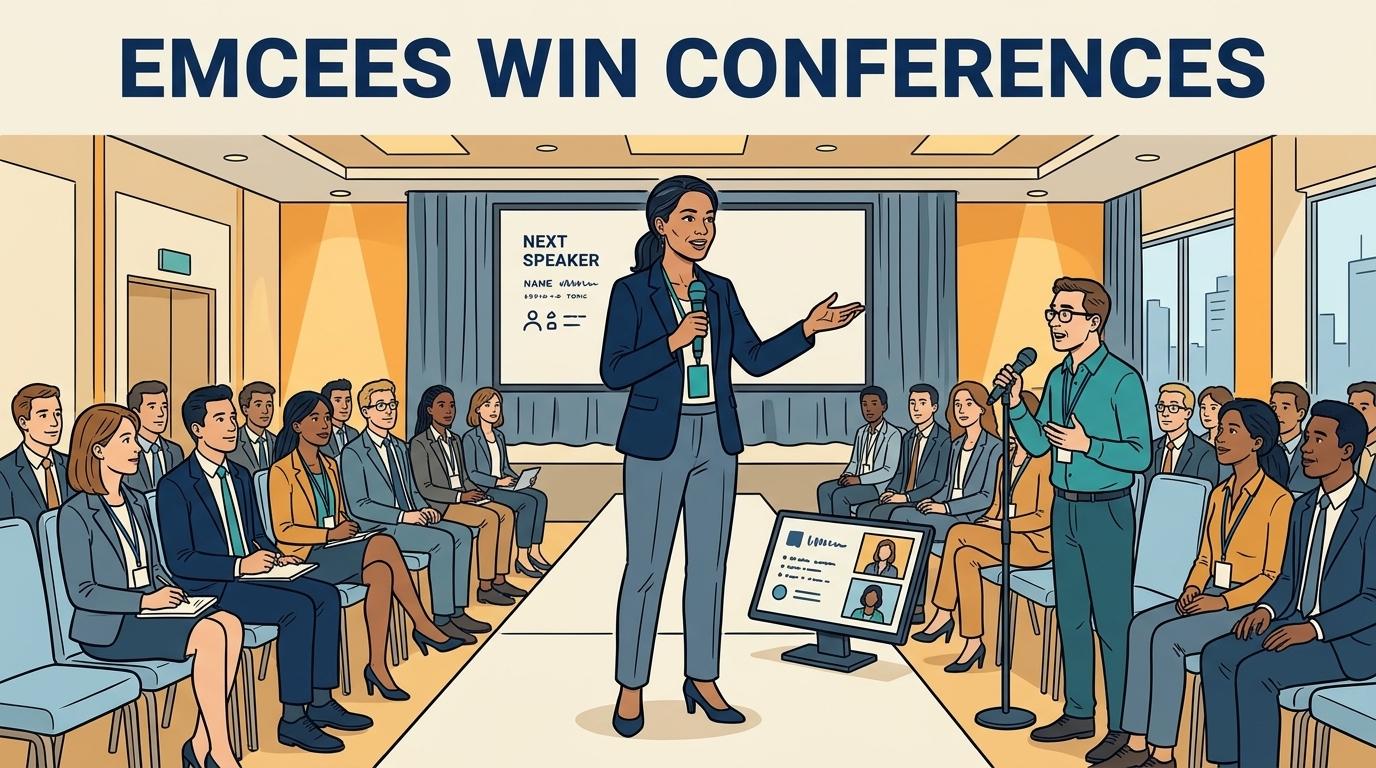
You spent six months building the speaker lineup. You vetted credentials, reviewed demo reels, negotiated contracts, and mapped a thematic arc that moves your audience from awareness to action across a full conference day. Then you filled the emcee role in the final four weeks because someone credible was available and looked good on camera.
This is the most expensive planning decision most conference directors never examine. Not because the emcee costs more than the speakers. Because the emcee determines whether the speakers you invested in are experienced as a coherent event or as a sequence of individually impressive sessions that never quite add up to something the audience can carry home.
According to the Freeman Trends Report (December 2025), 64% of event attendees identify keynote sessions as the most influential element of a conference. The programming decisions that connect those keynote sessions are being left to a role that most planners have not briefed, specified, or selected with anywhere near the rigor they applied to the speakers on either side of it. In 2026, that gap has a name. It is the emcee.
Why the Emcee Is a Programming Decision, Not a Logistics One
The standard mental model of the conference emcee is functional: someone to introduce speakers, manage the clock, and fill the space between sessions with enough energy that the audience does not drift to their phones. That model is producing a predictable and expensive failure mode at corporate events across every industry.
The emcee is not the person between the speakers. The emcee is the connective tissue of the conference arc. The speakers deliver the content. The emcee determines whether that content accumulates into a coherent event experience or dissolves into a sequence of individual sessions. A conference whose emcee cannot hold the emotional thread between sessions is a conference that resets its audience's attention and energy with every transition, erasing the momentum each speaker worked to build.
Meetings Today's 2026 analysis of the evolving emcee role, citing industry voice Anthony Vade, identifies a clear shift in what the role requires: there is growing demand for an emcee to serve more of a facilitation function, helping attendees transition not just from a tactical and functional sense, but from a mindset and emotional sense as well. That reframes the emcee from a schedule manager to a conference experience architect. And it requires a fundamentally different selection and briefing process.
Three planning failure modes result from treating the emcee as a logistics role. The first is the availability booking: the emcee is selected because they are available for the date and have a polished demo reel, without any assessment of their familiarity with the event's subject matter or their ability to connect the thematic arc across multiple speakers and session formats. The second is the internal default: a senior leader or internal communications professional is assigned the hosting role because they are credible within the organization, without any assessment of their ability to read a room, manage a live schedule change, or hold a cold audience through a technical delay. The third is the late appointment: the emcee is engaged four to six weeks before the event, leaving no runway for the pre-event preparation that separates a hosting performance that feels like an organic extension of the program from one that feels like a service layer applied on top of it.
Eye On Annapolis's April 2026 analysis of the emcee role at business events notes that the first 90 seconds of an event set the tone for the entire program, and that most emcee mistakes that hurt the audience experience happen in that window. That is the highest-stakes moment in the conference arc. It is being assigned to a role that most planners have not specified, briefed, or selected with anything close to the rigor they applied to the opening keynote.
The planner who selects and briefs the emcee with the same strategic discipline they apply to the speaker lineup is not adding a role to the program. They are activating the role that makes every other role more valuable.
The Three Emcee Profiles and Which Format Each Serves
The selection error most planners make is applying the same emcee profile across fundamentally different event formats. Three profiles consistently match distinct corporate event formats, and each requires a different selection process.
The Professional Event Host is polished, experienced in large-room energy management, and strong on pacing and audience engagement at scale. This profile is best suited for national conferences, sales kickoffs, and awards ceremonies where the primary emcee function is energy management, schedule protection, and seamless speaker transitions across a large and diverse audience.
The Subject-Matter Emcee is a credentialed expert in the event's topic area who can introduce speakers with genuine contextual depth, bridge thematic gaps between sessions with substantive framing, and hold a senior or expert audience through transitions by adding intellectual value rather than entertainment value. This profile is best suited for executive leadership summits, industry conferences, and thought leadership events where the audience's primary need is a host who can engage at their level.
Consider the difference in practice. At a 250-person AI strategy summit, a subject-matter emcee with operational experience in enterprise AI deployment introduced each speaker with genuine contextual depth, asked substantive bridging questions during post-keynote Q&As, and framed each session's implications in language that reflected real implementation experience. Post-event feedback described the hosting as indistinguishable from the speaking program. That is the highest compliment a conference emcee can receive, and it is only possible when the emcee profile matches the audience's expectations.
The Hybrid Facilitator-Host is trained in both camera presence and in-room facilitation, with experience managing dual-audience engagement tools, virtual transitions, and multi-format programming. This profile is built for hybrid conferences where the emcee must simultaneously hold the in-room audience and acknowledge, include, and engage the remote audience without treating either as secondary.
Meetings Today's 2026 guidance offers three qualifying questions that map directly to these profiles: Is the event complex enough that someone needs to stitch it together flawlessly? Can the emcee read a room and change course in an instant rather than simply delivering rehearsed lines? Is there a real throughline the planner wants participants to take away? The profile that answers all three most compellingly for the specific event format is the profile worth booking.
The internal emcee risk deserves specific attention. Senior leaders assigned to host their own organization's conference bring credibility and organizational authority but frequently lack the specific performance skills that a professional emcee has built across dozens of events: energy management at scale, live schedule recovery, audience re-engagement after a flat session. The risk is not that the internal emcee will perform poorly. It is that they will perform adequately in a role that a professional emcee would have used to produce a genuinely exceptional event experience.
A national sales conference assigned a senior VP to host a full-day program. The VP was credible, well-liked, and comfortable on stage. A speaker ran seven minutes over schedule. The VP had no prepared recovery routine, filled the gap with an extended thank-you, and the energy the previous speaker built dissolved before the next session began. A professional event host in the same scenario uses a 90-second audience interaction moment to reset the energy, acknowledge the time shift without dwelling on it, and hand the stage to the next speaker with the audience more engaged than they were at the session's end. The content was identical. The emcee was not.
The Emcee Brief: What It Must Include That Standard Briefs Omit
The emcee brief is the highest-leverage planning document in the conference program, and the one most consistently left incomplete. A speaker brief describes the audience, the event theme, and the behavioral objective. An emcee brief does all of that and adds the specific programming context that determines how the emcee performs their role.
A complete emcee brief includes six elements that standard speaker briefs rarely address.
The event's thematic arc: the single narrative thread the emcee is responsible for carrying from the opening through the close, including the specific vocabulary and frameworks the speakers will introduce that the emcee should reinforce in transitions.
The session energy map: for each session, the emotional state the audience should be in when the emcee takes the stage before it, and the emotional state they should be in when the emcee hands the stage to the speaker.
The transition architecture: the specific type of transition each session-to-session moment requires, whether that is an energy reset, a thematic bridge, an audience re-engagement, or a synthesis of the previous session before introducing the next.
The live schedule management protocol: what the emcee is authorized to do unilaterally when a speaker runs over, what requires a production team decision, and what the contingency content library looks like for extended technical delays.
The audience profile and room intelligence: who is in the room, what they already know, what their primary emotional association with the event's subject matter is, and which topics are productive to open versus which are organizational minefields the emcee should navigate around.
The close brief: the specific thematic synthesis the emcee is responsible for delivering at the event's conclusion, including the specific call-to-action the organization wants the audience to carry back to their work.
Eye On Annapolis's April 2026 analysis notes that professional emcees keep the audience informed during disruptions without sharing unnecessary detail, adjust the schedule on the spot when timings shift, and introduce additional content to maintain flow when a speaker is delayed. That fluency is not a natural talent. It is a prepared capability that requires the emcee to arrive at the event with a contingency content library, a clear understanding of the schedule's flexibility, and a production team relationship established before the day began.
The pre-event preparation timeline is the briefing variable most planners underspecify. According to Nostresszoneent's 2026 guidance, a conference emcee should be booked 60 to 90 days ahead of the event date whenever possible, with the full run of show shared two to three weeks before the event and a rehearsal or technical call scheduled in the week before the event, not the morning of it.
An L&D leader planning a 300-person hybrid leadership summit engaged the emcee 10 weeks before the event, shared the thematic arc and speaker briefs for all five sessions, scheduled a 45-minute pre-event call with the emcee and each speaker individually, and provided a transition brief specifying the energy type required for each session handoff. The emcee arrived with five speaker-specific bridging scripts, a contingency content library of three two-minute audience engagement moments for schedule gaps, and a close brief that synthesized all five sessions into a single actionable takeaway. Post-event feedback described the event as the most cohesive leadership conference the organization had produced in four years.
If you want a speaker and emcee recommendation built together around a defined thematic arc, audience profile, and event objective, the Speak About AI curation team at [speakabout.ai](https://speakabout.ai) starts every recommendation with the event's arc, not with individual availability. Connect with the team to build a program that coheres from the opening through the close.
The Hybrid Emcee Requirement: A Distinct Role Most Events Do Not Fill
A hybrid conference emcee must simultaneously manage the in-room audience's energy and the remote audience's engagement. These are two separate performance challenges that require different tools, different attention, and different content design. An emcee who has never worked in a hybrid format and has not been briefed on the remote audience's profile is not a hybrid emcee. They are an in-room emcee whose performance is being livestreamed to an audience it was never designed for.
PCMA research, cited by Highway 85 Productions in 2026, finds that remote attendee satisfaction drops significantly when virtual engagement is not built into the event design from the start rather than added as a last-minute layer. The emcee is the most visible evidence of whether virtual engagement was designed in or bolted on. An emcee who acknowledges the remote audience by name in the opening, directs specific questions to the virtual platform during audience interaction windows, and closes each session with a transition written for both audiences is demonstrating that the remote audience was designed into the program. An emcee who occasionally glances at the camera and says "and hello to everyone joining us online" is demonstrating that it was not.
A technology company programmed a hybrid leadership summit with 200 in-room attendees and 400 remote participants. The emcee was a nationally recognized professional event host with strong in-room credentials but no hybrid-specific brief. Remote attendees received three hours of watching the emcee address the in-room audience with no acknowledgment of the virtual platform. Remote satisfaction scores landed 24 points below in-room scores. The emcee was not the problem. The briefing process was.
For large hybrid events, the strongest programs designate a separate virtual host focused entirely on the online audience, while the primary emcee manages the in-room experience. Whether the event's remote audience size and engagement complexity justifies a dedicated virtual host is a structural decision that belongs in the program design phase, not the week before the event. And the technical rehearsal for a hybrid emcee is non-negotiable: camera angles, confidence monitor content, and interaction tool triggers must be rehearsed before the event day, not discovered during it.
The Emcee as Thematic Synthesizer: What the Close Must Deliver
The conference close is the highest-stakes emcee moment and the one most consistently underdesigned. The opening keynote sets the thematic agenda. The closing keynote delivers the final content message. But the emcee's closing remarks are the last words the audience hears before they leave the building, and those words determine whether the event's themes consolidate into a single, memorable, actionable takeaway or dissolve into a collection of interesting ideas the audience will not be able to reconstruct a week later.
The Funny Business 2026 Complete Guide to Corporate Emcees frames this precisely: the close is where the program's themes either consolidate or evaporate. A closing emcee moment that synthesizes the day's content into a specific call-to-action uses the vocabulary the speakers introduced, references the specific frameworks the audience encountered, and names the one behavior the organization wants to see in the 30 days that follow. A closing emcee moment that thanks the sponsors, thanks the speakers, and sends the audience to the networking reception has produced no synthesis and no retention.
Four elements make an effective conference close. Thematic synthesis: a two-to-three sentence summary of the day's central argument, using the vocabulary the speakers introduced. Framework integration: a single statement connecting the speakers' frameworks into a coherent sequence, demonstrating that the day's content was a progression rather than a collection. The behavioral call-to-action: the one specific thing the organization wants every attendee to do in the 30 days following the event, stated in concrete and observable terms. The emotional send-off: the final register the emcee sets for the audience as they leave, calibrated to the event's objective, whether that is energized and committed for an activate-objective conference, reflective and clear for an educate-objective conference, or inspired and connected for an inspire-objective conference.
A financial services firm provided its emcee with a four-element close brief two weeks before the event. The emcee's closing three minutes were described in post-event feedback as the moment the whole day clicked into place. The behavioral call-to-action was referenced by 34% of attendees in the 30-day pulse survey as the specific prompt that drove their post-event action. The emcee's closing remarks extended the conference's value into the post-event period. That is what a close brief is designed to produce.
Building an Emcee Selection Process That Matches the Rigor of Speaker Vetting
The four-stage emcee selection process applies the same discipline to the hosting role that sophisticated planners apply to speaker selection.
Stage 1: Profile definition. Specify the emcee profile required by the event format, the audience profile and seniority level the emcee must credibly engage, and the thematic and format requirements the emcee must serve. This decision should be made before the search begins, not during it.
Stage 2: Demo review. Review a full-length hosting recording from a comparable event format, a live transition moment rather than a highlight reel of best moments, and a recovery moment showing how the emcee handled a live schedule change or unexpected program shift. A highlight reel shows you what the emcee looks like at their best. A recovery moment shows you what they are made of.
Stage 3: Vetting call. A 30-minute conversation that tests the emcee's knowledge of the event's subject matter, their specific approach to the transitions the event's arc requires, and their process for the pre-event preparation that makes hosting performance consistent rather than variable. The three questions from Meetings Today 2026 are the vetting standard: Is the event complex enough that someone needs to stitch it together flawlessly? Can this candidate read a room and change course in an instant? Is there a real throughline this candidate can carry? A candidate who answers all three specifically and with concrete examples from comparable events is a candidate whose hosting capability is evidenced rather than assumed.
Stage 4: Brief alignment. A structured pre-event briefing session that gives the emcee the thematic arc, the session energy map, the transition architecture, the live schedule management protocol, and the close brief before any of those elements are finalized. The emcee's input at this stage can improve the program design before it is locked. That is not a courtesy. It is a planning advantage.
Booking the emcee at the same time as the keynote speakers, rather than after the speaker lineup is finalized, gives the planner the opportunity to select an emcee whose subject-matter profile complements the speakers' content areas and whose pre-event preparation can include direct conversations with each speaker before the event day. An emcee booked at 30 days out is working with a compressed timeline that structurally limits every downstream preparation decision.
A bureau that has placed an emcee at multiple events for comparable audience profiles has performance data on that emcee's hosting consistency, subject-matter adaptability, and live recovery capability that no highlight reel or vetting call can fully replicate. The planner who asks their bureau for an emc