
The Five-Layer Speaker Budget Framework Event Planners Need Now
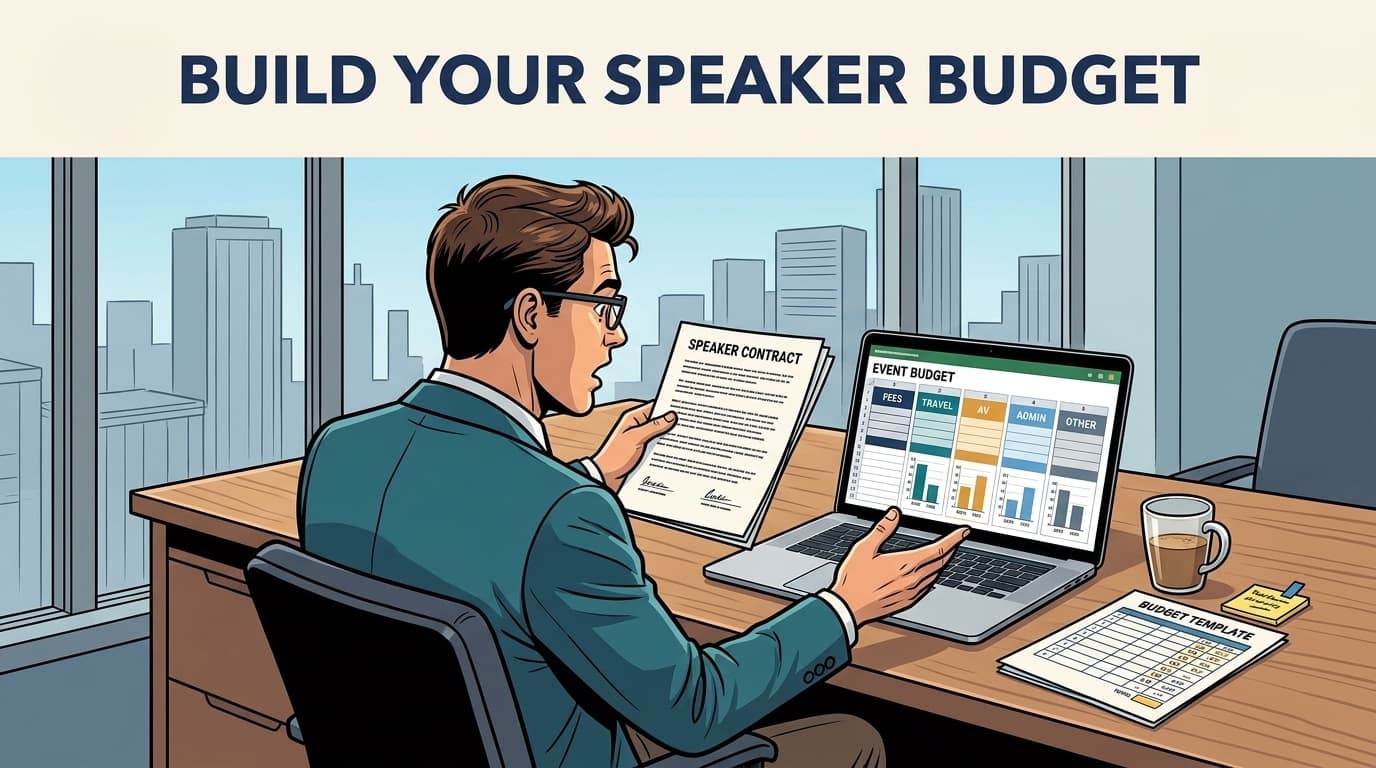
According to AAE Speakers' 2026 bureau-client survey of 340 event organizers and 378 professional speakers, the average planner budget for a keynote speaker is $22,449. For most planners, that number represents the honorarium. For almost none of them does it represent the total engagement cost. In 2026, the full cost of a professional keynote routinely runs 25 to 40 percent above the base honorarium once travel, customization premiums, recording rights, and technical rider requirements are factored in. The planner who budgets for the honorarium and discovers the rest at contract review is not making a careless mistake. They are using a budgeting framework that has not kept pace with how speaker contracts have evolved.
This is the framework that has.
Why the Honorarium Is Not the Budget
The speaker honorarium is the starting point of the budget conversation, not the ending point. A complete keynote engagement in 2026 has five distinct cost layers: the base honorarium, travel and logistics, customization premiums, recording and distribution rights, and technical rider requirements. A planner who has not anticipated all five before the contract is signed is not managing a budget. They are discovering one.
Consider what that discovery looks like in practice. A corporate event manager at a professional services firm approves a $28,000 speaker honorarium for their annual leadership summit. The contract review reveals a $3,000 flat travel requirement, a $6,500 recording rights fee for the internal replay the L&D team had already planned, and a technical rider that requires $2,200 in AV upgrades the venue cannot absorb within the existing production budget. The total engagement cost is $39,700, which is 42 percent above the approved budget. All four cost variables were negotiable before the contract was signed. None were anticipated before it was reviewed.
That scenario is not an anomaly. It is the predictable result of treating the honorarium as the budget. The five-layer framework below is designed to make it avoidable.
Layer One: The Honorarium Tier Framework
Matching the right speaker to the right budget begins with understanding how the 2026 honorarium market is structured. According to Speakers.com 2026 data, smaller association meetings and regional conferences typically find strong options in the $7,500 to $15,000 range. National conferences and major corporate meetings generally allocate $20,000 to $50,000. Celebrity speakers and globally recognized figures command $75,000 to $250,000 and above. These ranges reflect the honorarium only. The total engagement cost sits above them in every case.
For practical budget planning, four tiers define the market:
Tier 1 ($7,500 to $15,000): Regionally credentialed professional speakers, appropriate for regional conferences and training events where the audience's primary need is practical framework delivery rather than name recognition.
Tier 2 ($15,000 to $35,000): Nationally recognized specialists and bestselling authors, appropriate for sales kickoffs and leadership summits where the audience expects demonstrated subject-matter depth.
Tier 3 ($30,000 to $75,000): Prominent media figures, former C-suite executives, and speakers with significant enterprise client rosters, appropriate for high-stakes corporate events where the speaker's profile signals the organization's investment in the audience.
Tier 4 ($75,000 and above): Globally recognized figures and celebrity speakers, appropriate for events where the speaker's name is a primary attendance driver.
According to Ian Khan's 2026 planner guide, organizations typically allocate 15 to 25 percent of their total event budget to the speaker line. For a $100,000 conference, that means a speaker budget of $15,000 to $25,000, which maps to Tier 1 and the lower end of Tier 2. That proportion makes tier selection a budget-allocation decision as much as a quality decision.
The most common tier selection error is the false economy of the fee objection. A procurement team that reduces the speaker budget from $25,000 to $15,000 to save $10,000, replacing a nationally recognized sales transformation specialist with a broadly credentialed motivational speaker, is not making a budget-conscious choice. If the senior sales leadership audience needed specific, implementable frameworks for AI-assisted selling and received an energizing but generic session instead, the post-event feedback will be positive on energy and negative on applicability. The $10,000 saving produces a $15,000 spend on a session the audience cannot use. That cost does not appear in the honorarium comparison. It appears in the 30 days that follow.
One additional variable worth evaluating at the tier selection stage: virtual delivery. Virtual keynote speakers generally set their rates at 10 to 20 percent less than their in-person fees in 2026, according to Speakers.com, with some reductions reaching 30 to 50 percent when travel and logistics costs are eliminated. For a planner operating under budget pressure, exploring the virtual delivery option for a Tier 2 or Tier 3 speaker may unlock a meaningful cost reduction. That option should be evaluated against the hybrid delivery capability requirements the event format demands before it is treated as a straightforward substitution.
Speak About AI's speaker roster is organized by honorarium tier, audience type, and event objective, which makes the tier selection process considerably more efficient than a cold search. If you are matching a speaker profile to a defined budget, that is the right starting point.
Layer Two: Travel, Logistics, and the Flat Buyout Model
Travel and logistics represent the first hidden cost layer and the one most reliably controlled through a single negotiation decision. Standard contracts in 2026 typically mandate first-class or business-class airfare, ground transportation via professional car services, and four-star or higher lodging. For in-person events, planners should budget an additional $2,000 to $5,000 for travel expenses on top of the speaking fee, according to M.I.I. Professional Speaking 2026 data.
The cleaner approach is the flat travel buyout. Many planners now negotiate a fixed travel amount in the $1,500 to $3,000 range for domestic engagements, which eliminates post-event reconciliation and provides immediate budget certainty. One event planner negotiated a $2,000 flat travel buyout for a nationally recognized speaker whose actual expenses in prior engagements had ranged from $1,800 to $4,200 depending on departure city and hotel availability. The flat buyout came in $400 below the speaker's prior average actual expenses. The total engagement cost was precisely what was budgeted. The CFO conversation began with a confirmed number, not a range.
That is the difference between managing a budget and discovering one.
Layer Three: Customization Premiums and What They Actually Buy
Custom content development that requires the speaker to research the audience or build a tailored presentation typically adds a 10 to 25 percent premium to the base fee, according to M.I.I. Professional Speaking 2026 data. Exclusivity clauses that prevent the speaker from addressing competitor events add another 15 to 30 percent.
These premiums are not add-ons. They are the cost of the product quality that differentiates a customized keynote from a polished generic one. Pre-event executive interviews, audience surveys, and tailored content development are what allow a speaker to walk onstage and reference the organization's actual strategic challenges rather than a hypothetical version of them. That specificity is what produces behavioral change at the audience level.
The exclusivity clause deserves a separate evaluation. For organizations in competitive industries where the speaker's content could provide a strategic advantage to a competitor audience, the 15 to 30 percent premium is worth the cost. For organizations without that competitive exposure, the exclusivity clause is an unnecessary premium that can be removed from the contract without affecting the keynote's organizational value. Most planners do not know to raise it. Raising it is free.
For a deeper look at how to evaluate speaker customization quality before the contract is signed, the vetting framework we have built for AI and technology speakers covers the assessment criteria that apply across the full speaker market.
Layer Four: Recording Rights and the Post-Event Value Plan
Recording and distribution rights are the cost category most commonly overlooked until after the contract is signed, at which point the planner's negotiating leverage is gone and the cost has increased. Most standard agreements in 2026 allow for a 24-hour replay for registered attendees. Long-term internal storage, new-hire onboarding use, manager communication touchpoints, and regional replay sessions require separate negotiation. Recording and distribution rights can add $5,000 to $15,000 to the total engagement cost, according to 2026 industry sources.
Budget for recording rights before the contract review, not during it. The organizations that extract the most value from a keynote investment are the ones that treat the recording as a content asset with a defined distribution plan, not as an afterthought that gets negotiated under time pressure.
Layer Five: Technical Riders and the Venue Gap Problem
A speaker whose performance style requires specific AV configurations, confidence monitor placement, in-ear monitoring, or dedicated hardline internet connectivity has a technical rider that adds real cost to the venue and production budget. A technical rider that is incompatible with the venue's existing infrastructure creates a cost problem that surfaces during technical rehearsal, roughly 24 hours before the event, when the only solutions are expensive and rushed.
The technical rider review must happen before the venue contract is signed, not after. The gap between what the speaker requires and what the venue provides is a negotiable cost when identified early and an emergency cost when identified late.
The Cost-Per-Outcome Framework: The CFO Conversation Tool
The five-layer budget structure solves the post-contract surprise problem. The cost-per-outcome framework solves the stakeholder approval problem.
The question is not whether $30,000 is a lot to spend on a speaker. The question is what $30,000 produces for the organization and how that compares to the alternatives. A $30,000 speaker fee at a 400-person leadership summit is $75 per attendee, which is less than the per-person cost of the conference dinner when framed correctly.
Five calculations give procurement and CFO conversations a concrete foundation:
- Cost per attendee: Total engagement cost divided by audience size, expressed as a per-person investment comparable to other per-person event costs.
- Cost per behavioral change unit: Total engagement cost divided by the number of attendees who exhibit the target behavior at 30 days, drawn from post-event pulse survey data.
- Cost per hour of organizational reach: Total engagement cost divided by total hours of audience attention generated, including in-room attendance, recording replay sessions, and manager communication touchpoints.
- Comparison to alternative investments: The cost of a consulting engagement, a training program, or an internal initiative designed to produce the same behavioral outcome, compared to the speaker engagement cost.
- Retention and engagement value: Gallup data shows U.S. companies lose $1.9 trillion annually from disengaged teams. Even a modest engagement-score improvement across a senior leadership population produces organizational value that dwarfs the speaker honorarium.
An L&D leader at a 350-person national sales conference presented a $42,000 total speaker engagement cost to the CFO as a $120 per-attendee investment, which was less than the per-person cost of the conference dinner, with a projected 20-percentage-point increase in the target sales behavior based on comparable audience references provided by the speaker's bureau. The CFO approved the budget in the same meeting. The same engagement framed as a $42,000 honorarium would have required a second meeting and a committee review.
GoGather's 2026 Corporate Event Trends Guide reports that event satisfaction fell 8 percent from 2024 to 2025, and that two-thirds of planners report flat or reduced budgets even as supplier costs rise. In that environment, the speaker investment framed as a cost is the first line item cut. The speaker investment framed as a change management accelerator with a measurable per-attendee cost is the one that survives.
Building the Budget Template That Survives Procurement Review
A complete speaker budget template structured for procurement review has seven line items:
- Base honorarium, referenced against the industry-standard tier for the speaker's profile and audience type
- Travel and logistics, expressed as a flat-fee buyout with the recommended range of $1,500 to $3,000 for domestic engagements
- Customization premium, expressed as a percentage of the base honorarium and justified by the content quality improvement it produces
- Recording and distribution rights, with the specific use cases (new-hire onboarding, regional replay, manager communication) that justify the investment
- Technical rider requirements, reviewed against the venue's existing capabilities to identify gap costs before the venue contract is signed
- Workshop or follow-up session component, if applicable
- Total engagement cost, expressed as a per-attendee cost and compared to the alternative investment that would produce the same organizational outcome
A concrete example: a nationally recognized sales transformation specialist at a $25,000 honorarium, a $2,000 flat travel buyout, a $4,000 customization premium for pre-event executive interviews, $6,000 in recording and distribution rights for a 12-month internal replay license, $1,500 in AV rider requirements above the venue's standard package, and a $3,500 half-day workshop component. Total engagement cost: $42,000. At 350 attendees, the per-attendee cost is $120. The comparable investment, which is a two-day external sales training program for the same population, runs $85,000. The budget case writes itself.
The workshop component deserves particular attention as a negotiation addition. A technology company that added a $4,000 half-day workshop to a $22,000 keynote engagement found that the 80 senior people leaders who attended the workshop exhibited the target behavior at a rate 31 percentage points higher than the general attendee population at 30 days. The $4,000 workshop component produced the organization's highest-return hour of the entire event. Premiers bureaus, including Speak About AI, can identify which speakers in your honorarium tier have the workshop capability to make that addition viable before the contract negotiation begins.
The final tool in the framework is the post-event budget loop. A planner who captures post-event behavioral change data, recording replay reach, and workshop participation rates from the current engagement is building the evidence base for the next budget request. The CFO who approved $42,000 based on a projected per-attendee cost will approve $45,000 based on a demonstrated 23-percentage-point increase in the target behavior and a recording that reached 600 employees beyond the original audience. The budget conversation compounds in credibility when it is anchored in data rather than projected in optimism.
The most strategically sophisticated organizations in 2026 are not treating the speaker budget as an event line item. They are treating it as a change management investment with a defined cost structure, a per-outcome cost calculation, and a post-event measurement framework that produces the data the next budget request requires. The planners who build this framework do not just defend their current speaker budget. They build the institutional case for a better one.
If you are ready to begin a speaker search that accounts for the full cost structure before the contract is signed, the Speak About AI team can provide a budget-aware, audience-matched recommendation across every honorarium tier. Start that conversation here.