
Vetting a Keynote Speaker's Real Expertise vs. Stage Presence for Technical Audiences
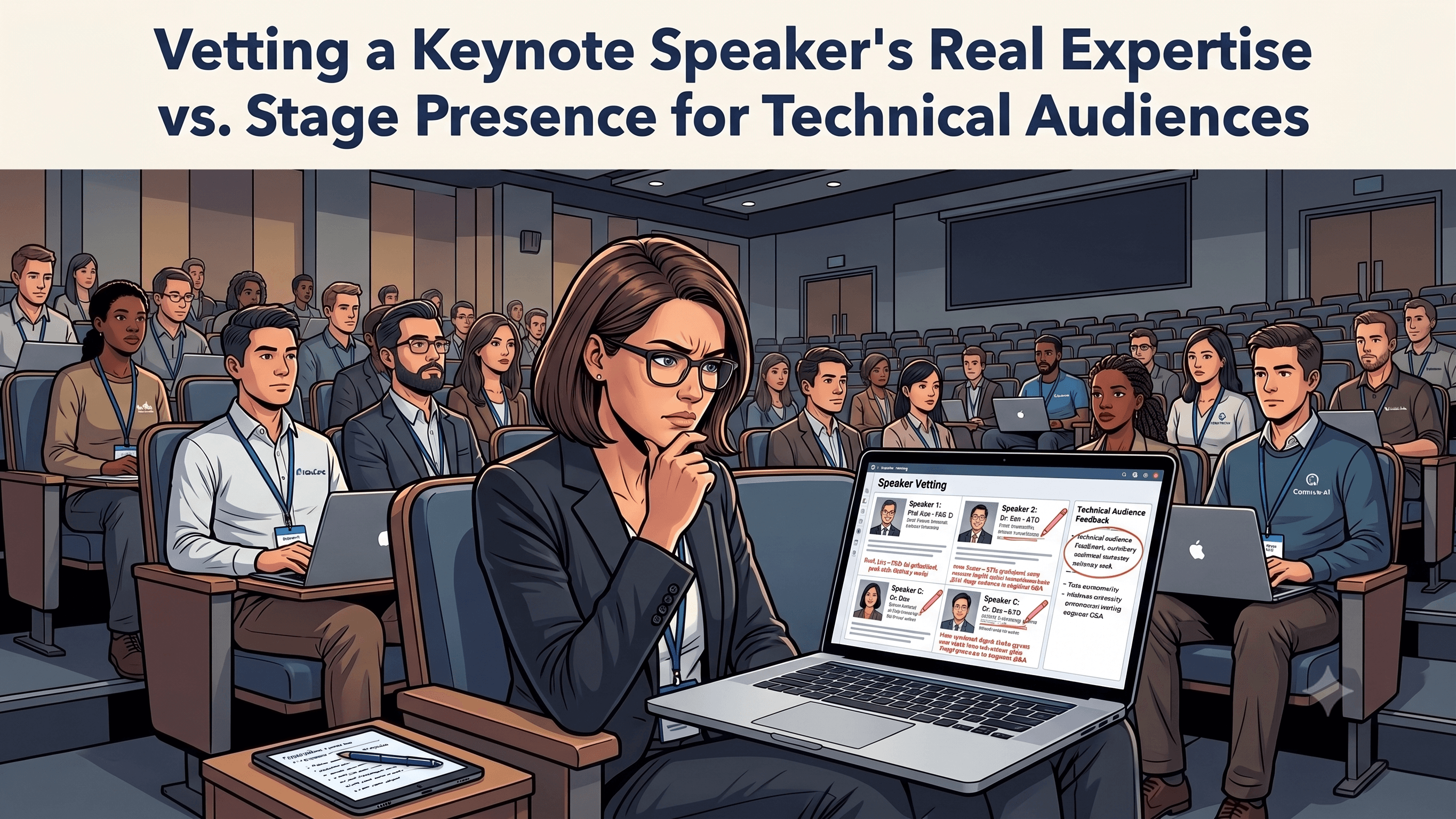
There is a specific kind of silence that fills a room when a keynote speaker loses a technical audience. It is not boredom. It is the quiet, collective recognition that the person on stage is reciting concepts they do not actually understand. And engineers, researchers, and technical operators detect that gap within the first five minutes. Once they detect it, the rest of the talk is lost, no matter how good the slides are.
If you are programming an event for a technical audience, a developer conference, an engineering all-hands, a research summit, an AI deployment forum, the speaker selection problem is different from the one most event planners are trained for. The general-audience playbook rewards stage presence, narrative arc, and emotional resonance. A technical audience rewards those things too, but only after the speaker has cleared a much higher bar: they have to be right. The challenge is that the very skills that make someone impressive in a sales call or a sizzle reel are not the skills that survive scrutiny from a room full of people who build the thing the speaker is talking about.
Why Technical Audiences Are a Different Vetting Problem
Most keynote vetting optimizes for the wrong signal. Booking decisions get made off a demo reel, a referral, and a polished discovery call, all of which measure presentation skill, not domain depth. For a general business audience, that is often enough. The audience cannot independently verify the speaker's claims, so confident delivery and a clean story carry the talk.
A technical audience inverts this completely. They can verify, in real time, against their own hard-won knowledge. When a speaker oversimplifies a tradeoff they live with daily, hand-waves past a known limitation, or uses a term incorrectly, the audience notices instantly, and the credibility loss is not recoverable within the session. Worse, technical audiences talk. A speaker who whiffs in front of an engineering org becomes a story that circulates internally and on social channels, and that story attaches to your event's brand, not just the speaker's.
This is why the polished-generalist failure mode is so expensive in technical contexts. The downside is asymmetric. A merely-okay speaker who is clearly credible leaves a neutral-to-positive impression. A magnetic speaker who is exposed as shallow leaves a distinctly negative one, and the audience blames the people who booked them.
The Tells That Separate Depth From Performance
The good news is that real domain expertise leaves fingerprints, and you can learn to spot them before you sign a contract. The difference between someone who did the work and someone who talks about the work shows up in identifiable patterns.
Depth shows up as specificity about failure. Genuine practitioners talk fluently about what did not work, the dead ends they hit, and the tradeoffs they are still uneasy about. Performers tend toward clean success narratives where everything resolved neatly. When you ask a real expert "what surprised you," you get a specific, slightly uncomfortable answer. When you ask a performer, you get a polished anecdote that has clearly been told many times.
Depth tolerates the follow-up question. A speaker with real command can go three or four questions deep on a single point without retreating to generalities. Surface-level speakers handle the first question well, and then deflect the second with reframing, a story, or a pivot to a different topic. The follow-up is where the floor either holds or gives way.
Depth is precise about scope. Real experts are quick to say "that's outside what I've worked on directly" or "that depends, and here's what it depends on." Performers are reluctant to concede the edges of their knowledge because the persona depends on comprehensive authority. Paradoxically, the willingness to say I don't know is one of the strongest credibility signals to a technical audience, and one of the hardest for a non-expert to fake.
Depth references the actual artifact. Someone who built, deployed, or researched the thing refers naturally to the specifics: the system, the dataset, the paper, the production incident, the model behavior. The references are concrete and incidental rather than central to the pitch. A performer's examples tend to be the same two or three case studies that everyone in the field already cites.
A Practical Vetting Protocol
Spotting the tells is one thing; building a repeatable process around them is what protects you across every booking. The following protocol is designed to surface real expertise without requiring you to be a domain expert yourself.
Verify the Body of Work Before the Call
Before you spend time on a discovery call, look at what the speaker has actually produced. For a technical or AI speaker, the trail is usually public: published research, open-source contributions, patents, engineering blog posts, conference talks with substantive Q&A, products they demonstrably built or led. You are looking for evidence of doing, not just commenting. A long history of media appearances and panel moderation, with little underneath it, is a yellow flag for a technical audience even if it looks impressive on paper.
Run a Substance-Forward Discovery Call
Most discovery calls are logistics and rapport. For a technical keynote, spend at least part of the call probing depth. Ask the speaker to walk you through a hard technical decision they made and why. Ask what they have changed their mind about in the last two years. Ask where the field is overhyped. Real practitioners almost always have a sharp, specific answer, while performers tend to stay diplomatically vague. You do not need to evaluate the technical content perfectly; you need to listen for specificity, comfort with nuance, and willingness to engage rather than redirect.
Bring a Technical Stakeholder Into the Loop
If you are not technical yourself, recruit someone who is: an engineering lead, a senior researcher, a member of the audience's own community, and spend 20 minutes with the speaker or review their materials. A domain insider will detect in minutes what would take you weeks to verify. This single step prevents the most expensive booking mistakes, and it has the secondary benefit of giving your internal technical stakeholders ownership of the choice.
Watch Unedited Q&A, Not the Reel
Demo reels are cut to flatter. The most revealing footage is unedited Q&A, a conference recording, a podcast where the host pushes back, a panel where the speaker had to think on their feet. How someone handles a question they did not expect tells you far more than how they deliver a rehearsed keynote. If no such footage exists, ask for a reference from a technical event they have done and call it.
Stage Presence Still Matters. It's Just Not Sufficient
None of this means delivery is irrelevant. The ideal technical keynote speaker is credible and compelling. In other words, someone who has genuinely done the work and can also hold a room, structure a narrative, and make a complex idea land. Those people exist, and they are worth the premium. The mistake is treating stage presence as a substitute for substance rather than a multiplier on top of it.
The framing that serves event planners well: substance is the gate, delivery is the optimization. First confirm the speaker is genuinely credible to this specific audience. That is non-negotiable. Then, among credible candidates, choose for the delivery, energy, and narrative fit that will make the credible content resonate. Reversing that order and selecting for charisma and hoping the depth is there is how technical keynotes go wrong.
A speaker who is a builder first and a presenter second can grow into a stronger stage performer. A speaker who is a performer first rarely acquires the depth, and a technical audience will always find the bottom of it.
For event leaders programming for engineering, research, or technical operator audiences, working with an AI keynote speaker who is a genuine practitioner, and not just a polished presenter, is the difference between a keynote that earns the room's trust and one that loses it in the first five minutes. The hard part is verifying that depth before you book, and it is exactly where a bureau that vets for real domain expertise saves you from the most expensive mistake in event programming.