
Why Skills Intelligence, Not Training Catalogs, Saves Your 2026 Workforce
The reskilling crisis landed on HR's desk in 2026 — not as a future risk to model, but as an operational emergency to manage. Mercer's Global Talent Trends 2026 report, drawing on responses from more than 12,000 business and HR leaders, found that employee concern about AI-driven job displacement jumped from 28% in 2024 to 40% in just two years. More telling: only 44% of employees say they're thriving at work. That's not a training gap. That's a trust gap, a strategy gap, and increasingly, a performance gap — all arriving at the same time.
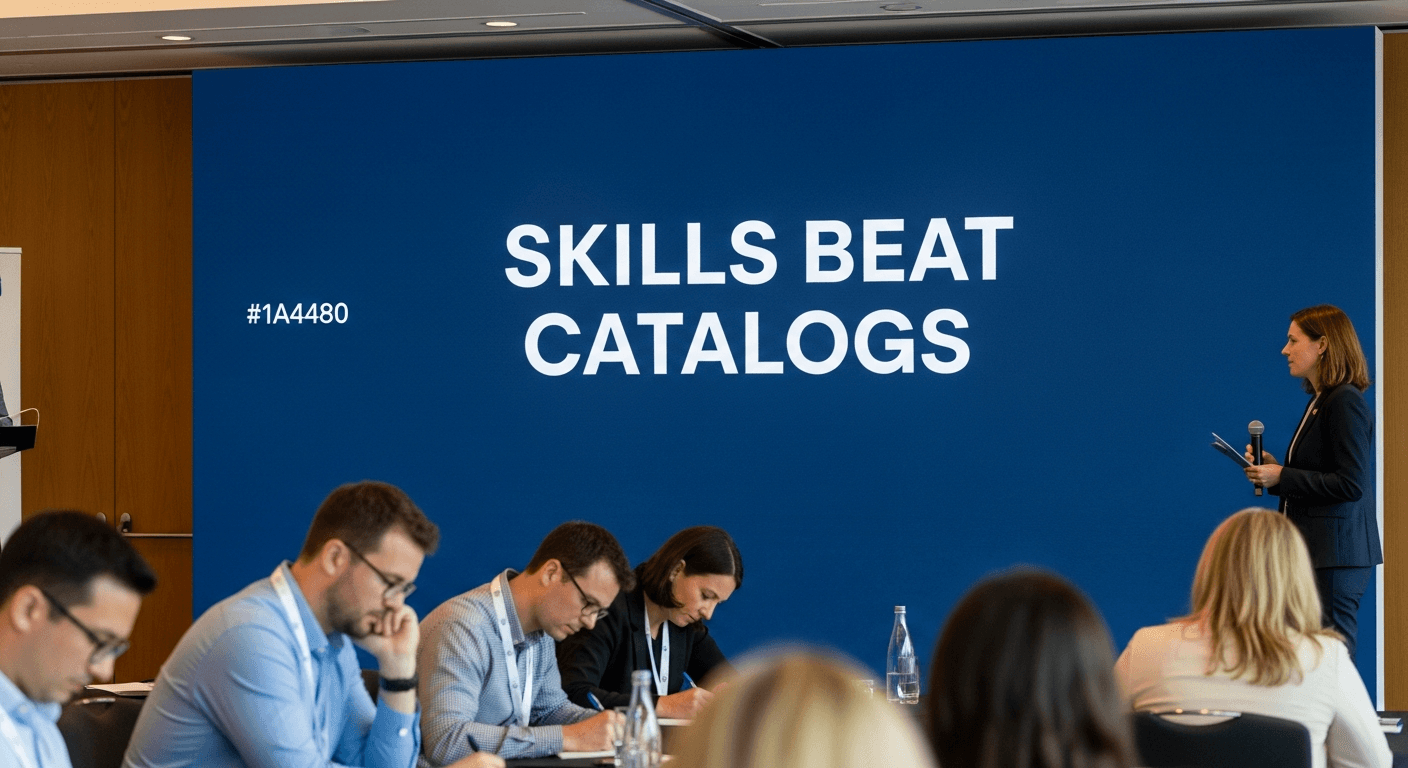
Most enterprises are responding with training catalogs. Curated playlists of AI literacy modules, subscriptions to learning platforms, mandatory "AI fundamentals" courses pushed through the LMS. The intention is right. The architecture is wrong. And the difference between a training catalog and a skills intelligence system is exactly where 2026 workforce strategy either succeeds or quietly fails.
The Scale of the Problem Is No Longer Theoretical
The World Economic Forum's Reskilling Revolution initiative set a target of upskilling one billion people by 2030. That number sounds abstract until you map it to your own headcount and ask: what percentage of my workforce is doing work that will look materially different in 18 months? For most mid-to-large enterprises, the honest answer is somewhere between "most of them" and "we don't actually know."
That uncertainty is the real crisis. Companies that don't know which roles are being disrupted, which employees have adjacent skills that could transfer, and which capability gaps are already affecting team output — those companies are flying blind into a labor market that is simultaneously tightening and transforming.
The Mercer data underscores the urgency. When four in ten employees are worried about displacement and fewer than half report thriving, you're already seeing the downstream effects in engagement scores, internal mobility friction, and voluntary attrition among exactly the people you can least afford to lose — your mid-career, domain-expert employees who understand your business but aren't sure where they fit in an AI-augmented version of it.
Why Training Alone Is Failing
Here's the distinction that matters: a training catalog tells employees what learning is available; a skills intelligence system tells the organization what skills it actually has, what it needs, and where the gaps are widening in real time.
Training catalogs are supply-side solutions to a demand-side problem. You're pushing content at people without a clear picture of what capabilities the business needs to build — or by when. The result is completion metrics that look healthy on a dashboard while actual skill gaps compound quietly in the background.
Skills intelligence flips the model. It starts with a dynamic map of the skills your organization currently holds, cross-referenced against the roles and capabilities your business strategy requires over the next 12 to 36 months. From that map, you can see which teams are already under-skilled for where the work is going, which individuals have latent capabilities that aren't being used, and where you need to intervene before a gap becomes a crisis.
In practice, this means moving from "we offer 200 AI courses" to "we know that our customer operations team needs conversational AI fluency by Q3, we've identified 47 people with the adjacent skills to get there, and here is the specific 90-day pathway to close that gap." One is a catalog. The other is a strategy.
What Skills Intelligence Actually Requires
Operationalizing this shift requires three things most L&D teams don't yet have in place: a living skills taxonomy tied to business roles (not just job titles), data infrastructure that connects learning activity to performance outcomes, and leadership alignment on what "AI-ready" means for each function — not generically, but specifically.
The taxonomy piece is harder than it sounds. Most HR systems still organize people by job title and tenure. Skills intelligence requires tagging people by demonstrated and inferred capabilities, then updating those tags as people learn, take on new projects, and demonstrate new competencies. It's a data problem as much as a learning problem, which is why the most effective implementations involve close collaboration between L&D, HR technology, and business unit leaders.
The Build-vs-Buy-vs-Bot Decision Framework
Once you have a skills intelligence foundation, the strategic question becomes: for each capability gap, do we build it internally, buy it through hiring, or automate it with AI tools? This framework sounds simple, but most organizations default to one answer — usually hiring — without actually running the analysis.
Building internally through reskilling is almost always faster and cheaper than external hiring when the gap is adjacent to existing skills. HCLTech's generative AI reskilling program, documented in a WEF case study, is one of the most instructive examples at scale. The company retrained more than 116,000 employees in generative AI concepts and applications — not through a passive course catalog, but through a structured program tied to specific role requirements, with hands-on project components and clear business application. The program wasn't about AI literacy in the abstract. It was about equipping people to use specific tools in specific workflows, with measurable outcomes attached.
That's the build case done right. The buy case — external hiring — makes sense when a capability is genuinely new to the industry, when time-to-productivity is critical, and when you can't close the gap through internal mobility within your required timeframe. The bot case — automating the task rather than reskilling for it — is increasingly viable for structured, repetitive work, and organizations that are honest about this can actually redeploy the humans doing that work into higher-value roles rather than waiting for attrition to do the math.
The mistake most organizations make is treating these as separate HR and technology decisions rather than a unified talent strategy. Your build-vs-buy-vs-bot analysis should be happening at the team level, driven by skills intelligence data, and reviewed quarterly as both AI capabilities and business requirements evolve.
The Hidden Cost of Not Reskilling
The business case for reskilling is often framed around cost savings versus external hiring. That's real — internal mobility is significantly cheaper than recruitment when you account for sourcing, onboarding, and the productivity ramp that comes with any external hire. But the more important cost of not reskilling is the one that doesn't show up cleanly on a spreadsheet.
When employees don't see a credible path forward inside the organization, they leave — or they stay and disengage. The Mercer data showing that only 44% of employees are thriving is a leading indicator of both. Attrition among high performers in disrupted roles is expensive. But the quiet disengagement of the majority who stay while feeling uncertain about their future is arguably more damaging, because it erodes the organizational capability you need to execute your AI strategy in the first place.
Internal mobility programs, when backed by skills intelligence, consistently outperform external hiring on both speed and retention. Employees who move into new roles internally reach full productivity faster because they already understand the business context. They stay longer because internal mobility is one of the strongest predictors of long-term engagement. And they carry institutional knowledge that an external hire simply cannot replicate.
The companies winning the reskilling race in 2026 are not the ones with the biggest training budgets — they're the ones that have made internal mobility a strategic priority and built the skills infrastructure to make it operationally real.
What an AI-Native Workforce Design Actually Looks Like
"AI-native" has become one of those terms that means everything and nothing depending on who's using it. In 2026, it has a practical definition: an AI-native workforce is one where AI tool fluency is embedded in how work is designed, not bolted on through occasional training.
This shows up in a few concrete ways. Job architectures are being redesigned around human-AI collaboration rather than task completion — roles are defined by the judgment, creativity, and relationship work that AI augments rather than replaces. Performance frameworks are being updated to include how effectively people use AI tools, not just whether they completed an AI course. And onboarding programs for new hires now include AI workflow integration as a core component, not an optional add-on.
The organizations doing this well have also moved past the "AI champion" model — the idea that you identify a handful of enthusiastic early adopters and let them evangelize to the rest of the workforce. That model works for early-stage adoption. It doesn't scale. AI-native workforce design requires that AI fluency be a baseline expectation across functions, with role-specific depth in areas where AI is most transformative.
HCLTech's approach is instructive again here. The 116,000-person reskilling program wasn't positioned as a special initiative for the tech-curious. It was positioned as a business requirement — the company's leadership made clear that generative AI competency was part of what it meant to work at HCLTech going forward. That framing matters. It shifts reskilling from optional professional development to organizational strategy.
The Leadership Alignment Problem
None of this works without senior leadership alignment on what the organization is actually building toward. The most common failure mode in enterprise reskilling programs isn't a lack of good content — it's a lack of clarity about what "AI-ready" means for the business, which means L&D leaders end up building programs without a clear target and measuring success by completion rather than capability.
CHROs and L&D leaders who are succeeding in 2026 have done the harder upstream work: getting business unit leaders to define what AI-augmented work looks like in their functions, translating that into a skills roadmap, and then building the learning and mobility infrastructure to execute against it. That's a cross-functional conversation, and it requires executive sponsorship to happen at the speed the market is demanding.
---
Aligning an entire organization around an AI reskilling strategy is exactly the kind of high-stakes, cross-functional conversation that benefits from outside perspective and structured frameworks. An AI keynote speaker can bring the urgency, the benchmarks, and the concrete playbooks directly to your HR and L&D leadership team — accelerating the alignment that makes the difference between a training catalog and a workforce strategy that actually works. Explore AI keynote speakers for your next HR or L&D leadership event.