
Hire Your Next Business Keynote Speaker With Confidence
A business keynote speaker is the expert you hire to deliver a powerful, high-impact presentation that captures the theme of your corporate event. They aren’t just public speakers; they’re specialists chosen for their ability to deliver a message that drives real business goals, whether that’s boosting sales, sparking innovation, or navigating organizational change.
The right speaker elevates an event from a simple get-together to a genuine catalyst for action. Our roster features industry leaders who do exactly that.
Defining Your Event Purpose Before You Hire a Speaker
Before you scroll through speaker profiles, you must nail down what you want to achieve. Getting past vague goals like "inspiring the team" is the most critical first step. Your event needs a clear purpose—an "event thesis"—that will guide every decision, especially who you put on stage.
This clarity ensures your investment pays off. The demand for speakers is growing; the market was valued at $4.5 billion in 2024 and is expected to climb. To maximize that spend, your speaker’s message must directly support your business objectives.
From Vague Ideas to Concrete Objectives
It starts by asking the right questions. Instead of jumping to "Who should we get?" shift your focus to "What do we want our audience to do differently after this event?" This simple change moves the conversation from personality to performance.
Here are a couple of real-world examples:
- Vague Idea: We need a talk on sales.
- Concrete Objective: We need to equip our sales team with practical AI-driven strategies from a proven expert like Nina Schick to shorten the sales cycle by 15% in the next quarter.
- Vague Idea: We want a session on company culture.
- Concrete Objective: We need to foster a more resilient and adaptive mindset to help our employees navigate our upcoming digital transformation, with insights from a leader like Dr. Jen Welter.
This level of detail becomes your north star. And as you're mapping out the vision, don't forget the little things that complete the experience, like event-specific orders for refreshments and other branded touchpoints.
Aligning Speaker Expertise with Your Goals
Once you have a crystal-clear objective, finding a speaker whose expertise is a perfect match becomes much easier. A general motivational speaker won't cut it if your goal is to introduce new technical skills. You need a specialist whose background and content directly solve your company's specific challenges.
The table below shows how specific event goals map directly to the specialized expertise of speakers on our roster.
Matching Speaker Expertise to Event Objectives
| Event Objective | Required Speaker Expertise | Example Speaker From Our Roster |
|---|---|---|
| Demystify AI for the leadership team to drive adoption. | Practical AI application, C-suite communication, innovation strategy. | Adam Cheyer, co-founder of Siri, who translates complex AI concepts into tangible business opportunities. |
| Build a high-performance culture of resilience and execution. | Elite team leadership, overcoming adversity, peak performance psychology. | Dr. Jen Welter, the NFL's first female coach, who brings firsthand experience in breaking barriers and fostering grit. |
| Equip the marketing team with generative AI content strategies. | Generative AI frameworks, content marketing efficiency, AI ethics in marketing. | Nina Schick, a leading GenAI expert who advises global enterprises on implementing AI-driven content workflows. |
| Guide employees through a major organizational change or merger. | Change management, corporate culture integration, employee resilience. | An expert in organizational psychology with a track record of advising companies through successful transformations. |
Event Objective | Required Speaker Expertise | Example Speaker From Our Roster
Demystify AI for the leadership team to drive adoption. | Practical AI application, C-suite communication, innovation strategy. | Adam Cheyer, co-founder of Siri, who translates complex AI concepts into tangible business opportunities.
Build a high-performance culture of resilience and execution. | Elite team leadership, overcoming adversity, peak performance psychology. | Dr. Jen Welter, the NFL's first female coach, who brings firsthand experience in breaking barriers and fostering grit.
Equip the marketing team with generative AI content strategies. | Generative AI frameworks, content marketing efficiency, AI ethics in marketing. | Nina Schick, a leading GenAI expert who advises global enterprises on implementing AI-driven content workflows.
Guide employees through a major organizational change or merger. | Change management, corporate culture integration, employee resilience. | An expert in organizational psychology with a track record of advising companies through successful transformations.
This alignment is everything. It ensures the message isn't just heard but is also actionable and relevant to the very people you need to influence.
Your event's purpose statement should be a single, powerful sentence. Example: "To provide our marketing team with actionable generative AI frameworks from a leading expert that will increase content production efficiency by 30%." This clarity makes it easy to vet and brief your ideal business keynote speaker.
Navigating Speaker Fees and Setting a Realistic Budget
Let’s talk about one of the biggest question marks in event planning: speaker fees. Getting a handle on how much a great business keynote speaker costs is the first step to building a smart budget that focuses on the impact you want to create, not just the price tag.
Speaker fees can feel like a black box, but they usually fall into predictable ranges based on a speaker's experience, demand, and public profile. Your budget doesn't just decide who you can afford; it signals the investment your company is making in its people.
Understanding Speaker Fee Tiers
Knowing the general landscape makes navigating speaker fees easier. These prices reflect a speaker's market demand, depth of expertise, and the tangible results they’re known for delivering.
Here’s a realistic breakdown of what to expect:
- Emerging Voices & Local Experts ($5,000 - $15,000): Rising stars and respected regional specialists who deliver incredible value for smaller, focused events or regional meetings.
- Established Professionals & Niche Experts ($15,000 - $30,000): Seasoned speakers with proven track records, published authors, and sought-after experts in specific fields like AI or leadership.
- Industry Icons & Best-Selling Authors ($30,000 - $75,000+): This bracket includes names everyone in your industry knows. Think of someone like Adam Cheyer, the co-founder of Siri, or Nina Schick, a globally recognized GenAI authority. Their presence brings instant credibility and game-changing insights.
- Celebrity & Global Personalities ($100,000 and up): Globally recognized figures whose name alone can generate massive buzz and media attention.
This is a critical piece of the planning puzzle. A 2025 report found that 47% of event planners work with less than $10,000 for keynotes, and 41% named "staying within budget" as their top priority. This underscores the need to find a speaker who delivers exceptional value for your investment. To dig deeper into this, check out our detailed guide on conference speaker fees.
What a Speaker Fee Typically Includes
When you get a quote, you need to know exactly what you’re paying for. A standard fee, or "honorarium," almost always covers the presentation itself and the prep time the speaker puts in to tailor it for your audience.
The big variable to clarify is whether the fee is "all-inclusive" or "plus expenses."
Key Takeaway: Always ask for a detailed breakdown. An "all-inclusive" fee bundles travel and accommodation for predictable costs. A "plus expenses" model means you'll be billed for flights, hotels, and meals after the event.
Don't forget to budget for other potential costs:
- Special A/V requirements: Some speakers have specific tech needs beyond a standard mic and projector.
- Recording rights: Planning to record the session often comes with an additional licensing fee.
- Additional sessions: A breakout session, book signing, or VIP lunch will typically be priced as a separate add-on.
Justifying the Investment to Stakeholders
Getting the green light for a top-tier speaker means framing the expense as an investment. Shift the conversation with your leadership away from the cost and toward the potential return by connecting the speaker's message directly to tangible business outcomes.
For instance, you aren't just hiring an AI expert for an interesting hour. You're investing in upskilling your entire team.
Here’s how you can frame that value proposition:
- Link Directly to Business Goals: "Hiring Adam Cheyer will give our leadership team the strategic framework needed to drive our AI adoption goals for the next fiscal year."
- Focus on Actionable Takeaways: "Attendees will walk away with a three-step framework for improving communication that will directly address our recent project delays."
- Highlight Long-Term Impact: "Dr. Jen Welter's message on resilience is exactly what our team needs to boost morale and retention during the upcoming org change."
Our speakers work with you to define clear objectives and deliver content designed not just to inspire, but to activate your audience and drive measurable results.
The Vetting Process: How to Truly Evaluate a Speaker
Watching a slickly produced highlight reel is easy, but it tells you almost nothing about how a keynote speaker will actually perform for your audience. A great sizzle reel shows polish; a great vetting process reveals a true partner.
The goal is to move past the performance and dig into their process. You want to understand how they think and confirm they can connect with your team on a meaningful level, not just deliver a canned speech. This starts with the initial discovery call, where the best speakers ask more questions than they answer, genuinely seeking to understand your goals.
Beyond the Sizzle Reel: Questions to Ask
It’s tempting to start with "What are your topics?" but that’s a rookie mistake. Instead, ask questions that reveal their customization process and strategic thinking. The quality of their questions back to you is often the biggest tell of their expertise.
Here are key questions to guide the conversation:
- Customization Process: "Walk me through how you would tailor your message for our audience of software engineers versus our sales team. What would change?"
- Audience Research: "What specific information would you need from us to make sure your content is deeply relevant to our current business challenges?"
- Measuring Success: "How do you define a successful engagement, and how can we partner to ensure we achieve it?"
- Handling Tough Audiences: "Tell me about a time you faced a skeptical or disengaged audience. What did you do?"
These questions force the conversation away from their standard pitch and toward their ability to create a unique, impactful experience.
Matching Speaker Background to Business Needs
A speaker's real-world, hands-on experience is often far more important than their speaking polish. You need someone whose credibility is built on authentic achievement. That’s what allows them to connect and deliver insights that stick.
A speaker’s true value isn't just in what they say, but in why the audience should listen. Their lived experience provides the authority that makes a message stick.
Think about the kind of credibility you need. Our roster is built on this principle:
- For AI Demystification: A speaker like Adam Cheyer, the co-founder of Siri, brings credibility no academic could. He doesn’t just talk about AI theory; he explains how he built one of the most recognized AI applications in history, making a complex topic accessible and exciting.
- For Generative AI Strategy: If you need to prepare your teams for the AI revolution, you need a true authority. Nina Schick, author of 'DEEPFAKES,' provides clear, actionable frameworks for businesses to harness generative AI's power.
- For Resilience and Leadership: To inspire teams through challenges, you need someone who has done it themselves. Dr. Jen Welter, the NFL's first female coach, offers powerful lessons on grit that come directly from breaking barriers in an elite, high-pressure world.
When the expertise is real, the message isn't just inspiring—it’s grounded in a reality your audience can trust. For a broader look at our experts, check out our introduction to speakers.
Checking References and Spotting Red Flags
Finally, due diligence is non-negotiable. Always ask for references from past clients, specifically someone who held an event similar to yours in size and audience type.
When you get them on the phone, go beyond "Did you like the presentation?"
Ask targeted questions like:
- How collaborative was the speaker during the planning phase?
- Did the final presentation reflect the customization you discussed?
- What did your audience say in post-event feedback?
Be alert for red flags. A speaker who is cagey about providing recent, relevant references or seems unwilling to dive deep into customization is a warning sign. A true professional acts as a strategic partner, committed to your event's success from the first call.
Securing Your Speaker From Contract to Kickoff
You've found the perfect business keynote speaker. Now the focus shifts from evaluation to execution. A methodical approach here turns what could be a headache into a smooth journey from signing the contract to a flawless delivery on event day.
Think of this phase as building a partnership. It all hinges on clear communication and making sure everyone is on the same page. The first milestone is the speaker agreement, which is your safety net, putting all verbal agreements into writing.
Decoding the Speaker Agreement
The speaker contract is the blueprint for your collaboration. Any professional speaker or agency will have a standard agreement, but you must read the fine print to ensure it aligns with your event's needs.
Pay special attention to clauses covering payment, cancellations, and intellectual property. A common payment structure is a 50% deposit to lock in the date, with the final balance due right before or on the day of the event. The cancellation clause is just as critical—it should clearly state the financial consequences if either party has to back out.
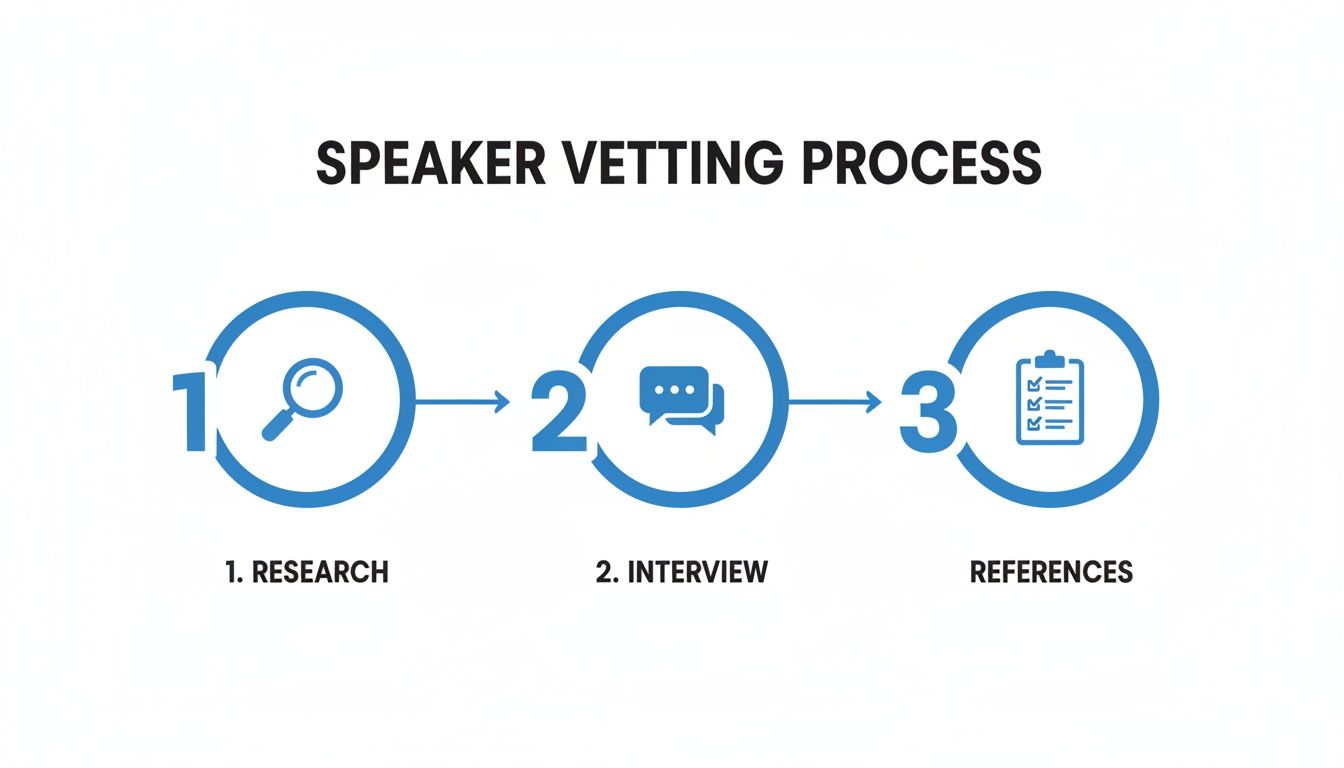
The entire vetting process is designed to give you total confidence before you get to the contracting stage. A solid contract is the foundation of a successful engagement and sets clear, professional expectations from the start.
Essential Speaker Contract Checklist
| Clause Category | What to Look For | Why It's Important |
|---|---|---|
| Scope of Services | Clear description of all deliverables: keynote length, Q&A, breakout sessions, social media posts, etc. | Prevents "scope creep" and ensures you get exactly what you paid for. |
| Fees & Payment | The total fee, deposit amount (50% is standard), payment schedule, and acceptable payment methods. | Guarantees financial clarity and helps with your event budgeting and cash flow. |
| Travel & Logistics | Who books and pays for travel/accommodation. Specify class of travel and any expense reimbursement policies. | Avoids unexpected costs and logistical confusion closer to the event date. |
| Cancellation Policy | Defines financial penalties for both parties if the event is canceled, with specific timelines (e.g., within 30 days). | Protects both you and the speaker from financial loss due to unforeseen changes. |
| Intellectual Property | States who owns the presentation content and outlines rules for recording, rebroadcasting, or distributing it. | Clarifies usage rights and protects the speaker's proprietary material. |
| Force Majeure | The "Act of God" clause. Outlines procedures for unforeseen events like natural disasters or emergencies. | Provides a clear path forward if circumstances beyond anyone's control disrupt the event. |
Clause Category | What to Look For | Why It's Important
Reviewing these points ensures your agreement is comprehensive, fair, and sets the stage for a smooth, professional partnership.
From Contract Signing to Event Day
Once the contract is signed, your planning timeline kicks into high gear. Proactive project management eliminates last-minute scrambles. For a complete roadmap, check out our event planning timeline template.
Here are the non-negotiable check-ins:
- Initial Kickoff Call (90+ Days Out): Your first strategic chat after booking. Go deep on audience demographics, event objectives, and key messages.
- Logistics Confirmation (60 Days Out): Lock down all travel and hotel details. Book ground transport and send a complete itinerary.
- Content Briefing (30-45 Days Out): The most important pre-event meeting. Provide a detailed briefing document covering audience pain points, recent company wins, and desired takeaways.
- A/V and Tech Check (1-2 Weeks Out): Connect the speaker (or their tech person) with your A/V crew to confirm slide formats, microphone preferences, and video or sound cues.
Crafting the Perfect Speaker Briefing
A killer briefing document is the secret to making a keynote feel like it came from inside your company. It arms the speaker with the context they need to customize their message and connect with your audience.
Your briefing document should be a concise, powerful guide. It’s not just about logistics; it’s about sharing the soul of your event and the heartbeat of your audience. The more a speaker understands your world, the more effectively they can speak to it.
A great brief is specific and includes:
- Audience Profile: Who are they? Go beyond titles. What's their mindset? Excited, skeptical, burned out?
- Event Thesis: What is the single-sentence purpose of your event?
- Desired Outcomes: List 3-5 specific, actionable things you want your audience to think, feel, or do after the keynote.
- "Insider" Language: Share any company acronyms, project code names, or inside jokes they should know (or avoid!).
When you provide this level of detail, you’re not just hiring a speaker; you’re collaborating with a partner to create a truly memorable experience.
Maximizing Your Investment by Measuring Speaker ROI

The real value of a business keynote speaker isn't the applause; it’s the lasting, tangible change they spark. To prove the value of this investment, you must move past anecdotal feedback and measure the return on your investment (ROI) by tracking real shifts in behaviors, skills, and business outcomes.
When you can connect a speaker's message to concrete results, the expense transforms into a strategic business driver. Our speakers are partners in this process, committed to delivering outcomes that keep paying dividends long after the event.
Defining Your Measurement Framework
Before the event, you need to know what success looks like. This means setting up metrics that capture both hard numbers and invaluable human insights. To truly grasp the value a speaker brings, you need the same rigor you'd apply when learning how to accurately measure marketing ROI.
Quantitative metrics are the measurable changes in performance. Examples include:
- Adoption Rate of New Tools: If the speaker introduced a new AI process, what percentage of your team started using it within 30 days?
- Sales Cycle Velocity: For a sales-focused keynote, did the average sales cycle shorten in the following quarter?
- Project Completion Rates: After a talk on productivity, did the rate of on-time project delivery improve?
These figures provide the concrete proof you need to justify future investments in high-caliber talent.
Capturing Qualitative Insights
Numbers are crucial, but they don't paint the full picture. Qualitative feedback—the stories, shifts in mindset, and buzz—provides the why behind the data. This is where you measure the human impact.
Post-event surveys are your best friend here, but go deeper than "rate this session from 1 to 5."
Pro Tip: Use a mix of rating scales and open-ended questions. Ask attendees to rate their confidence in a new skill on a scale of 1-10, but immediately follow up with, "What's the single biggest idea you'll implement from today's session?"
Consider these qualitative approaches:
- Targeted Survey Questions: "How has this session changed your perspective on using AI in your role?"
- Manager Check-ins: Ask team leaders to report on behavioral changes or new ideas they're hearing in their one-on-ones.
- Focus Groups: A month after the event, host a small follow-up session to discuss how the keynote's concepts are being applied.
This rich, story-based feedback brings your ROI report to life.
Extending the Message for Lasting Impact
The most successful speaking engagements are the start of an ongoing conversation. To maximize your investment, you need a plan to reinforce the keynote’s core message and keep the momentum going. This is how you embed new ideas into your company culture.
Think about creative ways to extend the speaker's influence:
- Follow-Up Workshops: We work with our speakers to design smaller, hands-on workshops that let teams apply the keynote's concepts to their own projects.
- Internal Content Campaigns: Create short videos or articles based on the key themes from the talk.
- Leadership Reinforcement: Arm your managers with talking points and resources to champion the speaker's message.
The demand for strong communication is growing. Companies with highly effective communicators outperform their peers by 3.5 times financially. Discover more insights about these industry trends. By measuring ROI and extending the message, you ensure your investment delivers a real competitive advantage.
Your Top Speaker Questions, Answered
Hiring a professional speaker can feel like navigating a new world. Getting clear, straightforward answers is the best way to move forward with confidence. Here are some of the most common queries we hear from event planners.
How Far in Advance Should I Book a Business Keynote Speaker?
For the best selection and less stress, aim to book your speaker 6 to 12 months in advance, especially for a high-demand expert or your annual conference. This lead time allows for a proper vetting process, smooth contract negotiations, and deep content collaboration. For smaller events, a 3 to 6-month timeline can work, but booking earlier almost always leads to a better partnership and a more polished presentation.
What Is the Difference Between a Keynote and a Breakout Speaker?
A business keynote speaker is your main-stage headliner. Their job is to set the tone for the entire event with a central, strategic message that anchors your theme. Other speakers, like those leading breakout sessions, dive deeper into specific, tactical subjects.
- Keynote Speaker: Addresses a big, unifying idea—like the future of AI in your industry or the principles of resilient leadership—to create a high-impact, memorable experience for the whole audience.
- Breakout Speaker: Teaches a specific skill or explores a niche topic, like "Using Generative AI for Sales Prospecting," for a smaller, focused group.
The keynote speaker provides the vision, and breakout speakers provide the tools to make it a reality.
Can I Ask a Speaker to Integrate Our Company's Messaging?
Absolutely; you should insist on it. The best business keynote speakers build their presentation around your specific world. True professionals see customization as a core part of their service. Give your speaker the inside scoop on your company's mission, recent wins, and current challenges. This allows them to weave your reality into their narrative, making the message far more powerful. This should be a major topic of conversation during your initial vetting calls.
Expert Insight: The best speakers act like strategic partners. They don't just sprinkle in your talking points; they use your internal messaging as the foundation for creating a bespoke experience that feels like it came from one of your own leaders.
What Happens if a Speaker Has to Cancel?
This must be clearly spelled out in your speaker agreement. Any professional speaker or agency will have a detailed emergency cancellation clause to protect your event.
Typically, this is handled in one of a few ways:
- Replacement: The speaker's bureau will work to find a suitable replacement of equal or greater caliber, with your final approval. This is a huge benefit of working with a reputable agency.
- Rescheduling: If your event date is flexible, you might reschedule the talk for a later date.
- Refund: If a replacement or new date isn't an option, the contract should guarantee a full and immediate refund of your deposit.
Established agencies and their speakers have contingency plans for these rare situations, ensuring your event is protected. This safety net is one of the most important reasons to partner with a professional speaker bureau.
At Speak About AI, we represent a roster of the world's leading experts who are not just speakers, but partners in your event's success. We simplify the entire process, from discovery to delivery, ensuring you find the perfect voice to drive your message home.
Explore our roster of top AI speakers and book a consultation today.