
How to Increase Operational Efficiency and Boost Productivity

Improving operational efficiency is about so much more than just trimming the budget. It’s about building smarter, more resilient systems that create real value. The journey starts with a brutally honest look at your current operations to find the sources of waste—from duplicated tasks to frustrating communication gaps—and then deciding what "efficient" actually means for your business.
Your Foundation for Greater Operational Efficiency
Boosting productivity is a top priority for just about everyone. In fact, research consistently shows that operational efficiency is one of the top two challenges facing businesses today, largely driven by fierce competition and constant pricing pressure.
The key is to move past generic advice and build a solid, measurable foundation for improvement. This ensures your efforts are targeted, directly support your main business goals, and deliver the biggest impact right from the start.
Before we dive into the specific tactics, let's establish the core principles that will guide every step of this framework. These three pillars are the bedrock of any successful efficiency initiative.
<br>
The Three Pillars of Operational Efficiency
| Pillar | Core Objective | Key Actions |
|---|---|---|
| People | Empower and align your workforce to drive continuous improvement. | Foster a culture of feedback, provide skill-based training, and ensure clear communication. |
| Process | Standardize and optimize workflows to eliminate waste and reduce friction. | Map key processes, identify bottlenecks, and implement lean methodologies. |
| Technology | Digitize and automate tasks to increase speed, accuracy, and scalability. | Adopt tools that integrate seamlessly, automate repetitive work, and provide actionable data. |
<br>
With these pillars in mind, you have a clear lens through which to view every operational challenge. They remind us that true efficiency is a balanced effort, not just a software upgrade or a new policy.
Diagnose Your Current Operational Health
Before you can get to where you're going, you need to know exactly where you are. This means taking an unfiltered look at your current processes to spot the friction, waste, and bottlenecks. Where do things grind to a halt? Where does communication fall apart? Many leaders are shocked to find that what they think is happening is a world away from the day-to-day reality.
A proper diagnosis involves a few key things:
- Mapping Workflows: Get a whiteboard (physical or digital) and visually chart a key process from end to end. This is often an eye-opening exercise that immediately reveals redundant steps, unnecessary handoffs, and hidden delays that drain time and money.
- Gathering Team Feedback: Your frontline employees are an absolute goldmine of information. They live with the daily friction and often have brilliant, practical ideas for improvements that leadership would never see.
- Analyzing Performance Data: Dive into metrics like cycle time, error rates, and resource utilization. Hard data gives you an objective view of where inefficiencies are costing you the most.
Define What Efficiency Means for You
"Efficiency" isn't some universal concept. For a software company, it might be about shipping code faster. For a manufacturing plant, it might mean slashing material waste. For a modern B2B SaaS company, the heart of efficiency often lies in [implementing Revenue Operations (RevOps)](https://altiorco.com/resources/blog/revenue-operations) to get sales, marketing, and customer success all rowing in the same direction.
True operational efficiency is achieved when your people, processes, and technology are perfectly aligned to deliver maximum value to your customers with minimum wasted effort. It's about working smarter, not just harder.
Defining your goals gets everyone on the same page and stops teams from pulling in different directions. This initial work is absolutely critical because it shapes every single step that follows, from standardizing processes to picking the right technology.
It also sets you up for successful change management, a crucial piece of the puzzle we cover in our guide to organizational change management strategies. By laying this foundation, you ensure every initiative is a deliberate move toward a more productive and resilient organization.
Map Your Processes to Uncover Hidden Bottlenecks
You can't fix what you can't see. That’s the simple truth behind operational efficiency. Before you can make anything better, you have to get an honest, unfiltered look at how work actually gets done in your organization. This is where process mapping comes in—it’s about creating a visual blueprint of your workflows, step-by-step.
This isn't just about creating diagrams. It's the foundational phase where you diagnose problems, define what success looks like, and pinpoint the exact opportunities for improvement.
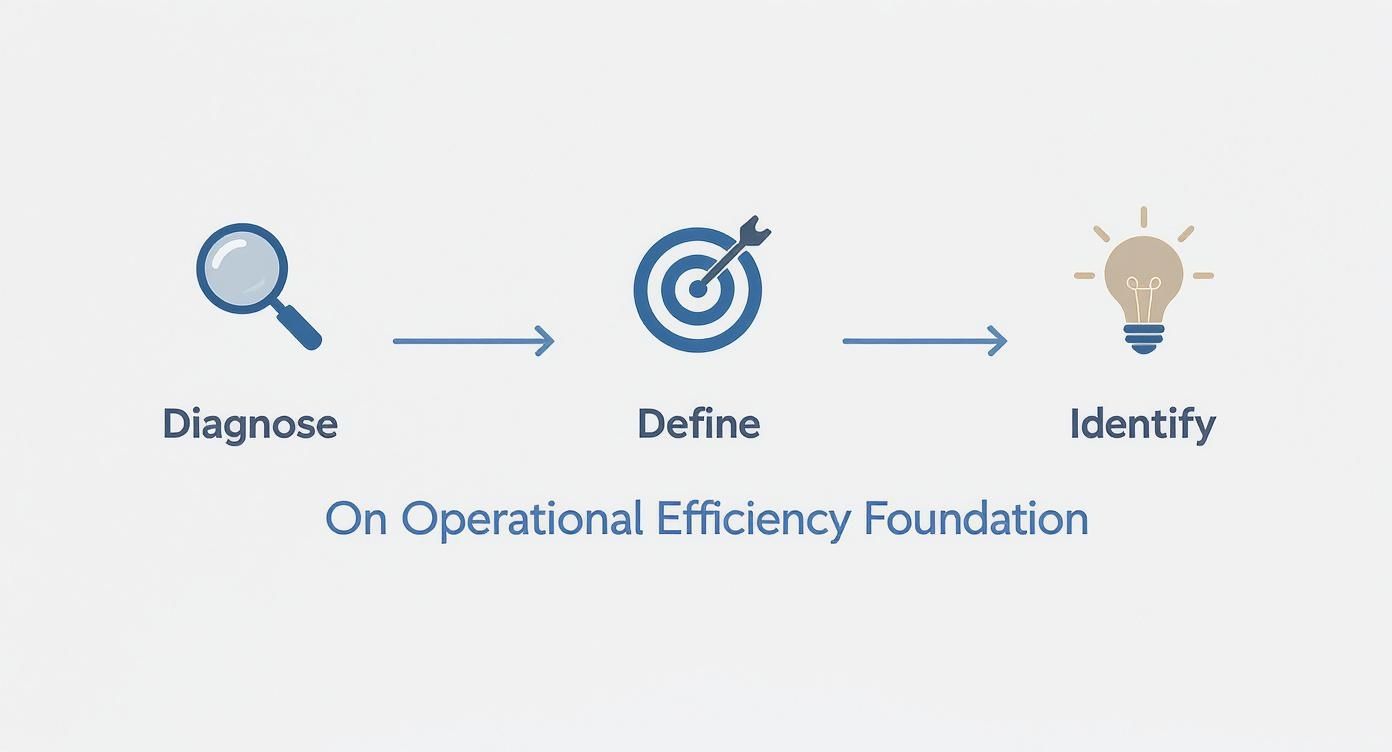
This simple flow is your starting logic. Diagnose the current state, define your target, and then identify the specific roadblocks. Skip this, and any "improvements" you make are just shots in the dark.
Getting started doesn't require complex software. Grab a whiteboard and some sticky notes. Trace a single task—like onboarding a new client or processing an invoice—from the very first action to the final handoff. The goal is to capture every single touchpoint, decision, and delay along the way.
The Power of Visualizing Workflows
Once you put a process on the wall for everyone to see, the hidden problems start to jump out. You might suddenly realize an invoice needs five approvals when two would do. Or maybe you'll discover two different departments are doing the exact same data entry, doubling the work and inviting errors.
These are the silent killers of productivity. They don't show up on a P&L statement, but they steadily drain resources and frustrate your team.
I once worked with a marketing team that mapped their content creation process. They immediately saw that a huge delay always happened between the final draft and the design phase. Turns out, the bottleneck was a single, overworked designer. That simple visual insight allowed them to redistribute certain tasks and clear the logjam almost overnight.
The real value of a process map isn't the document itself; it's the conversations it starts. When teams gather to map a process, they start questioning why things are done a certain way, sparking collaboration and innovation.
Standardize Processes for Consistency and Quality
After you've mapped your workflows and rooted out the obvious bottlenecks, the next move is to standardize. This means creating a single, agreed-upon "best way" to get a task done. Standardization is the cure for the chaos that comes when everyone does things their own way.
Expert speaker Alan O’Neill often points out that world-class companies are built on a foundation of ruthless consistency. He argues that standardizing even the smallest, most routine tasks creates massive wins in quality, speed, and customer experience. It’s all about creating predictable, high-quality outcomes every single time.
Standardizing your key processes delivers some immediate benefits:
- Fewer Errors: When everyone follows the same playbook, the chance of mistakes plummets. This is a game-changer for critical functions like customer service, finance, or compliance.
- Better Quality: A standardized process is an optimized one, intentionally designed to produce the best possible result, consistently.
- Faster Onboarding: New hires get up to speed in a fraction of the time when they have a clear, documented process to follow instead of relying on "tribal knowledge."
A shared understanding of the workflow is the bedrock for every other efficiency gain you want to make. It builds the foundation you need to introduce new technology, empower your team, and drive continuous improvement.
Weave in Automation and Technology Smartly
Technology can be a massive booster for operational efficiency, but only when you use it with a clear purpose. Just buying the latest and greatest software won't magically fix a broken process. The real win comes from picking the right tools for your specific headaches, making sure the tech serves your strategy—not the other way around.

This is about more than just digitizing your old, clunky habits. It’s a chance to completely rethink how work gets done. As renowned innovation expert and speaker David Rowan often points out, the right technology can reshape entire business models and give you a serious competitive edge.
Start with High-Impact Automation
Not every task is a good candidate for automation. The best place to start is with the low-hanging fruit: those repetitive, rule-based jobs that eat up your team's time but don't require any deep thinking. These are the classic "if this, then that" workflows bogging everyone down.
Take a look at tasks like:
- Data Entry and Transfer: Manually copying info from a customer form into your CRM or from a spreadsheet into an invoice.
- Report Generation: Pulling the same data from five different places every Monday morning to build a performance report.
- Standard Communications: Sending out routine appointment reminders, follow-up emails, or internal updates.
Automating these things frees your people to focus on what humans do best—creative problem-solving, strategic thinking, and building relationships. The trick is to start small, show a quick win, and then build from there. It's no surprise that 74% of leaders believe automating manual workflows has the most potential to drive major process improvements.
The Rise of Low-Code and No-Code Platforms
One of the biggest game-changers in recent years has been the arrival of low-code and no-code platforms. These tools have put the power of automation into the hands of the people actually doing the work, even if they don't know how to write a line of code.
When your team on the ground can build the exact tools they need to fix their own bottlenecks, you create a culture of distributed problem-solving. They're no longer waiting for IT; they're creating solutions themselves.
This is a huge deal for staying agile. Instead of a department manager waiting months for a new software solution, they can now use a simple drag-and-drop tool to build an automated workflow in an afternoon.
Integrating AI for Smarter Operations
If basic automation handles today's repetitive tasks, artificial intelligence helps you get ahead of tomorrow's problems. AI is no longer just about task management; it’s a strategic tool for predictive analytics and making proactive decisions.
For instance, AI can crunch historical sales and supply chain data to forecast future demand with incredible accuracy. This lets you optimize inventory so you're not stuck with costly overstock or disappointing stockouts. It can also monitor equipment performance to predict failures before they happen, allowing for preventative maintenance that keeps downtime to a minimum.
Dodging Common Technology Traps
Just picking the right software isn't enough. A successful rollout is all about smart integration and managing the human side of change. Too many companies stumble when their shiny new tools don’t talk to their existing systems, creating brand new data silos and even more manual work.
Here are a few classic mistakes to watch out for:
- Automating a Bad Process: Slapping technology on top of a flawed workflow just helps you do the wrong thing faster. Always map and fix the process first.
- Ignoring Integration: Make sure any new tool plays nicely with your core systems (CRM, ERP, etc.). A disconnected tech stack is a recipe for headaches.
- Forgetting Legacy Systems: Outdated tech can be a huge roadblock. You need a solid plan for updating or replacing old systems so they can support modern tools. Our guide offers deeper insights into effective legacy system modernization strategies.
When you approach technology with a clear strategy, it stops being just another tool and becomes a core engine for your operational success.
Empower Your Team for Peak Performance
Processes and technology are just tools. The real engine behind your operation is your people, and their engagement is directly wired to your bottom line. Creating an environment where employees feel valued, motivated, and trusted isn't just a "nice-to-have"—it's a core strategy for hitting peak operational efficiency.
Disengaged teams don't innovate. They don't solve problems, and they definitely don't go the extra mile. They just follow the script, and that's a recipe for stagnation. To really move the needle on efficiency, you have to nail the human side of the business.
Fostering a Culture of Ownership and Improvement
When employees feel a sense of ownership, their mindset shifts. They stop seeing their role as a list of tasks and start seeing themselves as direct contributors to the company's success. That shift is incredibly powerful, turning passive workers into proactive problem-solvers.
Performance psychologist and speaker Jamil Qureshi often discusses building resilient, high-performing teams that can adapt to change. His key insight is that the right culture empowers people to take initiative and constantly look for better ways of working.
So, how do you build this kind of culture?
- Encourage Bottom-Up Feedback: Create safe, clear channels for employees to share their ideas—and frustrations—about current processes. They're on the front lines and often have the best, most practical insights.
- Delegate Authority, Not Just Tasks: Give your team the autonomy to make decisions within their roles. When you trust people to manage their own work, they take more pride in the outcome.
- Recognize and Reward Initiative: When a team member spots an inefficiency or comes up with a creative solution, celebrate it publicly. This reinforces the value of continuous improvement and inspires others to do the same.
The Impact of Modern Work Models and AI
The way we work is changing, and so are the tools we use. Managing these shifts is key to keeping your team productive and engaged. Just look at the rise of hybrid work models—it’s been a massive factor in employee satisfaction.
Low employee engagement is a huge drag on efficiency. In 2024, only 21% of workers worldwide felt actively engaged at work. This lack of motivation is estimated to have cost the global economy $438 billion in lost productivity.
Yet, hybrid models where employees work from home a couple of days a week maintain the same productivity as full-time office work while cutting the risk of turnover by 33%. You can discover more insights about employee productivity statistics on archieapp.co. The data is clear: flexibility can boost both happiness and output.
True empowerment isn't just about giving people tools; it's about creating an environment where they feel trusted and motivated to use those tools to their fullest potential.
On top of that, artificial intelligence is playing a bigger and bigger role in job satisfaction. When used the right way, AI can eliminate the monotonous, soul-crushing parts of a job. This frees up your team for more strategic and fulfilling work.
Organizations that heavily use AI report higher employee productivity (72%) and improved job satisfaction (59%). By automating repetitive tasks, AI gives people more space for critical thinking and creativity. But to make this work, you have to invest in the right training. Our guide on AI training for employees offers a detailed approach to get your team ready.
When you focus on your team's well-being and development, you create a positive feedback loop. An engaged, empowered workforce is more innovative, more resilient, and ultimately, far more efficient.
Measure Success and Drive Continuous Improvement
Let's be clear: achieving operational efficiency isn't a destination. It’s not a project you finish and then move on from. It's a continuous journey. Once you've mapped your processes, brought in the right tech, and empowered your team, you're at the starting line of the final, most crucial phase: building a sustainable cycle of measurement, analysis, and refinement.
Without this, your improvements are just guesswork. Today’s slick, efficient process will inevitably become tomorrow's bottleneck if left unchecked. This is all about embedding a culture of learning and adapting into your daily operations so your organization stays agile, competitive, and ready for whatever comes next.
Select KPIs That Truly Matter
You can't improve what you don't measure. But here’s the flip side: measuring everything is just as useless as measuring nothing. The trick is to pick a handful of Key Performance Indicators (KPIs) that are a true pulse check on your operational health and tie directly back to your bigger business goals.
Vague metrics only lead to vague results. You need to focus on specific, actionable data points that tell a clear story.
Think about tracking metrics like these:
- Cycle Time: How long does it actually take to get from A to Z on a specific process? This is gold for finding hidden delays in things like customer onboarding or order fulfillment.
- Throughput: How much work is a team or a production line actually getting done in a given period? This is your go-to for measuring raw productivity.
- First Pass Yield: What percentage of work gets done right the first time, with zero rework? This is a powerful sign of how good your process quality and standardization really are.
- Cost Per Unit: Plain and simple, how much does it cost to produce one widget or deliver one service? This metric connects your team's daily actions directly to the bottom line.
These KPIs give you an objective, no-fluff view of how your changes are performing. You'll know exactly what to double down on and what needs to go back to the drawing board.
Establish Robust Feedback Loops
Data tells you what is happening. Your team on the ground knows why. Creating strong feedback loops is absolutely essential for any kind of sustainable improvement. You need a system that captures both the hard data and the invaluable insights from your frontline staff.
This is where you turn everyday observations into actionable intelligence. For instance, the numbers might show a sudden dip in productivity. But it’s a team member who can tell you it's because the latest software update keeps crashing their system.
A dashboard can show you a problem, but a conversation can reveal the solution. Continuous improvement thrives when data-driven insights are combined with the practical wisdom of the people doing the work every day.
Companies are catching on. According to PwC's 2025 Digital Trends in Operations Survey, a full 62% of respondents see AI as highly effective for boosting productivity and managing costs. To give you a specific example, nearly all operations leaders in the tech and telecom sectors (96%) said digital tools have given them much better visibility into their supply chain costs. You can explore the full findings on digital trends in operations at pwc.com. This just goes to show how technology is becoming the backbone of the feedback systems we need for constant improvement.
When you create an environment where people feel safe to speak up without fear of blame, you build a culture of shared ownership. And that’s when real, lasting operational success happens.
Common Questions About Operational Efficiency
Even with a great game plan, you're bound to have questions when you start overhauling your operations. It’s natural. Digging into the details of top strategies to improve operational efficiency often brings up a few common sticking points. Let's tackle them head-on.
Think of this as your field guide for the most frequent hurdles. The goal here is to give you short, practical answers you can put to work immediately.
Where Is the Best Place to Start?
Hands down, the best first step is to map your existing processes. Seriously. You can't fix what you don't fully understand. Before you even think about new software or team shake-ups, you have to get an honest, unfiltered look at how work gets done right now.
Pick a critical workflow—maybe it’s onboarding a new client or developing a product feature. Trace it from the very beginning to the very end. This single exercise will immediately shine a spotlight on the bottlenecks, redundancies, and frustrating loops that are slowing you down. It’s the blueprint you need to make sure every change you make actually counts.
How Should We Measure Our Progress?
You measure progress with Key Performance Indicators (KPIs) that are directly tied to your operational goals. Forget the vanity metrics that look good in a report but don't mean anything. You need data that tells you the real story about the health of your core processes.
A few solid metrics to consider tracking are:
- Cycle Time: The total time it takes to get one thing done from start to finish.
- Cost Per Unit: The all-in cost to produce one widget or deliver one service.
- First Pass Yield: The percentage of work that gets done right the first time, no rework needed.
- Throughput: How much work your team completes in a given time frame.
The trick is to pick the KPIs that give you a clean, objective signal on whether your changes are actually moving the needle.
Is This Only for Large Corporations?
Not at all. In fact, you could argue that small and medium-sized businesses stand to gain the most. When you’re running a smaller team, streamlining a few key processes or automating repetitive tasks can free up an incredible amount of time and money. It's how you punch above your weight class.
For a small business, even a seemingly minor tweak—like standardizing the sales follow-up process or automating invoice reminders—can create a massive ripple effect on productivity and profitability. The principles of efficiency scale down perfectly.
How Does Leadership Drive This Change?
Leadership isn't just important here; it's everything. A successful efficiency initiative needs a champion who can rally the entire organization around a clear vision. It’s the leader’s job to constantly communicate the "why" behind the changes, not just the "what."
But it goes deeper than that. As innovation expert David Rowan advises, real progress happens when leaders push beyond small tweaks and use technology to fundamentally rethink how the business operates. A leader needs to set that ambitious direction, clear the path for their teams to execute, and be the first to celebrate the wins that keep everyone motivated.
True operational excellence is a cultural trait, not a one-time project. It starts when leaders commit to a vision and empower their people to pursue it relentlessly. This creates a resilient organization that adapts and thrives.
Ready to inspire your team with expert insights on building a more efficient and future-ready organization? Speak About AI connects you with world-class speakers like David Rowan, Alan O’Neill, and Jamil Qureshi who can provide the actionable strategies and forward-thinking vision your team needs. Book a leading expert for your next event by visiting us at https://speakabout.ai.