
What Is Predictive Modeling? A Complete Guide
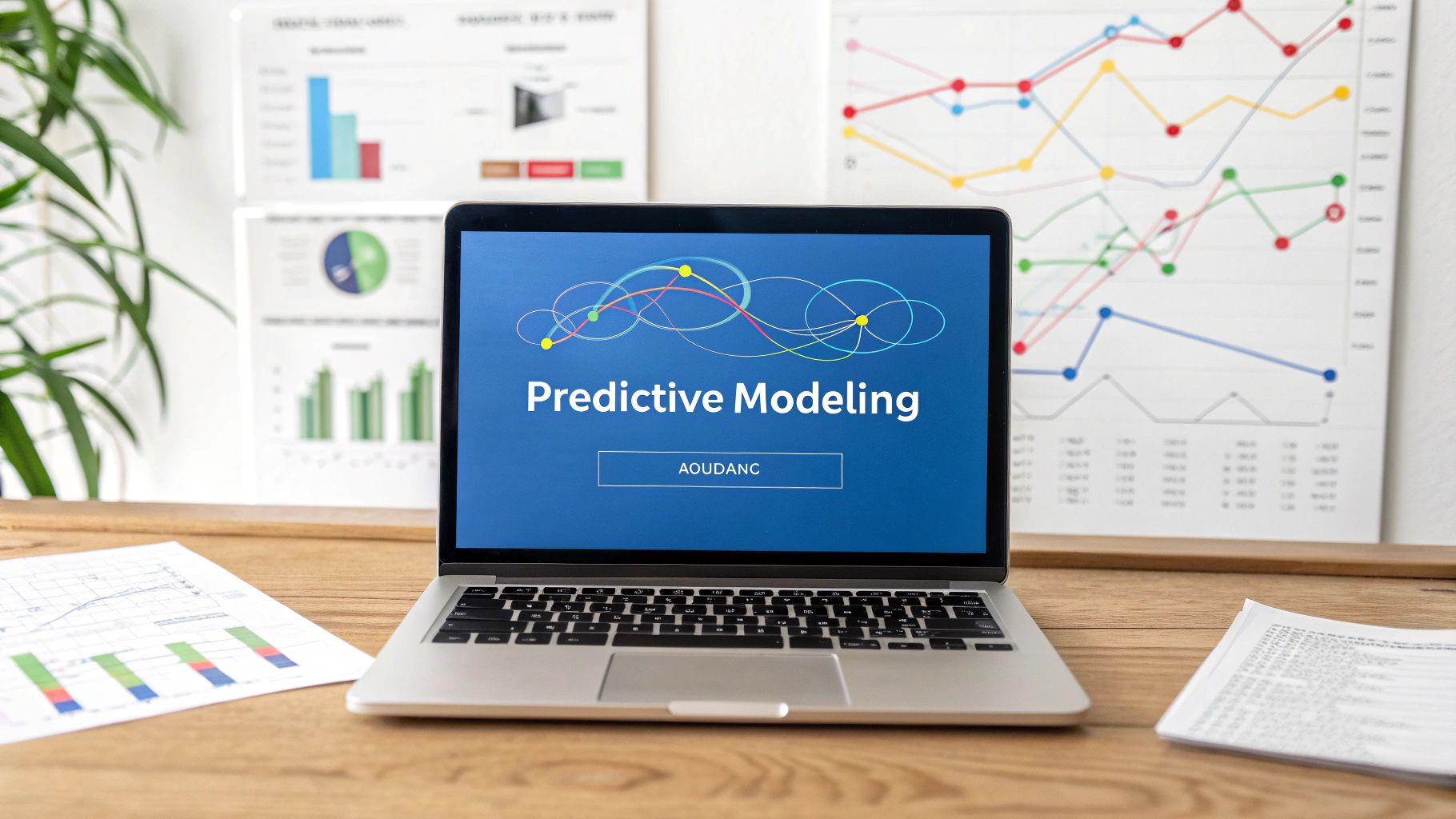
Predictive modeling is all about using what you already know to make a smart guess about what's coming next. Think of it as a GPS for business decisions, taking your past data and turning it into a roadmap for the future. It helps answer the big question: what's likely to happen?
Decoding the Future with Predictive Modeling

Trying to forecast tomorrow’s sales using only yesterday's reports is like driving while looking exclusively in the rearview mirror. It’s a recipe for disaster. Predictive modeling flips that around, analyzing patterns in your historical data to make educated, data-driven predictions.
This is the tech behind many of the things we now take for granted, like your bank flagging a weird transaction on your credit card or a retailer suggesting a product you actually end up loving. It's not magic; it's just really smart pattern recognition.
And businesses are catching on in a big way. The global predictive analytics market was recently valued at over $17 billion and is expected to rocket past $82 billion in the next decade. North America alone accounts for a massive 46% of that market. This tells us one thing loud and clear: companies that can anticipate the future have a serious competitive edge.
The Core Components of Prediction
At its heart, predictive modeling isn't as complicated as it sounds. It just needs a few key ingredients working together. Once you get these, you’ll understand its real power.
- Data: This is the fuel. It can be anything—customer purchase histories, website clicks, sensor readings from machinery, or market trends. The better the quality of your data, the more accurate your predictions will be.
- Algorithms: Think of these as the mathematical recipes that sift through all that data to find patterns, connections, and relationships you'd never spot on your own.
- Machine Learning: This is where the model "learns" from the data without someone having to program every single rule. By feeding it historical examples, the model fine-tunes its own algorithm to get better and better at making predictions on new information it has never seen before.
As marketing analytics expert Christina Inge puts it, "Your job will not be taken by AI. It will be taken by a person who knows how to use AI." This is especially true here. To really harness this technology, you need to understand its building blocks. For a great real-world example, you can delve deeper into the concept of predictive analytics in banking to see how one industry is putting these ideas to work.
Understanding Common Predictive Modeling Techniques
Predictive modeling isn't a single magic wand; it’s more like a carpenter's toolkit filled with specialized instruments. You wouldn't use a hammer to cut wood, and you wouldn't use a saw to drive a nail. The same principle applies here—understanding the core methods helps you pick the right tool for the job.
Let's demystify some of the most common techniques. The goal isn't to make you a data scientist overnight, but to give you a solid grasp of how these powerful algorithms turn raw data into smart decisions.
Regression Models: Predicting the Numbers
At its heart, regression analysis is all about forecasting a specific number. Think of it as your go-to tool for predicting continuous values like sales revenue, customer lifetime value, or even the temperature next Tuesday.
The most straightforward version is Linear Regression. Imagine plotting your company's monthly ad spend against its monthly sales on a simple graph. Linear regression draws the single best-fitting straight line through those data points. That line becomes your model, allowing you to ask, "If we spend $10,000 on ads next month, what will our estimated sales be?"
Classification Models: Answering "Yes" or "No"
While regression predicts a number on a sliding scale, classification models predict a category. They're built to answer yes/no questions or sort things into predefined buckets like "high risk" vs. "low risk."
A popular and surprisingly versatile method is Logistic Regression. Don't let the name fool you; it's a classification tool. Think of it as a probability calculator. It’s perfect for questions like, "Will this customer renew their subscription?" or "Is this credit card transaction fraudulent?" The model analyzes different factors and spits out a probability—for example, there's an 85% chance this customer will churn.
Another powerful classifier is the Decision Tree. This technique works a lot like we do when we make decisions, using a series of "if-then" questions to arrive at a conclusion. For instance, a model predicting loan defaults might first ask, "Is the applicant's income over $50,000?" If yes, it follows one branch; if no, it goes down another, asking more questions until it reaches a final prediction.
Clustering Models: Finding the Hidden Groups
But what happens when you don't have neat, predefined categories to begin with? That's where clustering comes in. This is a type of unsupervised learning, where the model finds natural groupings in your data all on its own, without being told what to look for.
If you want to dig deeper into these two fundamental approaches, check out our guide on [supervised vs. unsupervised learning](https://speakabout.ai/blog/supervised-learning-vs-unsupervised-learning).
Imagine dumping all your customer data onto a virtual table. A clustering algorithm would automatically sort them into distinct segments based on similar behaviors. You might discover groups you never knew existed, like "high-spending weekend shoppers," "discount-driven bargain hunters," and "newly acquired window shoppers." This is gold for creating targeted marketing campaigns.
"AI is a real efficiency driver," notes speaker Christina Inge. "It really makes your work easier to be able to sketch something out through AI, show it to your client or boss and then have them give feedback on that, versus creating multiple iterations of the same product."
To tie this all together, here’s a quick guide to help you match the right model to your business problem.
Comparison of Common Predictive Models
| Model Type | Primary Use Case | Example Question It Answers | Complexity |
|---|---|---|---|
| Linear Regression | Forecasting continuous numerical values. | How much revenue will we generate next quarter? | Low |
| Logistic Regression | Predicting a binary outcome (yes/no). | Is this customer likely to click on our ad? | Low-Medium |
| Decision Trees | Classifying outcomes based on clear rules. | Should we approve this insurance claim? | Medium |
| Clustering | Segmenting data into natural groups. | What are our main customer personas? | Medium-High |
Choosing the right predictive modeling technique is absolutely crucial. When you understand what each model does best, you can align your business questions with the right analytical approach and get the clear, actionable answers you need to move forward.
The Predictive Modeling Process Step by Step
Building a predictive model isn't a single event; it's a careful, cyclical process. It’s less like flipping a switch and more like assembling a high-performance engine piece by piece, where every part has to be perfectly calibrated. This ensures the final model is accurate, reliable, and genuinely useful for making business decisions.
The whole workflow, from the initial idea to real-world impact, follows a clear, logical path. Let's walk through it using a classic business challenge: predicting customer churn.
Stage 1: Defining the Business Problem
Before anyone writes a single line of code, the first step is to nail down exactly what you want to achieve. A fuzzy goal like "understand churn" won't cut it. A much better goal is "identify customers who have a greater than 70% probability of canceling their subscription in the next 30 days."
Getting this right is everything. It focuses the entire project, dictates what data you'll need, and tells you exactly how you'll measure success. It transforms an abstract idea into a concrete, measurable objective.
Stage 2: Data Collection and Preparation
With a clear goal in hand, the next phase is gathering your raw materials: data. For our churn example, this would include things like:
- Customer Demographics: Age, location, and how long they've been a customer.
- Usage Patterns: How often they log in, which features they use most, and session length.
- Support History: Number of support tickets filed and how long they took to resolve.
- Billing Information: Payment history, subscription plan, and any recent upgrades or downgrades.
This stage often takes the most time. Raw data is almost never perfect. It needs to be cleaned to handle missing values, fix errors, and ensure consistency across the board. Think of it as prepping ingredients for a recipe—you have to wash, chop, and measure everything before you can even think about cooking.
Stage 3: Feature Engineering and Selection
Once the data is clean, the next step is feature engineering. This is where the real art and science begins, as you select the most relevant data inputs (features) that will help the model make accurate predictions. Not all data is equally useful.
For instance, a customer's last login date is probably a much better predictor of churn than the date they signed up five years ago. This phase involves creating new, more powerful features from existing ones, like calculating a "customer engagement score" based on recent activity. The goal is to give the model the strongest possible signals to work with.
The diagram below shows some of the core modeling techniques that get applied once the features are ready.
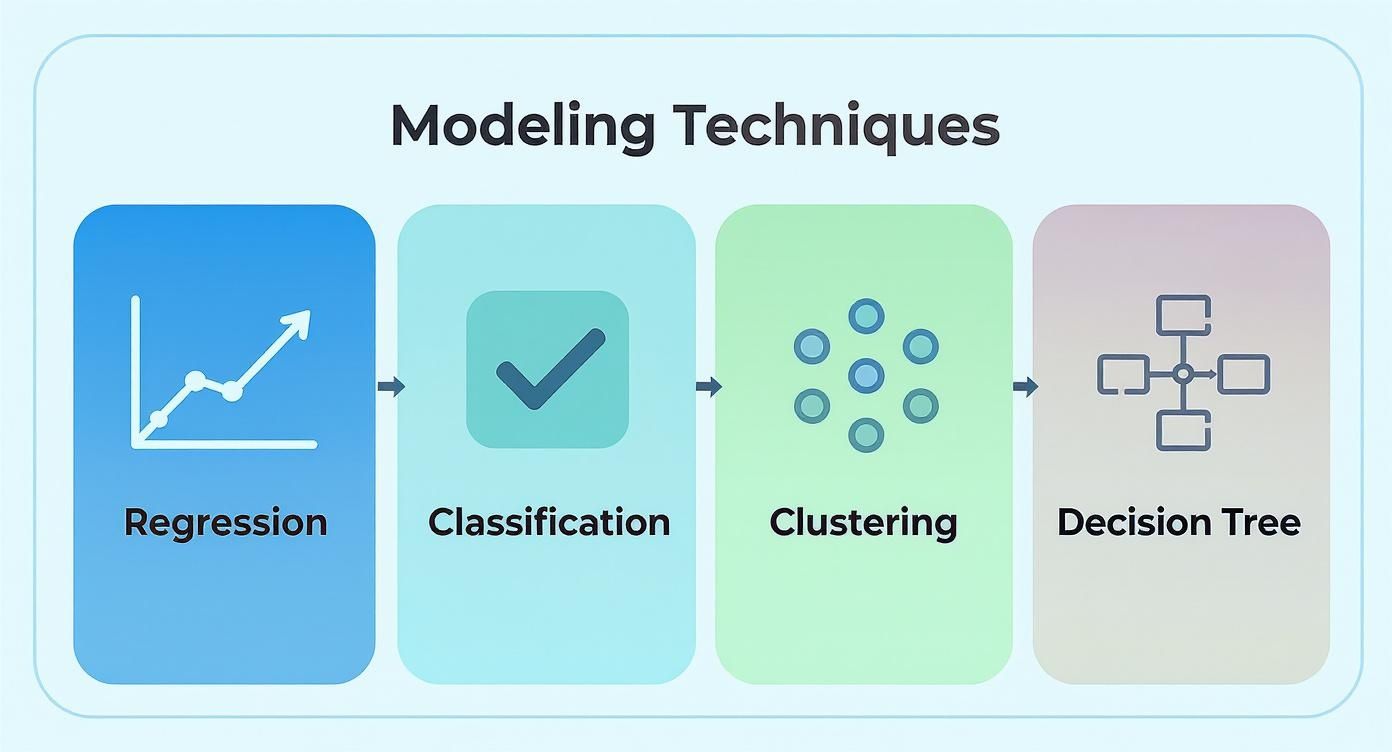
This visual is a great cheat sheet for how different techniques, like regression and classification, are designed for different types of predictive jobs.
Stage 4: Model Training and Evaluation
Now for the exciting part: model training. The prepared data is split into two piles: a training set and a testing set. The model "learns" from the training data, studying past examples of customers who churned and those who didn’t to find the underlying patterns.
After training, the model's performance is put through its paces on the testing data it has never seen before. This evaluation is critical. It ensures the model can generalize to new, real-world information and wasn't just "memorizing" the training examples. We use metrics like accuracy, precision, and recall to get an objective score on how well it did.
A model is only as good as its ability to perform on data it has never seen before. The evaluation phase is the ultimate quality check, preventing the deployment of a model that looks good on paper but fails in practice.
Stage 5: Model Deployment and Monitoring
Finally, a model that passes the tests is deployed into a live environment where it can start providing value. This could mean integrating it with a CRM, a marketing automation platform, or a business dashboard. For our churn example, the model would flag at-risk customers in real-time, allowing retention teams to step in with special offers or proactive support.
But deployment isn't the end of the line. Models have to be constantly monitored to make sure their accuracy doesn't degrade over time—a phenomenon known as model drift. Business conditions change, customer behaviors evolve, and the model must be retrained periodically with fresh data to stay effective.
This is also where you make key decisions about infrastructure. The predictive analytics market is leaning heavily into the cloud, with cloud-based solutions expected to grab around 62% of the market share in the next decade because of their flexibility and scale. At the same time, on-premises solutions are still growing at a strong 24.61% CAGR, especially in industries like healthcare and finance where data security and compliance are non-negotiable. This shows that choosing how to deploy is a critical business decision, and you can discover more about these deployment trends and what they mean for the market.
How Predictive Modeling Drives Business Growth
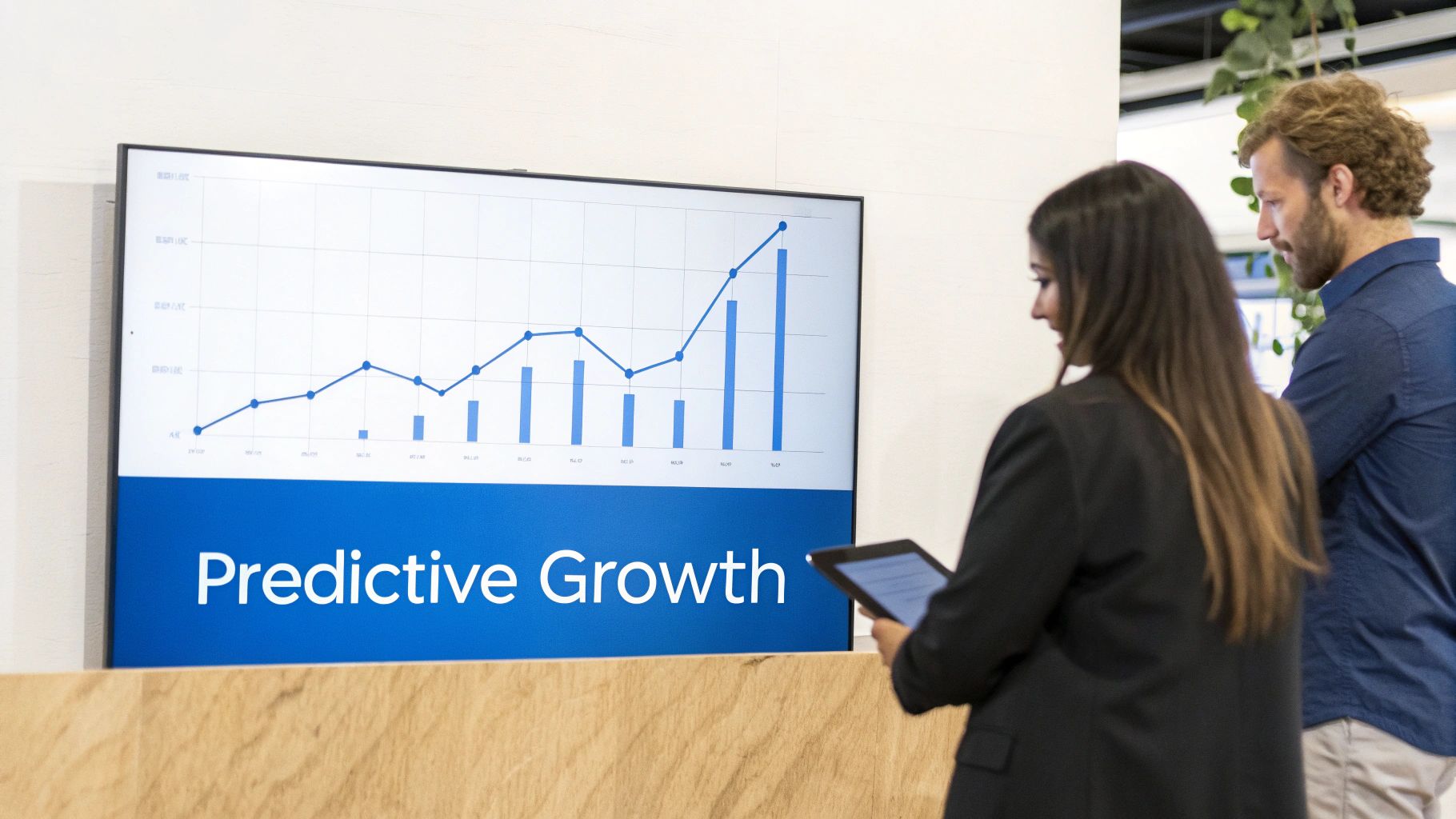
All the theory and complex algorithms in the world don’t matter much if they can’t deliver real-world results. This is where predictive modeling truly shines, turning abstract data into tangible business growth across just about every industry you can think of. It marks a fundamental shift from simply reacting to what’s already happened to proactively shaping what comes next.
Companies that get this right can anticipate what customers want, sidestep potential risks, and jump on opportunities that their competitors don't even see coming. It’s not just a trend; it's a completely different way of operating. Let’s look at a few concrete examples of how this technology is creating a serious competitive advantage.
Financial Services: Fraud Detection and Risk Scoring
The entire financial sector is built on trust and managing risk, two areas where predictive modeling makes a massive impact. Banks and credit card companies handle millions of transactions every single second. Spotting a fraudulent one in that flood of data is a monumental challenge.
Predictive models are the answer. They instantly analyze thousands of data points for each transaction—things like purchase amount, location, time of day, and a customer’s usual spending habits. If a purchase suddenly deviates from the norm, the model flags it as potentially fraudulent in milliseconds, often before the transaction is even approved. It’s a powerful shield protecting both the customer and the bank from losses.
It’s not just about fraud, either. These models are the backbone of modern credit scoring. By analyzing an applicant's financial history, income stability, and other key data, models can predict the likelihood of a loan default with incredible accuracy. This leads to lending decisions that are fairer, faster, and far more consistent.
Healthcare: Personalized Patient Outcomes
In healthcare, the stakes couldn't be higher. Here, predictive modeling is helping providers make decisions that can literally save lives. One of the most powerful uses is predicting disease outbreaks. By analyzing public health data, seasonal trends, and even social media chatter, models can forecast flu hotspots or other viral surges, giving hospitals the heads-up they need to stock up on resources.
At the individual level, predictive analytics is paving the way for truly personalized treatment plans. A model can analyze a patient's genetic makeup, lifestyle, and medical history to predict how they'll likely respond to different therapies. This helps doctors select the most effective treatment right from the start, improving outcomes and avoiding a frustrating, costly trial-and-error process. For a closer look at improving forecast accuracy across different fields, our detailed guide has you covered.
As AI implementation expert Jared Bienz often says, "A predictive model is a powerful tool because it doesn't just tell you what happened—it gives you a statistically sound glimpse into what's likely to happen next. This foresight is what separates market leaders from the rest of the pack."
Retail: Inventory Optimization and Personalization
For any retailer, success often comes down to a simple formula: have the right product, in the right place, at the right time. Predictive modeling is completely changing the game for inventory management by forecasting demand with pinpoint precision. These models chew through historical sales data, seasonality, planned promotions, and even outside factors like the weather to predict exactly how many units of a product a specific store will need.
The result? No more costly overstocking and no more frustrating "out of stock" signs that send customers straight to a competitor.
At the same time, predictive models are the engine behind the personalized shopping experiences we all now expect. When an e-commerce site recommends a product you actually want to buy, that’s a predictive model doing its job. It analyzes your browsing history, past purchases, and what similar shoppers have bought to figure out what you’ll be most interested in next. This doesn't just drive sales; it builds real customer loyalty.
The global rush to adopt these techniques proves just how valuable they are. While North America is currently the biggest market for predictive analytics, Asia Pacific is the fastest-growing region. The U.S. market alone was recently valued at USD 4.64 billion and is projected to rocket to USD 32.85 billion within a decade. This incredible growth is fueled by the clear ROI companies in finance, retail, and tech are seeing.
These examples are just scratching the surface. From manufacturing and energy to marketing and logistics, the applications are practically endless. To better understand how these models create a real edge, you can explore the many benefits of predictive analytics for your own business growth. The main takeaway is clear: knowing what is predictive modeling is the first step toward unlocking its immense potential to push your organization forward.
Navigating Common Challenges and Ethical Issues
Predictive modeling is incredibly powerful, but with that power comes a lot of responsibility. While the upsides are huge, getting it right means navigating some tricky hurdles. Understanding these potential pitfalls is the first step toward building models that are not only accurate but also fair and trustworthy.
One of the most common technical problems is simply poor data quality. Think of a predictive model like a student learning from a textbook. If the book is full of errors, typos, and missing pages, the student’s understanding will be shaky at best. It's the same with models—if they're trained on incomplete or messy data, their predictions will be unreliable.
Another classic issue is overfitting. This is what happens when a model learns its training data too well. Instead of grasping the underlying patterns, it just memorizes the specific examples it was shown. An overfit model looks like a genius on historical data but falls apart completely when it sees new, real-world information, making it pretty useless for actually predicting the future.
The Black Box Problem
One of the biggest conversations in AI right now revolves around the "black box" problem. Some of the most complex and accurate models, like deep neural networks, can give you an answer without being able to explain how they got there. This lack of transparency is a massive issue, especially in high-stakes areas like finance or healthcare where every decision needs a clear justification.
When you can't interpret how a model works, you can't fully trust it. It also makes it nearly impossible to spot errors or hidden biases. If a model denies someone a loan, regulators and customers have a right to understand why.
This is exactly why the field of explainable AI is booming. To get a better handle on how data scientists are cracking open these systems to make them more transparent, it’s worth learning about [what explainable AI is and why it matters](https://speakabout.ai/blog/what-is-explainable-ai). Making the black box see-through is non-negotiable for responsible AI.
Confronting Ethical Dilemmas
Beyond the technical glitches, there’s a whole landscape of ethical issues we can’t afford to ignore. The data we use to train these models is a reflection of our world, complete with all its historical biases. If we aren't careful, our models will not only learn these biases but amplify them.
- Algorithmic Bias: Imagine a hiring model trained on a company's past hiring decisions. If those decisions historically favored a certain demographic, the model might learn to perpetuate that unfair pattern, locking out qualified candidates for all the wrong reasons.
- Data Privacy: Predictive modeling runs on data, and lots of it. This immediately brings up serious questions about how personal information is being collected, stored, and used. Staying on the right side of privacy laws and respecting user trust isn't just good practice—it's essential.
- Accountability: If a predictive model makes a call that causes harm, who’s on the hook? Figuring out where the responsibility lies between the developers, the business using the model, and the end-users is a thorny but vital challenge.
The only way to manage these risks is to put people first. This means running regular bias audits, making transparency a priority, and setting up solid governance rules. The goal is to make sure these powerful tools are guided by strong ethical principles, building a future where technology works for everyone, fairly and responsibly.
Bringing in an Expert Predictive Modeling Speaker
Knowing the theory behind predictive modeling is one thing. Actually getting it to work across an entire organization? That’s a completely different challenge.
This is where bringing in an outside expert can be a game-changer, helping you bridge the gap between abstract concepts and real-world results. A seasoned speaker can demystify complex ideas, fire up your teams, and instill a genuine data-first mindset that sticks.
An expert voice is especially powerful during pivotal moments. Just kicking off your data science journey? A specialist can help you build a solid foundation. Need to get leadership on board with AI's strategic value? A compelling keynote can align stakeholders and unlock budget. Or maybe your teams just need to level up their skills? A hands-on workshop delivers the practical know-how they need to start building.
Featured Speakers on AI and Data Science
To help you find the right fit, here are a few leading experts from our roster who specialize in turning predictive modeling theory into bottom-line impact. Each brings a unique perspective to help your organization navigate the opportunities and hurdles of AI adoption.
- Christina Inge: As an authority on marketing analytics, Christina is the perfect speaker for teams aiming to apply predictive modeling to customer behavior and market dynamics. She has a real talent for making data science feel approachable and shows you exactly how to use predictive insights to drive marketing ROI. Her sessions often center on creating a data-driven culture and using analytics for a killer competitive advantage.
- Jared Bienz: With a deep background in rolling out AI in the real world, Jared brings a ton of hands-on experience to the stage. He’s a great fit for both technical and business crowds, breaking down the entire process of building and deploying models. His talks often cover scaling data science operations and, crucially, how to avoid the common mistakes that derail machine learning projects.
"Your job will not be taken by AI. It will be taken by a person who knows how to use AI." - Christina Inge, Marketing Analytics Expert
Key Topics Our Experts Address
When you book one of our speakers, your team gets direct access to actionable advice on the most critical topics in the field today. Our experts don't do generic talks; they tailor the content to your specific needs, making sure the message hits home whether they're speaking to executives, data scientists, or marketers.
Common presentation topics include:
- AI for the C-Suite: A high-level, strategic look at how predictive tech creates real business value.
- Building a Data-Driven Culture: Practical, step-by-step guidance for fostering an organizational mindset that puts data first.
- The Future of Marketing with Predictive Analytics: A deep dive into anticipating customer needs and delivering personalized experiences at scale.
- Ethical AI in Practice: A clear guide to navigating the moral complexities and responsibilities of using predictive models.
Booking an expert speaker gives your organization a clear roadmap and the confidence needed to make your AI initiatives a success.
Frequently Asked Questions
You've got the basics down, but that's usually when the real questions start to surface. Let's tackle some of the most common ones that come up when people start thinking about how predictive modeling works in practice.
What Is the Difference Between Predictive Modeling and Machine Learning?
This is a classic point of confusion, but the distinction is actually quite simple. Predictive modeling is the entire game—it’s the broad process of using data to figure out what happens next. Machine learning is your star player—a powerful set of algorithms and techniques you use to build the actual model.
Think of it like this: if your goal is to build a house (the predictive model), machine learning is the set of advanced power tools you use to do the construction. You could technically build a house with hand tools (like simple statistics), but machine learning gets the job done faster, smarter, and on a much bigger scale by letting the model "learn" on its own.
How Much Data Do I ReallyNeed to Get Started?
There’s no magic number here, and anyone who gives you one is guessing. The truth is, quality is far more important than quantity. A smaller, cleaner, more relevant dataset will always outperform a massive, messy one.
The real key is having enough historical data that shows clear outcomes. If you're trying to predict customer churn, for instance, you need a decent number of examples of customers who left and customers who stayed. This is what allows the model to spot the patterns that separate one group from the other. Start with a sharp business question, and it will become much clearer what data you actually need.
The real challenge isn't just collecting data; it's collecting the right data. Focusing on data that directly relates to your business question is the most effective approach.
Can Small Businesses Benefit from This Technology?
Absolutely. The idea that predictive modeling is exclusively for massive companies with deep pockets and huge data science teams is a myth. The game has completely changed thanks to accessible cloud platforms and automated machine learning (AutoML) tools.
Services from providers like Google Cloud, Amazon Web Services, and Microsoft Azure have put incredible power into the hands of small businesses. You can now build and deploy sophisticated models without a huge upfront investment in hardware or a roster of PhDs. These tools make it possible for any team to forecast sales, pinpoint their best customers, or optimize marketing spend with impressive accuracy.
Ready to bring this level of insight to your organization? Speak About AI connects you with top AI and data science experts who can demystify predictive modeling and provide your team with a clear, actionable roadmap. Explore our roster of speakers at https://speakabout.ai and find the perfect voice to guide your data-driven transformation.