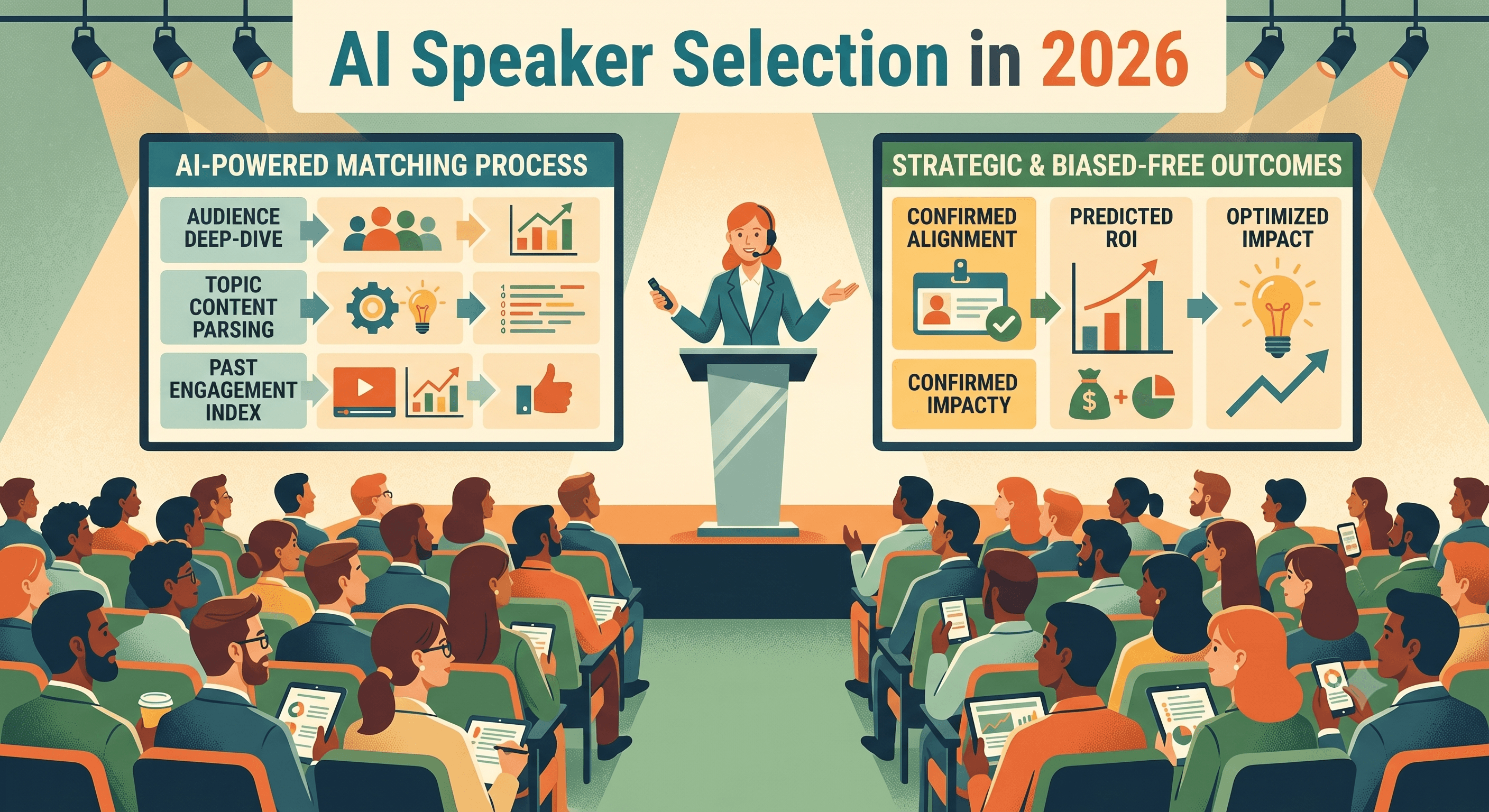
AI Speaker Selection in 2026 Requires Matching Audience Stage, Not Just Booking Fame
The AI speaker your board loved in 2023 might be the wrong choice for your 2026 conference. Not because that speaker got worse. Because your audience got smarter.
AI-related keynote enquiries rose 237% year-on-year according to The Motivational Speakers Agency, making AI the single largest growth category in corporate speaking. That number sounds like a success story. In practice, it has created a selection trap. Event planners are booking AI speakers at record rates while the audiences receiving those speakers have quietly outgrown the content those speakers deliver. The planner who books a high-level AI futurist for a leadership team that has already run three pilots and hired an internal AI lead is not delivering inspiration. They are delivering a disconnect.
In 2026, the most important question in AI speaker selection is not "who is the most talked-about AI speaker right now?" It is "what does our audience actually need next?"
The AI Speaker Category Has Matured Faster Than Most Planners Realize
The corporate speaking market has absorbed AI as a mainstream topic faster than the selection frameworks used to book speakers have evolved. Survey data from 2026 shows AI and machine learning at 49% of corporate event topic interest, trailing only leadership and teamwork at 66% and motivation at 50%. That positioning matters. AI is no longer a differentiator on an event agenda. It is an expectation, and the bar for what constitutes a valuable AI session has risen accordingly.
The speakers who built their reputations in 2022 and 2023 did so in a market where generative AI was a novelty and audiences needed orientation. Broad-strokes talks about the coming AI revolution, demonstrations of ChatGPT, and predictions about job displacement were genuinely useful then. Many organizations were encountering these ideas for the first time.
That audience no longer exists in most corporate environments.
The organizations sending people to leadership summits, sales kickoffs, and annual company events in 2026 have, in many cases, already run AI pilots, stood up internal AI working groups, and started asking harder questions about governance, implementation ROI, and workforce restructuring. Booking a speaker calibrated for a 2022 audience to address a 2026 room is not a neutral mistake. It signals to that room that leadership does not understand where they are.
The speaker discovery process must now begin with an honest audit of audience adoption stage, not with a shortlist of the most-booked names on the circuit.
The Three Audience Stages That Should Drive Every AI Speaker Decision
The most reliable framework for AI speaker selection in 2026 starts with a single diagnostic question: where is this audience in their AI journey? The answer almost always places them in one of three stages, and each stage requires a fundamentally different speaker profile.
Stage 1: AI Awareness
These audiences are still building foundational literacy. They understand that AI is consequential, but they have not yet translated that understanding into organizational action. They need context, strategic imagination, and a credible map of where AI is heading in their industry.
Amy Webb of the Future Today Institute is a strong fit for this audience. Her annual tech trends report maps AI trajectory across industries using a scenario-planning methodology that opens strategic thinking without assuming prior implementation experience. She meets audiences where they are and gives them a framework for thinking forward rather than a list of tools they do not yet use.
Stage 2: AI Exploration
These audiences understand AI conceptually but are navigating the early stages of real adoption. They are asking questions like: where do we start, what tools are actually useful, and how do we build internal confidence? They need a practitioner-educator hybrid who can bridge vision and action.
Ethan Mollick of Wharton, author of Co-Intelligence, is built for this stage. His credibility comes not from theoretical research alone but from extensive hands-on experimentation with AI tools across real workflows. His keynote content gives exploration-stage audiences practical frameworks for integration rather than broad vision about what AI might eventually become. That specificity is exactly what this audience needs to move forward.
Stage 3: AI Implementation
These audiences have already launched AI initiatives. They are now grappling with the harder problems: leadership alignment, cultural resistance, change management, workforce restructuring, and the human dimension of scaling AI across an organization. They do not need a technology explainer. They need a speaker who understands organizational change.
Allie K. Miller, named one of the most influential people in AI by TIME in 2025 and a former AI leader at both IBM and AWS, is purpose-built for this stage. Her particular skill is converting audiences from AI anxiety to AI agency, which is precisely the cultural shift implementation-stage organizations are trying to make. Chris Dyer approaches the same audience from the culture and leadership angle, addressing the organizational change management challenges that most technology-focused speakers are not equipped to handle.
Booking a Stage 1 speaker for a Stage 3 audience is not a neutral mistake. It wastes budget, damages credibility, and leaves a room full of practitioners feeling like their time was not respected.
Before building any speaker shortlist, ask your stakeholders three questions: What AI initiatives has our organization already launched? What is the primary emotion our people associate with AI right now? What do we want people to do differently in the 30 days following this event? The answers will tell you exactly which stage you are in and which speaker profile belongs on your shortlist.
Why Fame and Fees Are Unreliable Proxies for Fit
The instinct to default to the highest-profile AI speaker available is understandable. Name recognition reduces internal approval friction and signals ambition to senior stakeholders. But speaker profile and audience fit are separate variables, and conflating them is one of the most documented mistakes in event planning.
The market is moving away from name-driven selection. According to The Motivational Speakers Agency, 54% of recent corporate keynote briefs now explicitly reference audience engagement, internal communication, or post-event value as part of the booking requirement. Buyers are asking outcome-based questions, and that shift is reshaping how smart planners build their shortlists.
The fee spectrum in 2026 reflects this complexity. Credentialed AI practitioners typically range from $10,000 to $35,000. Specialists with significant media presence and enterprise client rosters command $30,000 to $75,000. Globally recognized names sit at $75,000 to $250,000 and above. The top of that range does not guarantee the highest audience relevance. A globally recognized AI speaker delivering a generic overview to a room of senior leaders who are already deep in implementation can trigger the most damaging outcome in keynote history: a room full of experts who feel their time was wasted.
Use demo reels, testimonials from comparable audience profiles, and a direct pre-booking conversation about the speaker's ability to customize content for your specific audience stage as your primary filters. Apply those filters before considering fee or profile. The speaker who fits your audience at $35,000 will outperform the speaker who impresses your board at $120,000 every time.
The Customization Variable Most Planners Undervalue
Customization is not an add-on to the AI keynote. It is the product.
A keynote built around your organization's specific AI adoption challenges, workforce concerns, and strategic priorities compresses months of relevant thinking into a 45 to 60-minute session. That intellectual investment has real cost and real value. The best AI speakers conduct pre-event calls and may interview the leadership team directly before building their content. Treat that process as a qualification signal, not a logistical courtesy.
For top AI speakers, booking six to twelve months in advance is recommended. Earlier booking does more than secure availability. It gives both parties the time needed for the pre-event preparation and content customization that separates a transformational keynote from a competent one.
The contractual dimension matters here too. Customization scope, the right to reference proprietary company challenges, and recording and distribution rights must all be negotiated upfront. Recording and distribution rights alone can add $5,000 to $15,000 to the total engagement cost and are frequently overlooked until after the contract is signed.
September through November and January through March represent peak corporate event seasons. The most in-demand AI speakers at the implementation-focused tier are often locked out by mid-year for the following season. Planners who wait until 90 days out are choosing from a significantly narrowed pool.
If you want access to the right speaker for your audience stage and your timeline, the Speak About AI curation team at speakabout.ai builds every recommendation around your event goals and audience profile first, not around whoever happens to be available. That distinction matters more than it sounds.
The Bureau Advantage in a Fast-Moving Market
Online research dominates speaker discovery. According to Burrus.com, 56% of business leaders find AI speakers through online searches, while 26% use speaker bureaus. But the bureau cohort benefits from a structural advantage that no search algorithm can replicate: active, current knowledge of which speakers are delivering well for which audience profiles right now.
A specialized AI speakers bureau curates exclusively within the AI and technology space. The matching intelligence is deeper, the vetting is more granular, and the audience-stage alignment is more reliably accurate than what a generalist bureau or a keyword search can produce. Bureaus can also assist with vetting expertise, negotiating contracts, and coordinating logistics in ways that reduce the risk of a misaligned keynote when the stakes are high.
The economics are frequently misunderstood. Speakers generally pay bureaus a commission on their fee, which means event planners receive consulting, vetting, and coordination support at no additional direct cost. The bureau relationship is not a fee-adding intermediary. It is a cost-neutral risk reduction layer.
Building a 2026 Speaker Brief That Sets the Selection Up for Success
The anatomy of a high-quality AI speaker brief in 2026 covers five elements: audience AI adoption stage (awareness, exploration, or implementation), primary event objective (inspire, educate, or activate), the one behavioral change you want to see in the 30 days post-event, budget range inclusive of customization and rights, and preferred speaker profile (practitioner, futurist, or organizational change specialist).
Corporate buyers in 2026 are framing their requirements around a set of questions that Cvent's event trends research has surfaced as the markers of a serious brief: why this topic, why this speaker, why now, and what should the audience do with it. That framing forces the brief to anchor in outcomes rather than logistics, and it makes internal approval faster because the rationale is already built in.
Consider the contrast between two real-world scenarios. A sales leadership team at a 300-person technology company preparing to adopt AI-assisted selling tools needs a practitioner-educator who can make the tools feel immediately actionable. A board-level strategy retreat evaluating an enterprise-wide AI governance framework needs an organizational change specialist who understands the leadership and policy dimensions of scaling AI. Same broad topic category. Entirely different speaker profile. Confusing the two produces a forgettable session at best and a credibility-damaging one at worst.
The most strategically sophisticated organizations in 2026 are treating the AI keynote not as a standalone event moment but as the opening chapter of a longer internal change narrative. That means the speaker selection brief must align with the broader AI adoption roadmap, not just the event agenda.
If you want to build a brief that actually matches your audience, gets internal approval faster, and sets the keynote up to do real work inside your organization, connect with the Speak About AI curation team at speakabout.ai. The first conversation is always about your audience, your adoption stage, and the outcome you are trying to drive. Not the speaker's calendar.