AI Speakers for Non-Technical Executive Audiences: Who Actually Lands
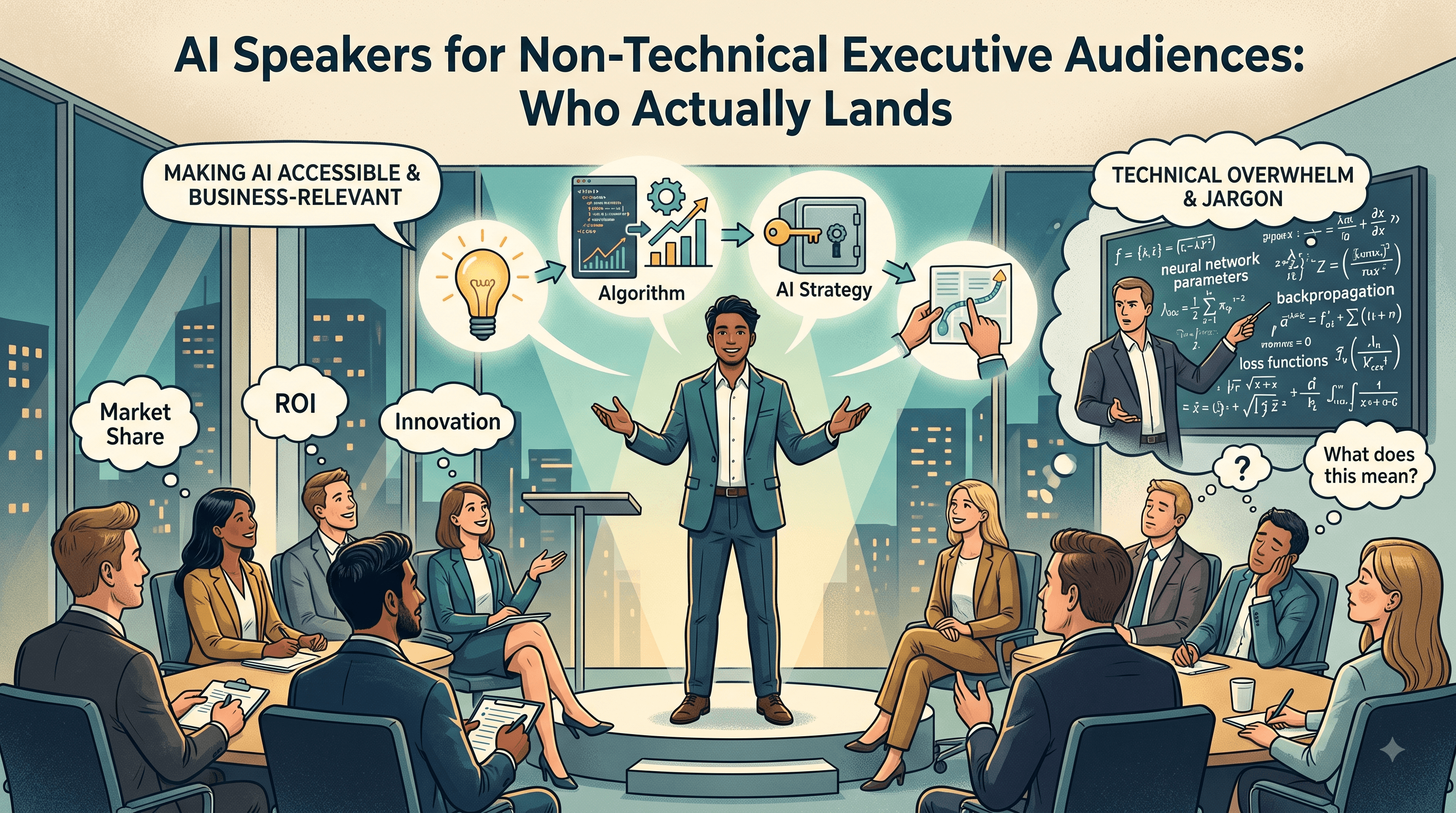
Sixty one percent of CEOs say their own boards are rushing AI transformation, with hype distorting boardroom judgment (Boston Consulting Group, 2026). That is the real state of the executive audience in 2026. They are not disengaged. They are overwhelmed, moving fast on AI while quietly unsure they understand it. Into that room walks your keynote speaker. Book the wrong one and you do not fix the problem, you make it worse, adding a layer of jargon and architecture diagrams to an audience that needed clarity and a way to decide.
This is the most common mismatch in AI event programming. The most brilliant researcher on the roster, the one whose credentials look unbeatable on paper, is often the worst possible choice for a nontechnical leadership meeting or a board offsite. Deep expertise and the ability to make that expertise land with a CFO are different skills, and they do not reliably come in the same person. The speaker who lands with a nontechnical executive audience is not the one who knows the most. It is the one who can translate.
The Difference Between a Translator and a Lecturer
A lecturer explains AI on AI's terms. A translator explains it on the audience's terms. That sounds simple, but it is the whole ballgame for a nontechnical room, and it shows up in three concrete behaviors you can look for before you ever sign a contract.
They lead with analogies, not architecture. A lecturer tells a board how a transformer model processes tokens. A translator tells them AI is like hiring a brilliant intern who has read everything but has never worked at your company: fast, capable, and in need of supervision and context. The analogy does more work in ten seconds than the architecture diagram does in ten minutes, because it connects the unfamiliar to something the audience already knows. When you preview a speaker, listen for whether they reach for the audience's world or retreat into their own.
They demonstrate, they do not just describe. The most effective AI keynotes for nontechnical audiences in 2026 include a live moment, the speaker actually using the tools on stage, showing what happens instead of asserting it. A live demo closes the gap between abstraction and reality faster than any slide can. For an audience that has heard endless claims about what AI will do, watching it happen in real time is what turns skepticism into real understanding. A lecturer shows you a chart of capabilities. A translator shows you the capability.
They frame everything as a business decision. The question a nontechnical executive is actually asking is never "how does this work?" It is "what do we do about it on Monday, what will it cost, and what is the risk if we move too slowly or too fast?" A translator builds the whole talk around that question, covering outcomes, tradeoffs, and the decisions leadership actually owns. A lecturer builds it around the technology and leaves the audience to do the translating, which they cannot. Business framing is not dumbing the content down. It is aiming the same rigor at the decision instead of the mechanism.
A fourth marker sits underneath all three. A translator reads the room and adjusts, taking questions, checking comprehension, and shifting register on the fly. That responsiveness is hard to fake and easy to spot in a recorded talk. When you are vetting a speaker for a nontechnical audience, watch how they handle a live, nonexpert crowd, not just how they perform a polished set piece.
The Translators Who Actually Land
Speak About AI tags every speaker by the audiences they are best suited for, which makes it easy to find the ones built for nontechnical, executive rooms. The five below are not the roster's most academic names. They are its best translators, and for a leadership meeting or a board that is not technical, that is exactly the point.
Cassie Kozyrkov is the translator's translator. As Google's first Chief Decision Scientist she spent years turning machine learning into decisions that nontechnical leaders could actually make, and her profile lists her as best for executive and senior leadership audiences and general business audiences alike. She is known for making complex AI concepts accessible to both. For a board that needs to understand not the algorithm but the decision the algorithm changes, she is close to a perfect fit.
Allie K. Miller pairs real enterprise AI credibility, as the former Global Head of Machine Learning for Startups and VC at Amazon, with a gift for translating complex ideas for general business audiences, grounded in her cognitive science background and the AI guidebooks she has written. She gives leadership teams a practical, no hype roadmap: what to do, in what order, without pretending the audience needs to become engineers first. That mix of authority and accessibility is rare, and it is exactly what an executive room responds to.
Charlene Li comes at AI from the leadership side rather than the technical side, which is exactly why she lands with executives. She is a New York Times bestselling author of Open Leadership and The Disruption Mindset, a Harvard MBA, and an advisor to 49 of the Fortune 100, and she frames AI as a question of disruption and leadership, of how leaders and organizations change, rather than a technical one. For a board wrestling with what AI means for strategy and culture, she speaks their native language. Listed at $30,000 to $55,000.
Alison McCauley has spent 30 years in human centered technology adoption and change management, and her bestselling book How to Think with AI is aimed squarely at nontechnical professionals. A LinkedIn Top Voice in AI whose executive education work has reached more than 100,000 learners, she focuses on the mindset shift leaders need to actually adopt AI, the human side of the transition rather than the codebase. Listed at $20,000 to $40,000, she is a natural fit for future of work and leadership audiences.
Nicky Verd is tagged, in her own profile, as best for nontechnical leadership and executive audiences. It is the center of her practice. A digital futurist and author of Disrupt Yourself or Be Disrupted, she works at the intersection of AI, people, and organizational culture, helping nontechnical leaders and workforces make sense of transformation without drowning in the technology. Listed at $20,000 to $30,000, she is built for exactly the room this article is about.
How to Book for the Room You Actually Have
The lesson is not that technical depth is bad. For a room full of engineers, the researcher who can go deep is the right call, and a translator who stays at the analogy level will underwhelm them. The point is that the audience determines the fit, and a nontechnical executive audience has one firm requirement: the speaker has to meet them where they are. The most common booking regret in this category is choosing on credentials alone and finding out too late that the most impressive résumé in the room could not make the material land.
The reliable way to avoid that is to name the audience out loud before you evaluate a single speaker. Say it plainly: this is a nontechnical board that needs to make an investment decision. Then select against that brief. That is what audience based curation is built to do, and it is why the Speak About AI leadership and business speakers page is organized around fit rather than fame.
Event planners booking an AI speaker for a leadership meeting or a board that is not technical can connect with the Speak About AI curation team at speakabout.ai. Tell us who is in the room and what they need to walk out able to do, and we will match you to a translator, not a lecturer. You can also browse the full AI speakers roster, filtered by the audiences each speaker is best suited for, to see the fit for yourself.
The best AI keynote for a nontechnical executive audience is not a compromise on substance. It is substance delivered in the audience's language, and the speakers who can do that are a specific, identifiable group. Choose from it deliberately, and the room that walked in overwhelmed walks out with a decision it can actually make.
Frequently Asked Questions
What kind of AI speaker works best for a non-technical board?
A translator, not a lecturer. The speakers who land with executive audiences lead with analogies instead of architecture, demonstrate the tools live instead of describing them, and frame everything as a business decision: what to do, what it costs, and what the risk is of moving too slowly or too fast.
Who are the best AI speakers for executive and leadership audiences?
Five proven translators: Cassie Kozyrkov (Google's first Chief Decision Scientist), Allie K. Miller (former Amazon Global Head of ML for Startups), Charlene Li (NYT bestselling author, advisor to 49 of the Fortune 100), Alison McCauley (author of How to Think with AI), and Nicky Verd (digital futurist for non-technical leadership rooms).
How do I tell whether an AI speaker will land with a non-technical audience?
Watch a recording of them in front of a live, non-expert crowd, not a polished set piece. Listen for whether they reach for the audience's world with analogies, check comprehension, and adjust on the fly. A speaker who retreats into jargon on video will do the same on your stage.