How Much Does an AI Keynote Speaker Cost in 2026? (Real Fee Data)
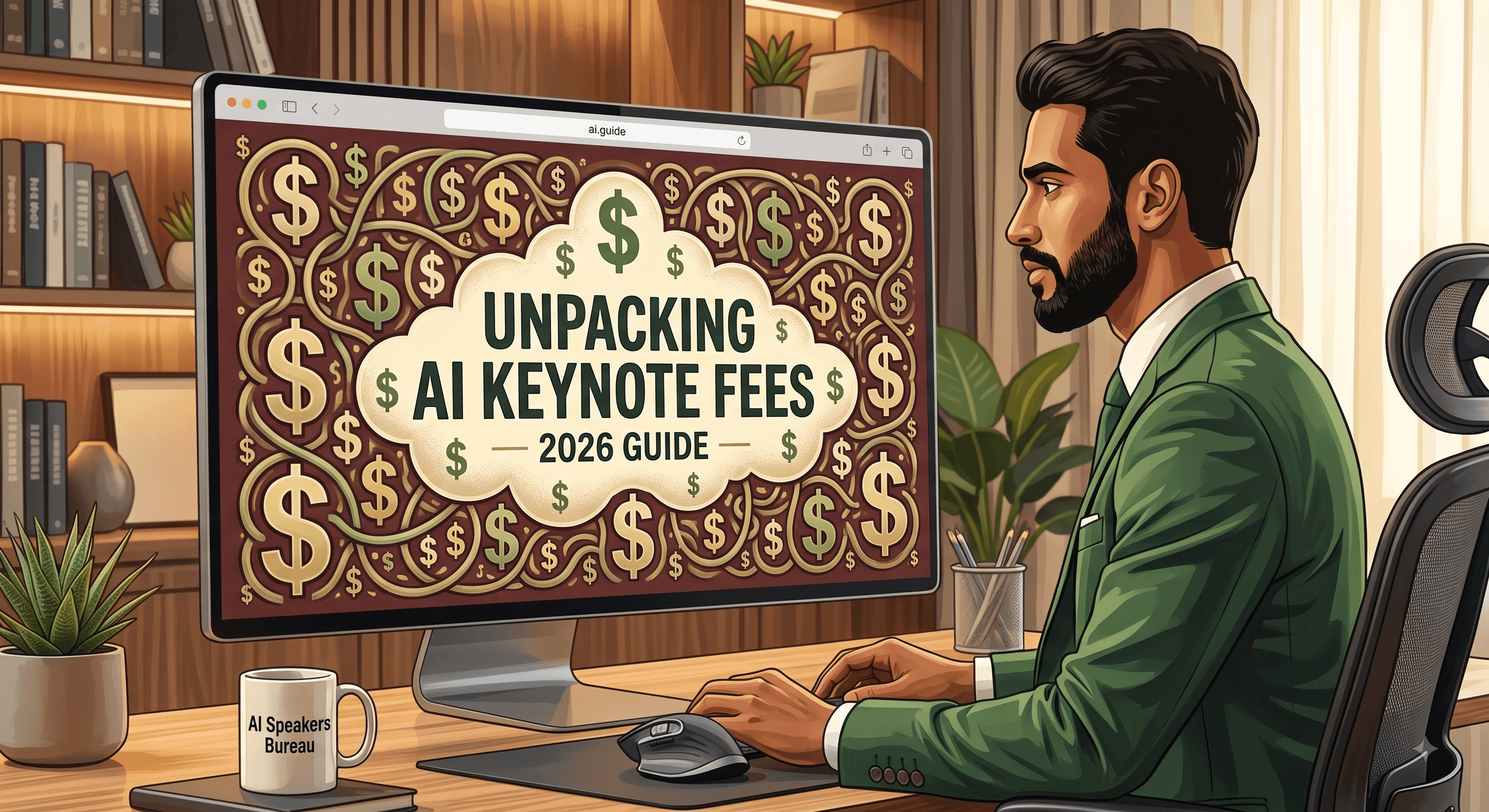
It is the first question almost every event planner asks, and the hardest one to get a straight answer to: how much does an AI keynote speaker cost? Search it and you will find fee schedules that stretch from $5,000 to $200,000, "please inquire" buttons where a number should be, and bureaus that treat pricing like a state secret until you are three emails deep. According to Speakers.com's 2026 fee schedule, general keynote fees now span four tiers, from $5,000 for emerging regional speakers to more than $200,000 for global icons, with the market rising 5% to 8% year over year. That range is technically accurate and practically useless, because it tells you what a keynote speaker costs, not what an AI keynote speaker costs, and the two are no longer the same market.
Speak About AI is one of the only bureaus that publishes actual fee ranges rather than hiding them behind an inquiry form. So instead of another "it depends" guide, here is the real data. The fee for an AI keynote speaker in 2026 falls into three clear bands, and the band is set far less by stage polish than by the depth and rarity of the expertise the speaker brings to the room.
The 2026 AI Keynote Speaker Fee Table
Here is what AI keynote speakers actually cost in 2026, based on live fee ranges from the Speak About AI roster rather than industry averages.
Speaker Tier | Typical Fee (In Person) | Who Sits Here |
Emerging experts | $15,000 to $20,000 | Rising researchers, working practitioners, and specialized academics with deep technical credibility and a growing speaking track record |
Established founders & researchers | $20,000 to $30,000 | Proven speakers with senior industry titles, published work, or founder credentials, the reliable core of most AI programs |
Marquee names | $30,000 to $65,000+ | Pioneers, recognized authorities, and household names in the field whose presence is itself a draw for attendance |
Two things are worth noticing about this table before you read another word. First, the AI market starts higher than the general keynote market. A Tier 1 general speaker in the Speakers.com schedule runs $5,000 to $10,000. The equivalent entry point for a credible AI expert is closer to $15,000, because genuine, current, hands on AI expertise is scarce and in demand. Second, the ceiling for most corporate AI programs is far lower than the celebrity keynote stratosphere. The overwhelming majority of AI keynotes booked in 2026 land between $15,000 and $50,000, not in the six figure range reserved for former world leaders and celebrity founders.
What Each Tier Actually Buys You
The temptation is to read a fee table as a quality ladder, where more money buys a better talk. That is the wrong way to think about it. The fee reflects scarcity and draw, not talk quality. A $20,000 speaker and a $50,000 speaker can both deliver an exceptional session. What you are paying for at the top of the range is name recognition that fills seats and a depth of authority that changes how the room receives the message.
The $15,000 to $20,000 emerging tier is where the value conscious planner should look first, for breakout sessions, midsize corporate events, and audiences that care more about substance than celebrity. These are working researchers and practitioners who are often closer to the technology than a marquee name who now spends most of the year on stage. They tend to be more available, more willing to customize, and more energized by a live audience.
The $20,000 to $30,000 established tier is the workhorse of a well built AI program, and it is where most planners find their best fit. Speakers here carry the titles and track records that make a stakeholder case easy to defend. On the Speak About AI roster, Mo Tiwari, a Staff Research Scientist at Google and former OpenAI technical staff, lists at $20k to $30k. So does Chris Yeh, cofounder of Blitzscaling Ventures and coauthor with Reid Hoffman. Both bring senior credibility to an audience that will fact check the resume, at a fee that clears most corporate budgets without special approval.
The $30,000 to $65,000+ marquee tier is for the moment when the speaker is the event, the opening keynote you build the marketing around, or the name that justifies the ticket price. Peter Norvig, former Director of Research at Google and one of the most cited figures in the field, lists at $20k to $50k. Daniel Kraft, the Stanford and Harvard trained physician and inventor, and Divya Chander, a neuroscientist applying AI to cognitive longevity, both sit in the $25k to $65k band. At this level you are paying for a draw that raises attendance and a level of authority that reframes how seriously the audience takes the entire program.
What Actually Moves the Number
Within any tier, the final quote moves for reasons that have nothing to do with the speaker's reputation and everything to do with the logistics of your specific event. Understanding these levers is how a planner turns a listed range into a booked number, and often how a stretch booking becomes affordable.
Virtual delivery is the biggest single discount. A virtual keynote typically commands 50% to 75% of the speaker's in person rate (Speakers.com, 2026). A speaker who lists at $30,000 in the room may deliver remotely for $18,000 to $22,000. For a tight budget, moving one anchor session to virtual can free up enough to add a second speaker entirely.
Travel and expenses sit on top of the honorarium, not inside it. Standard domestic travel adds a flat $1,500 to $3,500, and international engagements carry roughly a 50% premium on expenses (Speakers.com, 2026). A West Coast speaker for an East Coast event is a real line item, and it is one reason a geographically closer speaker at the same fee can be the better value.
Adding a workshop, panel, or breakout raises the total but lowers the cost per hour of value. Most speakers price a half day workshop or an extra breakout as an addition to the keynote fee rather than a full second engagement. If you are bringing a $25,000 speaker across the country, extending them into a hands on AI workshop the same day is usually the highest return dollar in the whole budget, because the fixed travel cost is already spent.
Timing, exclusivity, and recording rights each nudge the number. A booking six months out gives you more negotiating room than a four week scramble. Peak conference season tightens availability. And if you want to record the session for internal reuse, expect roughly a 10% to 25% premium on the honorarium (Speakers.com, 2026). None of these are large on their own. Together they explain most of the gap between a listed range and a final invoice.
Why AI Keynote Fees Run Higher Than General Keynote Fees
A recurring surprise for first time buyers is that a qualified AI speaker costs more than a general business or motivational speaker with a bigger public profile. The reason is supply. The pool of people who can speak accurately and currently about large language models, agentic systems, AI governance, and real deployment, not just narrate headlines, is small and shrinking relative to demand. Requests for AI keynotes have risen sharply year over year as every industry races to make sense of the technology, and the speakers who genuinely understand it are the same people the labs, startups, and Fortune 500 AI teams are competing to employ.
That scarcity is why a working Google research scientist commands an established tier fee while a generalist futurist with a larger following may not. In the AI category, current expertise is the asset, and current expertise is expensive because the people who have it have better paid day jobs than speaking. It is also why vetting matters more here than in any other category. A polished stage presence is easy to find. The ability to withstand a technical Q&A from an audience that builds this technology is not. Our companion guide on vetting real expertise versus stage presence covers how to tell them apart before you sign.
Getting the Most From a Budget Under $30,000
Most corporate AI keynotes are booked for under $30,000, and that is a healthy budget, not a constrained one. It covers the entire emerging tier and the majority of the established tier, which together hold the speakers most likely to deliver a substantive, well received session for a business audience. The planner who assumes AI expertise requires a six figure marquee name is usually overspending for recognition their audience did not need.
If your budget sits at or below $30,000, the move is to browse by fit rather than fame. Speak About AI maintains a curated view of AI keynote speakers available under $30,000 so you can start from the roster that matches your budget and then filter for the expertise and audience fit your event actually requires. A well matched established tier speaker at $25,000 will almost always outperform a marginal marquee booking at $45,000 for a working corporate audience, because the audience remembers what they learned, not what the speaker's fee was.
The Bureau Advantage: Why This Guidance Costs You Nothing
One point that surprises planners new to the category: working through a reputable bureau does not raise the speaker's fee. Bureaus earn a commission from the speaker's fee rather than charging the event planner a separate fee (Speakers.com, 2026). That means the fee guidance, availability checks, budget matching, and negotiation support come at no additional direct cost to you. It is the same booking and the same number, with an experienced intermediary who knows where each speaker's real number sits versus their listed range.
For an AI program specifically, that intermediary knowledge is the difference between paying a marquee fee for name recognition you did not need and finding the established tier researcher who fits the audience precisely. A specialized bureau that curates only within AI knows which speakers deliver at which price points, which ones flex their rate for virtual or off season dates, and which experts under $30,000 consistently outscore names that cost twice as much.
Event planners trying to match a real budget to the right AI keynote speaker can connect with the Speak About AI curation team at speakabout.ai. Tell us the budget and the audience, and the first conversation is about which tier actually fits your event, not which speaker happens to be the most expensive name we can put in front of you. You can also browse the full AI speakers roster, organized by expertise, industry, and fee, to see exactly where your budget lands before you ever pick up the phone.
The honest answer to "how much does an AI keynote speaker cost in 2026" is this: between $15,000 and $65,000 for nearly every event that is not chasing a household name, with most strong corporate bookings landing under $30,000. The number that matters is not the top of the range. It is the one that matches your audience to the expertise they will actually remember.
Frequently Asked Questions
How much does an AI keynote speaker cost in 2026?
Most AI keynote speakers cost between $15,000 and $65,000. Emerging experts run $15,000 to $20,000, established founders and researchers $20,000 to $30,000, and marquee names $30,000 to $65,000 or more. The majority of corporate AI keynotes are booked for under $30,000.
Do virtual AI keynotes cost less than in-person?
Yes. A virtual keynote typically commands 50% to 75% of the speaker's in-person rate, so a speaker who lists at $30,000 in the room may deliver remotely for $18,000 to $22,000. Travel and expenses also disappear from the invoice.
Why do AI keynote speakers cost more than general keynote speakers?
Supply. The pool of people who can speak accurately and currently about large language models, agentic systems, and real AI deployment is small relative to demand, and those experts have well-paid day jobs at labs and Fortune 500 AI teams. Genuine, current AI expertise starts around $15,000, versus $5,000 to $10,000 for entry-level general keynotes.
Does booking through a speaker bureau cost extra?
No. Reputable bureaus earn a commission from the speaker's fee rather than charging the event planner a separate fee, so fee guidance, availability checks, and negotiation support come at no additional direct cost to you.