
How to Book an AI Keynote Speaker: Timeline, Process, and What It's Like to Work With a Bureau
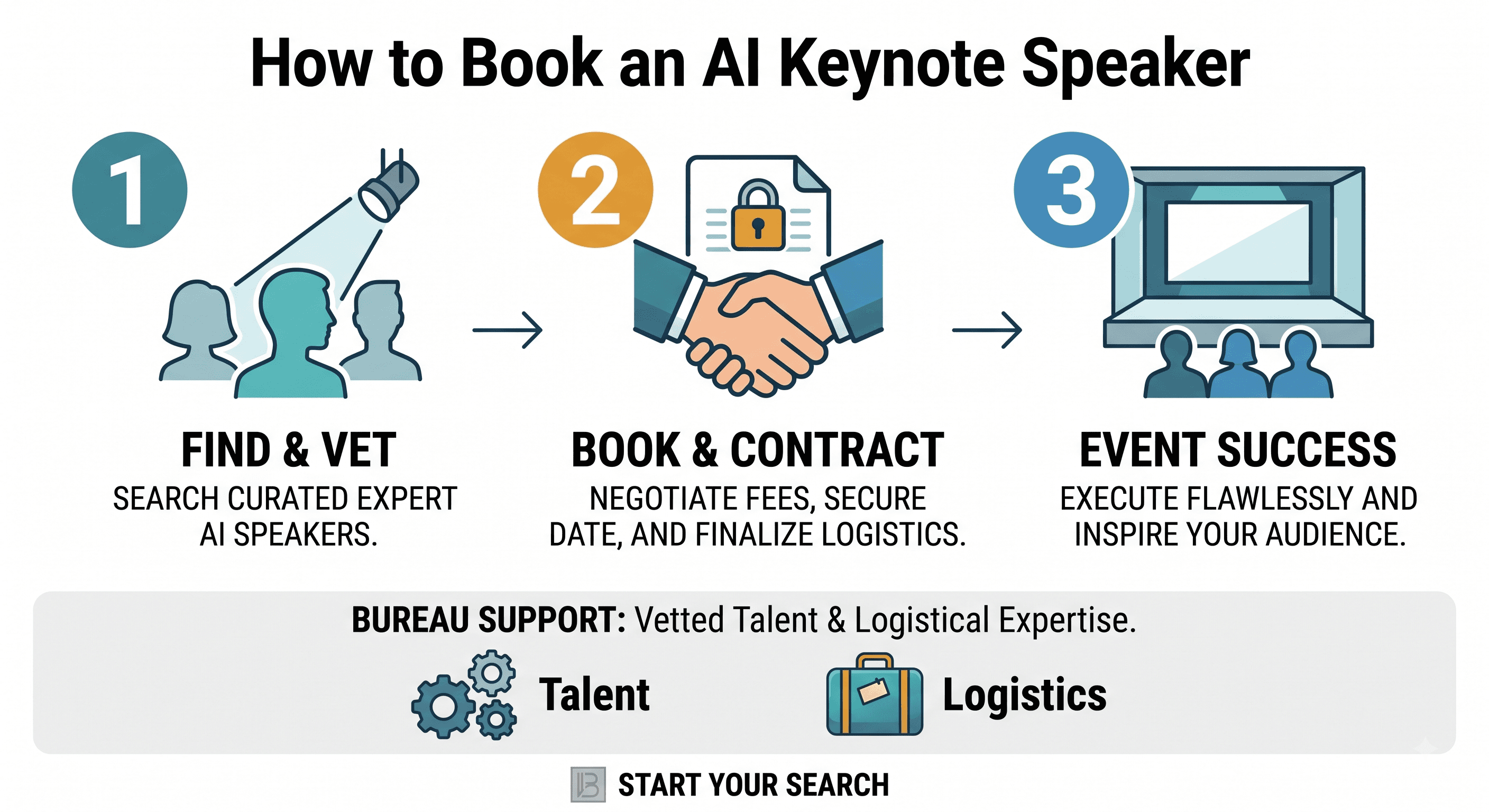
The median time from "we should book an AI speaker" to a signed contract is about 4.5 months (Talkadot, 2026). For most planners, a good chunk of that time is not spent negotiating. It is spent uncertain about how the process even works. What actually happens after you send an inquiry? How long does each step take? When do you have to commit? And what does a bureau really do that you could not do yourself with a few emails?
This guide answers all of that, start to finish, because the booking process is far less mysterious than it looks from the outside. Knowing the steps in advance is the single best way to keep an event on schedule. Below is the real sequence, the honest timelines for each stage, and a candid look at what is possible when you have six months and what is still possible when you have four weeks.
Before You Start: What Working With a Bureau Actually Costs You
The most common misconception is that going through a bureau adds a fee. It does not. Reputable bureaus are paid a commission out of the speaker's fee rather than charging the planner a separate cost (Speakers.com, 2026). The number you would pay booking a speaker directly is, in almost all cases, the same number you pay booking them through a bureau. The difference is that through the bureau you also get availability intelligence, fee guidance, contract handling, and a single point of contact who does this every day. For a busy planner, that is help at no additional direct cost, which is why the process below is worth understanding as a partnership rather than a transaction.
Step 1: The Inquiry (Time: Minutes, but Do It Well)
Everything starts with an inquiry, and the quality of your inquiry sets the pace for everything after it. A vague "how much is Speaker X?" gets a slower, less useful answer than a specific brief. The five details that make the whole process faster are your event date or window, your location and format (in person, virtual, or hybrid), your audience (who they are and roughly how many), your objective (what the audience should think, feel, or do differently afterward), and your budget range.
That last one is not a trap. Sharing a budget helps the bureau point you at speakers who actually fit, instead of burning a week on someone out of range. In 2026, 68% of keynote requests now begin with a business objective rather than a name (Motivational Speakers Agency, 2026), and that is exactly the right instinct. The more you lead with the outcome, the better the match. If you are still shaping the audience case internally, our guide on building a speaker case your stakeholders cannot argue with helps you arrive at the inquiry already aligned.
Step 2: The Availability Check (Time: 24 to 72 Hours)
Once the bureau understands your date and shortlist, the next step is confirming who is actually available. This is where a bureau earns its keep early. A speaker's public calendar rarely reflects reality, and "available" can mean anything from fully open to holding a tentative date for another client. The bureau checks real availability, identifies who can genuinely make your date, and often surfaces strong alternatives you would not have found on your own, speakers in the same lane whose fee, style, or audience fit is a better match than your original pick.
For most professional AI speakers this confirmation comes back within a day or two. During peak season, meaning Q1 and the September through November stretch, it can be faster in the sense that the answer is often simply "already booked," which is exactly why early inquiries matter so much.
Step 3: The Quote (Time: 1 to 3 Days)
With availability confirmed, you get a quote. A complete quote is more than the honorarium. It includes the speaking fee, travel and expenses (typically a flat domestic amount, more for international), and any extras you have asked about, such as a workshop, a panel, an extended Q&A, or recording rights. A good bureau breaks these out clearly so you can see where the money goes and where you have room to flex. Moving a session to virtual, for example, usually reduces the fee substantially, and bundling a same day workshop lowers your cost per hour of the speaker's time.
Because the bureau knows where each speaker's real number sits versus their listed range, this is also the stage where realistic negotiation happens. You are not haggling in the dark. You have someone who books this speaker regularly advising on what is and is not movable.
Step 4: The Contract (Time: 1 to 2 Weeks to Execute)
Once you approve the quote, the agreement is drawn up. The contract covers the fee and payment schedule (usually a deposit to secure the date and the balance around the event), travel and AV requirements, cancellation and force majeure terms, recording and content use rights, and the specifics of the deliverable, meaning talk length, format, and any customization commitments. This is the stage where working with a bureau quietly saves you the most grief, because the contracting details that planners most often overlook are the ones the bureau handles as routine.
The paperwork itself moves quickly. The variable is your own internal approval and procurement process. Building in one to two weeks here is realistic, and it is the reason to start earlier than you think you need to. The speaker is not fully secured until the contract is signed and the deposit is paid.
Step 5: The Prep Call (Time: 2 to 4 Weeks Before the Event)
A booked speaker is not the finish line. The prep call is where a good keynote becomes a great one. Two to four weeks out, the speaker and the planner, often with the bureau facilitating, align on the details that determine whether the talk lands: who exactly is in the audience and what they care about, the specific objective for the session, the organization's language and context, what came before and after in the agenda, and any sensitivities to navigate. This is when a speaker tailors examples, adjusts technical depth, and shapes the talk to your event rather than delivering a generic version of it.
Do not skip or shortchange this call. The difference between a speaker who mentions your industry and one who clearly understands your specific challenge is almost always made here, and compressed timelines that squeeze this stage are where late bookings quietly lose their value.
Step 6: The Event (and the Day After)
On the day, the logistics are straightforward when the earlier steps were done well. The run of show, AV check, timing, and any meet and greet or Q&A are confirmed in advance, and the bureau remains a point of contact if anything shifts. The speaker delivers, and for the planners who get the most from their investment, the relationship does not end at the closing applause. A quick post event debrief captures what worked, and any agreed recording or content assets are delivered for internal reuse, extending the value of the booking well past the event itself.
The Honest Timeline: Six Months vs. Four Weeks
Here is the guidance the industry data supports, stated plainly.
Book professional AI speakers in the $15,000 to $50,000 range at least three to six months out. High demand names, meaning bestselling authors, former executives, and the marquee tier, need six to twelve months, and globally recognized figures can require twelve to eighteen months. During peak seasons, availability is routinely exhausted up to a year in advance, so a spring or fall event should begin its search the prior year. Booking early does not just secure the speaker. It protects every downstream stage, especially the customization and prep that make the talk work.
So what about four weeks out? It is possible, and this is exactly where a bureau's relationships change the math. A bureau can move faster than a cold outreach because it knows who is genuinely open, can reach speakers and their teams directly, and can compress the availability to contract sequence into days. But be honest with yourself about the tradeoffs. A short timeline means a narrower pool, since the best fit speaker may already be booked. It usually means a rush premium of 10% to 30% on the fee (Talkadot, 2026). And it leaves less runway for the prep call that tailors the talk. A rushed booking can absolutely still be a great event. It simply asks you to accept a smaller menu and a higher price for the speed. If you want the full reasoning on why lead time matters so much, our deep dive on why late speaker searches fail lays it out.
Why Go Through a Bureau at All
You can book a speaker directly. Plenty of planners do. But the process above has a dozen small places to lose time or money: a public calendar that is wrong, a quote that omits travel, a contract missing a recording clause, a prep call that never gets scheduled. A specialized bureau exists to close every one of those gaps. When the bureau focuses exclusively on AI, that advantage compounds. It knows which speakers are genuinely current versus coasting on a two year old talk, which ones fit a nontechnical board versus a room of engineers, and which under the radar experts will outperform a more famous name for your specific audience. All of that, again, at no additional direct cost to you.
Event planners ready to start, whether your event is six months out or four weeks away, can connect with the Speak About AI curation team at [speakabout.ai](https://speakabout.ai/contact). Send the five details from Step 1 and you will get a real availability check and a straight quote, fast. You can also browse the full AI speakers roster to build your shortlist before you reach out.
Booking an AI keynote speaker is not complicated once you can see the whole path: inquiry, availability, quote, contract, prep, event. Start early enough to walk it without rushing, lead with your objective rather than a name, and lean on the people who run this process every day. Do that, and the speaker on your stage will be the right one, booked calmly, at the right price, and fully prepared for your room.
Frequently Asked Questions
How far in advance should I book an AI keynote speaker?
Book professional AI speakers in the $15,000 to $50,000 range at least three to six months out. High-demand names need six to twelve months, and globally recognized figures can require twelve to eighteen. During peak seasons (Q1 and September through November), availability is routinely exhausted up to a year in advance.
What are the steps to book an AI keynote speaker?
Six steps: a detailed inquiry (date, format, audience, objective, budget), an availability check (24 to 72 hours), a quote (1 to 3 days), the contract (1 to 2 weeks to execute), a prep call (2 to 4 weeks before the event), and the event itself with a post-event debrief.
Can I still book an AI speaker four weeks before my event?
Yes, especially through a bureau that knows who is genuinely open and can compress availability-to-contract into days. Expect tradeoffs: a narrower pool, a rush premium of roughly 10% to 30% on the fee, and less runway for the prep call that tailors the talk.
Does working with a speaker bureau add a fee?
No. Reputable bureaus are paid a commission out of the speaker's fee rather than charging the planner separately. The number you would pay booking directly is, in almost all cases, the same number through the bureau, with availability intelligence, fee guidance, and contract handling included.