
How to Build a Speaker Case Your Stakeholders Cannot Argue With
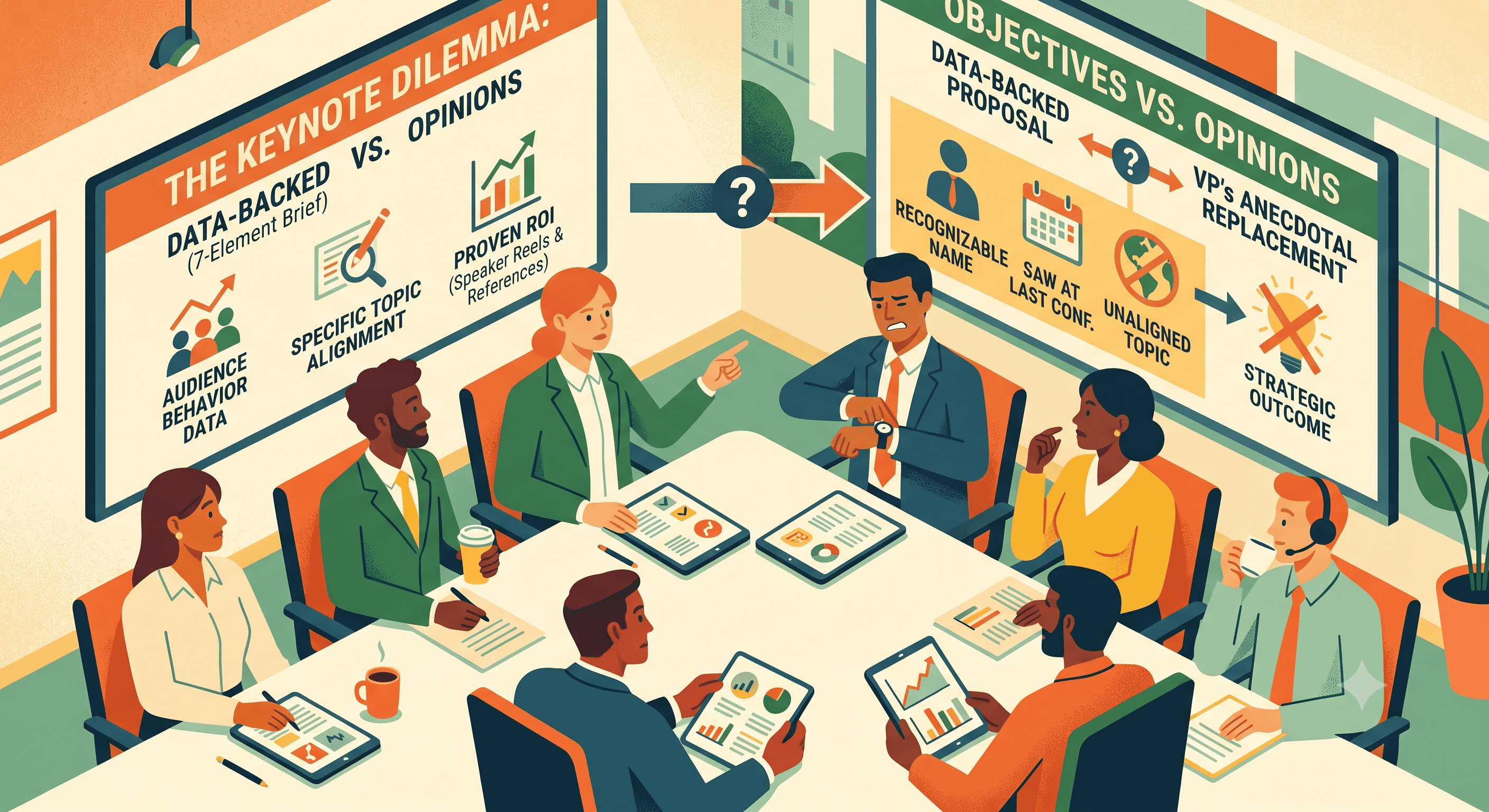
You did the research. You found the right speaker. You built the shortlist, checked the references, watched the reels, and aligned the topic to the event objective. Then a senior VP walked into the approval meeting, mentioned someone they saw at a conference last quarter, and the conversation shifted in a direction you could not recover from.
This is not a rare experience. It is the most common and most demoralizing failure mode in corporate event planning, and it has almost nothing to do with the quality of your recommendation. It has everything to do with how that recommendation was packaged and presented to the people who had the authority to override it.
The 2026 Keynote Speaking Trends Report from The Motivational Speakers Agency, based on analysis of 1,568 UK events, found that 68% of keynote requests now begin with a business objective before a speaker name is mentioned. That is a meaningful shift. But the data point masks a structural problem that the industry has not fully addressed: even when planners start with the right objective, the internal approval process frequently collapses the quality of that decision. A stakeholder substitutes a familiar name. Procurement challenges a five-figure fee without context for what it delivers. A senior leader questions whether the topic is right for the audience, and without a framework to resolve the disagreement, the recommendation loses.
The most costly speaker selection mistake in 2026 is not choosing the wrong speaker. It is choosing the right speaker and failing to defend that choice with a brief that makes the case too clearly to be overruled.
Why Great Speaker Recommendations Die in Committee
Speaker recommendations collapse in committee when they are framed as preferences rather than evidence-based decisions. A planner who says "I think this speaker would be great for our audience" is inviting disagreement. A planner who says "here is the audience we are serving, here is the behavioral outcome we need, and here is why this specific speaker is the only profile that serves both" is presenting a decision, not a preference.
The distinction matters because internal approval processes are not rational by default. They are political, time-pressured, and vulnerable to the loudest voice in the room. A speaker brief is not a logistics document. It is a persuasion document. The event planner who treats it as a form to fill out will lose internal battles that the planner who treats it as a strategic argument will win consistently.
The three most common internal approval failure modes each have a specific cause and a specific solution:
The name substitution happens when a stakeholder replaces the recommended speaker with someone they already know. It occurs because the recommendation was not anchored to criteria that are harder to override than personal familiarity. The fee objection happens when procurement challenges the honorarium without context for what it delivers. It occurs because the fee was presented as a total cost rather than a cost-per-outcome. The relevance challenge happens when a senior leader questions whether the topic is right for the audience, and there is no data in the room to resolve the disagreement. It occurs because the brief did not define the audience's readiness level before recommending the speaker.
Each of these failure modes is preventable. The prevention is structural, not interpersonal.
Consider this scenario: an L&D leader at a 600-person financial services company recommends a highly credentialed speaker whose track record directly matches the audience and event goal. Without a structured brief, the recommendation gets replaced by a well-known general business speaker with no relevant subject depth because a senior VP has seen that person before. With the right brief, the L&D leader demonstrates who the audience is, what the primary event objective is, and why only a speaker with that specific profile addresses both. The substitution becomes logically indefensible because the brief has already answered every question the substitution would need to satisfy.
The Seven-Element Speaker Brief That Survives Stakeholder Scrutiny
The Motivational Speakers Agency found that 54% of recent corporate keynote briefs referenced audience engagement, internal communication, or post-event value as part of the booking requirement. Sophisticated buyers have already shifted to outcome framing. The planners who have not made that shift are the ones whose recommendations are most vulnerable to override.
Here is the framework that closes that gap.
Element 1: Audience Readiness and Context. State explicitly who the audience is and where they are relative to the event's subject. Use a defined framework: awareness, familiarity, or active application. A brief that reads "our leadership team has already run three internal initiatives in this area and hired a dedicated lead" is not an opinion. It is a fact that constrains the speaker options to a specific profile. This single element does more work than any other part of the brief because it converts a subjective topic choice into an objective audience diagnosis.
Element 2: The Primary Event Objective. Distinguish between inspire, educate, and activate as the governing event goal. An audience that needs to be activated toward a specific change requires a fundamentally different speaker than an audience that needs to be educated on a topic for the first time. Conflating these creates a vague recommendation that is easy to challenge. Stating them precisely makes the speaker choice feel inevitable rather than arbitrary.
Element 3: The One Behavioral Change. Define the single behavior the organization wants to see in the 30 days following the event. This forces the planner to think like a business stakeholder rather than an event professional, and it gives every other stakeholder a shared success criterion that replaces subjective debate with a concrete target. The Motivational Speakers Agency found that 46% of recent briefs asked for a speaker who could connect their subject to practical workplace behavior. That expectation is now industry standard, and a brief that does not address it is already behind.
Element 4: The Speaker Profile Rationale. Explain why the specific speaker type is the correct match for the audience and event objective. A strategic-foresight speaker whose published research is used by executives as a planning tool is a strong profile for awareness-stage audiences. A hands-on practitioner-educator whose credibility comes from doing the work fits audiences beginning real adoption. For audiences deep into implementation, a leadership and culture specialist addresses the organizational-change challenges that pure subject-matter speakers miss. You can explore Speak About AI's curated roster of vetted speakers organized by audience, event type, and organizational readiness to see how this matching logic works in practice.
Element 5: The Fee Justification Layer. Present the speaker fee as a cost-per-outcome, not a total honorarium. A $25,000 fee for a 500-person leadership summit is $50 per attendee, which is less than the cost of a business lunch when framed correctly. Premier keynote talent accounts for approximately 20% of the total event production budget, a proportion that is consistent across event tiers. A brief that surfaces this context in advance prevents the fee objection from arriving as a surprise.
Element 6: The Customization Commitment. Document what the speaker will do before the event to tailor their content to the specific audience. A speaker who conducts executive interviews before every engagement and builds content around the organization's specific challenges is not delivering a speech. They are delivering a strategic session that no generic speaker can replicate. This element neutralizes the name substitution failure mode directly: a stakeholder cannot replace a recommended speaker who has already committed to a specific pre-event customization process with a speaker who has not.
Element 7: The Post-Event Value Plan. Describe how the keynote extends beyond the 60 minutes on stage. The Motivational Speakers Agency found that 41% of recent speaker briefs referenced interaction, audience participation, follow-on content, or internal use after the event. Bizzabo's 2026 research found that 95% of respondents consider experiential learning important. A brief that includes recording rights, internal replay sessions, and a one-page framework summary for teams who were not in the room signals that the planner is treating the keynote as a strategic investment, not an event moment.
The Name Substitution Problem and How the Brief Solves It
The name substitution deserves direct attention because it is the most emotionally charged internal approval problem, and the most damaging. When a senior stakeholder substitutes their preferred speaker for the planner's recommendation, it is rarely because they have better information. It is almost always because the recommendation was not anchored to criteria that are harder to override than personal familiarity.
The structural solution is to make the brief's selection criteria explicit enough that any substitution requires the stakeholder to argue against the audience, event objective, and behavioral outcome rather than against the speaker's name. A brief that says "we are recommending this speaker because they specialize in this audience's specific challenge and have delivered this content to comparable organizations" creates a burden of proof that a name substitution rarely meets.
Cvent's 2026 event trends report notes that audiences are becoming more selective about the events they attend, and that events are being shaped by intentionality, relevance, and measurable outcomes. This shift gives planners with outcome-anchored briefs a structural advantage over stakeholders operating from intuition or familiarity.
When a substitution is proposed in real time, the response that works is not "I think our recommendation is better." The response that works is: "What specific aspect of our audience's challenge does your suggestion address that our recommendation does not?" That question redirects the conversation from preference to criteria, and criteria-based conversations almost always favor the planner who built the brief.
There is also a booking window dimension to this problem. Top speakers are booking six to twelve months in advance, with peak seasons from September through November and January through March filling fastest. A late substitution does not just risk audience misalignment. It risks being locked out of the speakers most qualified to address the audience's actual needs, leaving the planner to choose from a pool that was already narrowed by the delay.
Converting the Fee Objection from a Budget Problem to a Framing Problem
The fee objection almost always reflects a framing problem rather than a budget problem. Most bureaus operate on a commission structure paid by the speaker rather than the client, typically in the range of 20% to 25%, which means the planner receives consulting, vetting, and coordination support at no additional direct cost. Reframing the bureau relationship from a fee-adding intermediary to a cost-neutral risk reduction layer is an argument that survives most procurement conversations.
The false economy of the fee objection is worth naming directly. A $25,000 audience-matched speaker replaced by a $15,000 general speaker to save $10,000 risks spending $15,000 on a session that the audience disengages from within the first ten minutes. That is not a budget-conscious choice. It is the most expensive possible outcome: a high fee tier combined with the lowest audience relevance, producing a session that cannot be justified in post-event review.
A brief that proactively addresses the total cost structure, including recording and distribution rights that must be negotiated upfront, prevents the second wave of fee objections that derail implementations rather than selections.
When the Brief Becomes the Competitive Advantage
A well-constructed speaker brief does more than prevent internal approval problems. It positions the event planner as a strategic partner rather than a logistics coordinator. The questions that define a serious brief in 2026 are "why this topic, why this speaker, why now, and what should the audience do with it." That framing forces planners to anchor the brief in outcomes rather than logistics, which is exactly the shift that earns sustained stakeholder confidence.
The compounding effect is real. When a planner builds a brief that survives scrutiny, they establish a standard for every subsequent booking. The next recommendation arrives with the same framework, the same criteria, and the same stakeholder confidence, creating an institutional pattern that reduces approval friction over time.
A specialized bureau accelerates this process. A generalist bureau may represent thousands of speakers across dozens of unrelated topics. A specialized bureau curates deeply within a defined space, meaning the matching intelligence is deeper, the vetting is more granular, and the audience alignment is more reliably accurate. For planners working in the AI and technology space, the Speak About AI curation team at speakabout.ai builds every recommendation around the client's specific approval context, not just the speaker's current availability or social media following. The first conversation is always about the audience, the brief, and the stakeholders who need to say yes.
The One-Page Brief Template for High-Stakes Approvals
Here is the anatomy of a brief structured for stakeholder approval rather than internal record-keeping:
- Audience readiness and context with supporting evidence of where the audience currently sits relative to the topic
- Primary event objective stated as inspire, educate, or activate
- The one behavioral change targeted in the 30 days post-event
- Speaker profile rationale tied directly to the audience readiness and event objective
- Recommended speaker with specific credentialing tied to the audience's current challenge
- Fee justification framed as cost-per-outcome rather than total honorarium
- Customization commitment from the speaker, including pre-event research or interviews
- Post-event value plan including distribution rights and follow-on use
Every element should be written to answer the question a skeptical senior leader would ask, not the question a satisfied event planner would ask. The difference is the difference between a brief that invites agreement and a brief that invites collaboration.
The contrast between a weak brief and a strong brief for the same event makes this concrete. A weak brief says: "We recommend a keynote speaker for our annual leadership summit to educate our team about the future of work." A strong brief says: "Our 400-person leadership audience has already completed two internal initiatives in this area and is entering the restructuring phase. We need a speaker who addresses organizational culture and change management in the context of implementation, not introduction. We recommend this speaker because their practitioner background in leading organizations through this exact phase directly matches our audience's current challenge, and their pre-event executive interview process ensures the content addresses our specific organizational context rather than a generic narrative."
The most strategically sophisticated organizations in 2026 are treating the keynote not as a standalone event moment but as the opening chapter of a longer internal change narrative. The brief that earns approval for the right speaker is the same brief that defines the measurement framework, the post-event communication plan, and the criteria for the following year's selection. That makes it not just an approval document but a strategic planning tool.
Event planners who want to arrive at their next internal approval meeting with a speaker recommendation already structured around audience, event objective, and outcome alignment can connect with the Speak About AI curation team at speakabout.ai. Every engagement begins with the audience, the brief, and the approval context, delivering a recommendation that arrives pre-justified rather than pre-defended.