
Hybrid Keynote Speaker Selection: Serving Two Audiences With Equal Intentionality
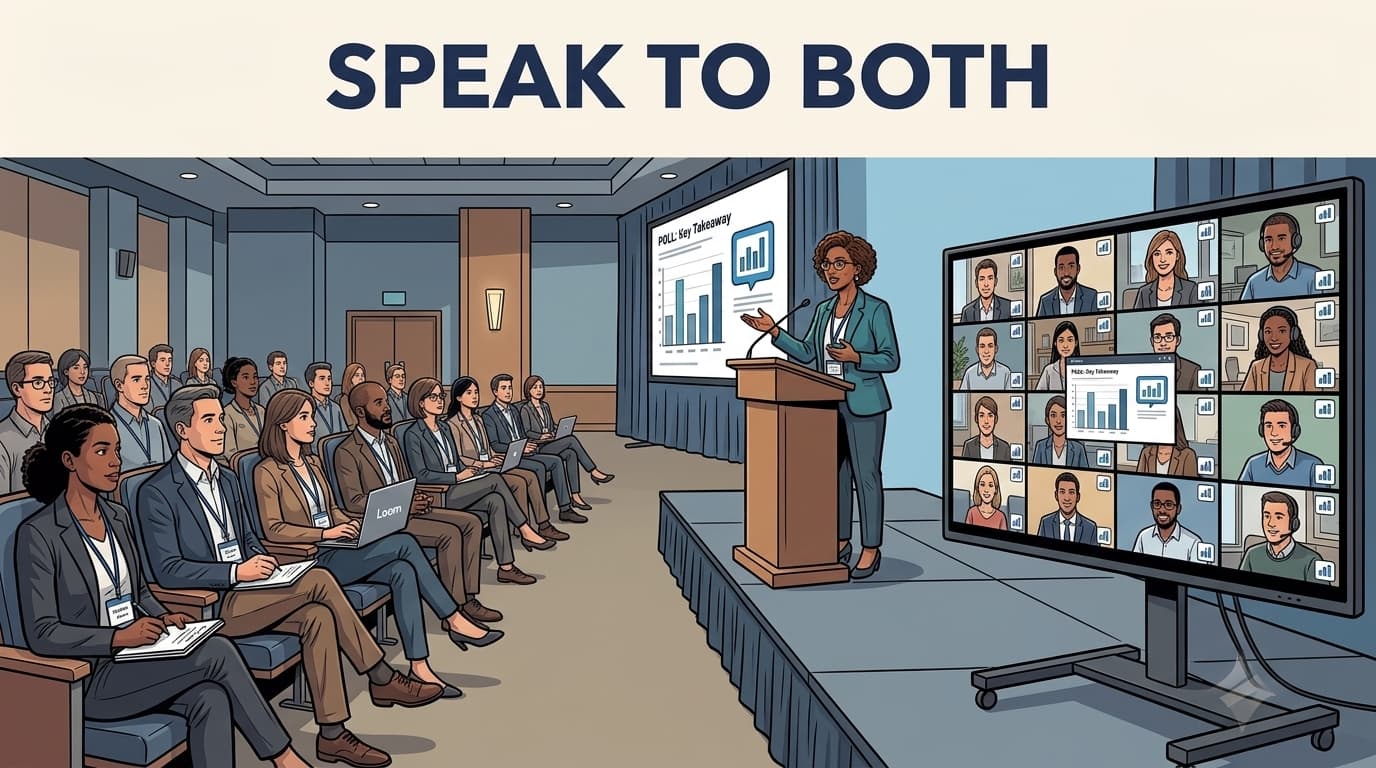
You have invested in broadcast-grade cameras, a dedicated streaming platform, a virtual host, and an AV crew that could staff a network television production. Your remote attendees log in to find clean video and clear audio. And then, 12 minutes into the opening keynote, your post-event survey data tells you the same story it told last year: in-room attendees rated the session 4.7 out of 5. Remote attendees rated it 3.4. The gap is not a production problem. It never was.
By 2026, hybrid events have moved from pandemic accommodation to industry default. Over 70% of events now include a virtual attendance option, according to Skift Meetings, a figure that represents a near-complete reversal from the under-20% baseline that existed before 2020. Seventy-six percent of organizers report growing demand for hybrid formats, and the global virtual events market is projected to reach $657 billion by 2030, growing at a 23.7% CAGR. The infrastructure investment has followed. What has not followed, in most organizations, is a speaker selection framework built around the reality that hybrid is now the default format and not a technical afterthought.
The most persistent failure mode in hybrid conference programming is the speaker. Not the technology. The speaker.
Why Hybrid Is a Speaker Selection Variable, Not Just a Technical One
Here is the core reframe that changes how sophisticated event planners approach hybrid programming: your venue's AV infrastructure, streaming platform, and camera configuration determine whether remote attendees can see and hear the speaker. The speaker's content architecture, interaction design, and energy management determine whether remote attendees are actually engaged. These are separate variables, and most hybrid event planning addresses only the first one.
A presenter whose entire performance architecture is built around reading a live room, feeding off physical energy, and holding a crowd through presence alone is not delivering a hybrid keynote. They are delivering an in-person keynote that is being livestreamed to an audience it was never designed for. Research from PCMA consistently shows that remote attendee satisfaction drops significantly when virtual engagement is not built into the event design from the start rather than layered on afterward. That design responsibility begins with the speaker, not the production crew.
The two-audience design principle is simple to state and genuinely difficult to execute: a successful hybrid event treats the conference as a single cohesive experience for two distinct audiences rather than as an in-person event with a streaming option attached. A speaker selected without this principle in mind is a structural problem. And structural problems do not get solved during load-in.
The planner who adds hybrid delivery as a single yes-or-no checkbox at the end of the vetting process is not vetting for hybrid at all. They are hoping that a strong in-person speaker will translate, and the data on remote attendee satisfaction does not support that hope.
The Hybrid Speaker Profile: What to Look For Before the Contract
There are five hybrid-specific speaker attributes that should be evaluated before any booking is confirmed, and none of them appear on a standard speaker vetting checklist.
Structured interaction design. The speaker builds audience participation into the content architecture rather than improvising it. Interaction that is designed in advance can be executed simultaneously for both audiences. Interaction that is improvised almost always defaults to the in-room audience.
Camera-anchored delivery. The speaker can hold direct camera presence without sacrificing room energy. This is a specific skill, and it is visible on a virtual demo reel within the first three minutes. A speaker who reads their slides or addresses the physical room while the camera captures their profile is not camera-anchored.
Format flexibility. The speaker has demonstrated performance in fireside, panel, and traditional keynote formats across both virtual and in-person environments. Elite planners in 2026 evaluate consistency across three distinct formats: a full-length live keynote, a spontaneous Q&A session, and a high-quality virtual engagement. For hybrid events, the virtual engagement review is not optional.
Pacing discipline. The speaker manages session pacing with awareness that remote attention cycles are shorter than in-room attention cycles. A 60-minute keynote designed for a ballroom audience will hold in-room attention through room energy and social dynamics. It will not hold remote attention through the same mechanisms, because those mechanisms do not exist on the other side of a screen.
Content segmentation. The speaker structures content in discrete, clearly signaled segments that allow remote attendees to re-engage after a momentary distraction without losing the thread. This is a content architecture decision, not a presentation style preference.
The interaction design dimension deserves particular attention because it is the highest-stakes hybrid variable. Tools like Slido or Mentimeter, displayed simultaneously on the venue screen and the virtual platform, create the shared participation experience that tells both cohorts they are part of one conversation. Consider what happens when that design is absent: at a technology company's hybrid annual kickoff, two speakers presented back to back. The first used Slido polls triggered simultaneously for both audiences at three designated windows, with results displayed on both the venue screen and the virtual platform. The second used a physical show-of-hands exercise and a room-based table discussion. Remote attendee drop-off during the second session was 34% higher than during the first. The interaction design difference, not the content quality, drove the engagement gap.
The pre-booking vetting call should include a direct question about the speaker's approach to managing dual-audience energy. A specific answer is the qualifying response. A general assurance is not.
The Briefing Difference: How the Hybrid Speaker Brief Diverges from the Standard Brief
The Freeman Trends Report found that 64% of event attendees identify keynote sessions as the most influential element of a conference. That influence potential applies to both audiences in a hybrid event. When the remote audience experiences a keynote that was not briefed or designed for their participation, that influence gap is not a production failure. It is a planning failure that begins at the speaker selection and briefing stage.
A hybrid-specific brief goes substantially beyond the standard audience profile and event objective. It must include:
- The remote audience's demographic and technical profile. Device type, connection environment, time zone distribution, and expected concurrent attendance versus on-demand viewing. A speaker presenting to 700 remote participants across four time zones needs to know that before they write their opening.
- The interaction tools that will be active during the session. Whether the speaker is expected to trigger them or the virtual host manages them, and the exact timing of the designated engagement windows.
- The camera configuration and stage boundaries. The speaker's physical performance space is defined by what the camera can capture. A speaker who does not know this will discover it during the session, when the production team is already managing a live stream.
- The pacing contract. Session length, hard breaks, and the designated interaction windows are not suggestions. They are the architecture of the remote audience's experience.
- The content segmentation expectation. How the speaker will signal transitions for remote viewers who cannot read room energy cues.
- The content objective. The single behavioral or attitudinal outcome the event is designed to produce in both audiences simultaneously.
The real-world contrast between briefed and unbriefed hybrid keynotes is measurable. A national insurance company programmed a hybrid leadership summit with 400 in-room attendees and 600 remote participants. The opening keynote speaker was highly credentialed and delivered a physically dynamic, room-reading performance that generated strong in-room energy. Remote satisfaction scores came in 22 points below in-room scores. Post-event analysis revealed that the speaker had no interaction design for the remote audience, no camera-anchored delivery discipline, and no awareness of the virtual host's role. The speaker was not the problem. The selection and briefing process was.
Compare that to a global technology company that programmed a hybrid leadership summit with 300 in-room attendees and 700 remote participants across four time zones. The opening keynote speaker was briefed with a full remote audience profile, a Slido interaction script aligned to three designated engagement windows, a stage map defining the camera-optimal delivery zone, and a 45-minute pacing framework with two hard content breaks. Remote satisfaction scores matched in-room scores within three percentage points. The briefing closed the gap. Not the production technology.
A mandatory pre-event technical rehearsal is not a courtesy. It is a contractual requirement that must appear in the speaker agreement before the contract is signed.
Venue Selection and Speaker Compatibility: The Overlooked Intersection
Most hybrid event planners address the venue-speaker compatibility question too late. The speaker's delivery style must be compatible with the venue's hybrid infrastructure, and this compatibility check must happen before the venue contract is signed.
A financial services firm selected a speaker known for wide-stage movement and intimate audience proximity for a hybrid event in a converted hotel ballroom with a single fixed camera angle. The in-room experience was strong. Remote viewers received a narrow, partially obscured frame for 40 of the session's 60 minutes. The speaker's virtual score was the lowest of any session despite the highest in-room score. That is a compatibility failure that a venue-speaker alignment review would have prevented.
A hybrid-ready venue in 2026 should be judged by what remote attendees will actually see, hear, and do, not by how impressive the physical space appears in site visit photos. The specific infrastructure requirements include multiple camera angles, clean stage lighting, speaker confidence monitors, reliable hardline internet, and isolated audio. Dedicated symmetric internet at 100 Mbps or higher is the current standard for events with 100 or more attendees who are streaming, presenting, or running video calls.
AV typically takes 10 to 15% of the total event budget. For a 300-person, three-day corporate conference with breakouts, professional AV alone can reach $25,000 to $50,000. Hybrid formats save roughly 40% on venue and travel costs compared to an equivalent all-in-person event, but that saving is returned in production premium and platform fees. A speaker whose technical rider is incompatible with the venue's hybrid capability is a budget risk that surfaces at the worst possible moment: during technical rehearsal, 24 hours before the event.
The Bureau Advantage in Hybrid Speaker Selection
A bureau's active knowledge of which speakers have genuine hybrid delivery experience, versus which speakers have added hybrid availability to their website without substantive format adjustment, is intelligence that online research cannot reliably surface. A highlight reel looks identical whether the speaker has delivered to 500 remote attendees or to a single in-studio camera.
Professional bureaus operate on a commission paid by the speaker rather than the client, making bureau support cost-neutral for the planner. For a hybrid event with complex dual-audience requirements, this cost-neutral support includes the hybrid-specific vetting layer: review of virtual engagement demos, confirmation of interactive tool compatibility, and technical rider alignment with venue infrastructure. A direct-booking process does not systematically include any of these.
A generalist bureau representing hundreds of speakers across dozens of unrelated topics provides broad access but limited depth on hybrid delivery performance. A specialized bureau that has placed speakers in hybrid environments for comparable audience profiles has direct knowledge of which speakers' satisfaction scores hold across both audiences and which show the in-room-versus-remote gap.
Event planners designing a hybrid conference who want to start with a speaker recommendation already vetted for dual-audience delivery, matched to their in-room and remote audience profiles, and calibrated to their event's technical environment can connect with the Speak About AI curation team at [speakabout.ai](https://speakabout.ai). Every hybrid speaker recommendation begins with the event format, the audience split, and the technical infrastructure, not the speaker's general availability or claimed hybrid experience.
Hybrid keynote contracts in 2026 must address recording and distribution rights for the remote audience stream, technical rider requirements specific to the hybrid format, the speaker's obligations for pre-event technical rehearsal, and the interaction design commitments the speaker is making for both audiences. A bureau experienced in hybrid engagements will surface these contractual requirements proactively. A direct-booking process will frequently discover them after the contract is signed, when negotiating leverage is gone.
Building the Dual-Audience Benchmark Into Your Post-Event Evaluation
The right question to evaluate a hybrid speaker booking is not whether the in-room audience gave high scores. It is whether the remote audience gave comparable scores. A planner who builds this benchmark into the post-event evaluation process, and who shares it with the speaker during the briefing, is setting a standard that shapes the speaker's preparation in ways that a general-satisfaction evaluation does not.
The most strategically sophisticated organizations in 2026 are treating the hybrid keynote as the anchor of a multi-channel content strategy: a session designed to serve in-room attendees, remote attendees, on-demand viewers, and internal replay audiences simultaneously. New revenue models are emerging around virtual ticketing, on-demand content libraries, and digital sponsorships. The speaker who can serve a dual audience is not just solving a programming problem. They are the asset that enables the content monetization, distribution, and data capture strategies that make hybrid events a business advantage rather than a logistics complication.
The speaker selection and briefing decisions that make this possible are not made at the production stage. They are made at the earliest phase of the planning process, before the venue is booked and before the speaker roster is assembled.
Event planners who want to build a hybrid conference keynote program that serves both audiences with equal intentionality, and who want to start with speaker recommendations already vetted for dual-audience delivery and matched to their specific hybrid format, can connect with the Speak About AI curation team at speakabout.ai. The first conversation is always about the event format, the audience split, and the outcome. Not the speaker's name.