
Prove Your AI Keynote Speaker ROI to Your CFO With Data
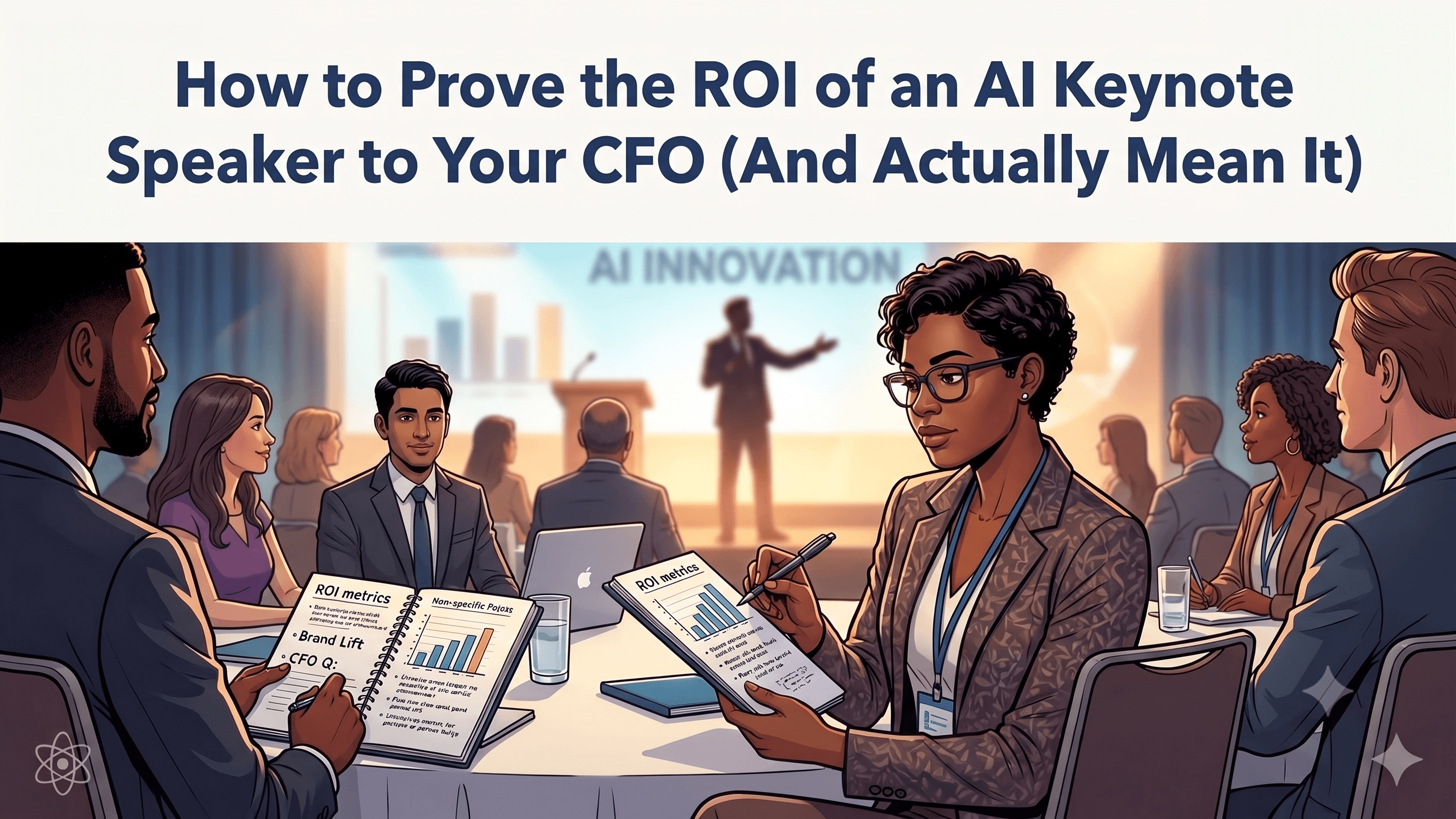
A CFO walks up to you after the annual leadership summit and asks: "That AI speaker was great, but what did it actually change?" If your answer is "the feedback scores were really strong," you already know the conversation that follows. According to a 2025 EventMB survey, 74% of event professionals cite proving ROI as their single greatest challenge when it comes to speaker budgets, and that number climbs sharply when the topic is artificial intelligence, where the outcomes are cultural and behavioral rather than transactional. This article gives you a practical, defensible framework to change that conversation entirely.
Why AI Keynote Demand Has Outpaced ROI Measurement Maturity
AI-related keynote enquiries rose 237% year-on-year according to The Motivational Speakers Agency, with corporate clients requesting sessions on workplace adoption, AI ethics, productivity transformation, and the human impact of automation. The demand surge is real. The measurement sophistication to match it is not.
Cvent's 2026 event trends report signals why this is becoming urgent: corporate buyers are now arriving at the pre-booking conversation with sharper questions about why this topic, why this speaker, why now, and what the audience should do with it. That represents a meaningful shift. The era of booking a well-known name and measuring success by applause is giving way to something more rigorous, and event planners who can't operate in that space are increasingly exposed.
The underlying reason is structural. Most organizations have moved out of the AI education phase, where awareness and curiosity were legitimate goals, and into the implementation phase, where the question is no longer "what is AI?" but "how do we actually change the way we work?" That shift means keynote outcomes need to connect to operational reality, not just inspiration. It also creates a direct line between a well-chosen AI keynote and Gallup's finding that U.S. companies lose $1.9 trillion annually from disengaged, change-resistant teams. A strategically matched AI speaker is not a soft spend. It's a change management intervention with a measurable cost of inaction.
Why Traditional ROI Formulas Break Down for AI Keynotes
The standard revenue-divided-by-cost calculation was built for sales events with a clear pipeline outcome. It fails almost completely for AI keynote speakers, and applying it is one of the most common mistakes organizational buyers make.
A keynote on AI-driven workforce transformation may not generate a single direct sale. It may, however, shift how 400 managers think about automation, reduce resistance to a new AI toolset rollout, and prevent the quiet attrition of high performers who feel their organization isn't keeping pace. None of that shows up in a revenue attribution model, yet all of it has real dollar value.
The second failure mode is what might be called the applause trap. Post-event buzz, standing ovations, and a flood of LinkedIn posts about the speaker are lagging indicators of engagement. They tell you the audience felt something in the room. They tell you nothing about what the audience did differently on Monday morning. For AI topics specifically, where the goal is behavioral adoption rather than product purchase, this distinction is critical.
The keynote speaker is often the single largest line item on a program budget, with a median corporate fee sitting around $20,000, yet it remains one of the least systematically measured investments in the event industry. That imbalance is exactly what a multi-dimensional ROI framework is designed to fix.
The 5-Dimension ROI Framework for AI Keynote Speakers
This framework replaces the single-number ROI calculation with five distinct measurement layers, each capturing a different type of value that an AI keynote can deliver.
Dimension 1 — Engagement Depth
Use live polling tools like Poll Everywhere or Slido to establish a real-time baseline before the keynote begins. A simple confidence prompt such as "Rate your readiness to implement AI in your current role from 1 to 10" takes 90 seconds and gives you a pre-session benchmark you can compare against a post-session score. Slido word clouds capturing one-word audience takeaways immediately after the session add qualitative texture. This data is captured in the room and costs nothing beyond the tools you're likely already using.
Dimension 2 — Knowledge Retention
Deploy a structured 48-hour post-event survey asking attendees to recall the speaker's core frameworks and strategic recommendations without prompting. Set a target retention rate before the event, where 60% recall of three key frameworks is a reasonable benchmark for a 60-minute keynote, and measure against it. Low retention is useful data too: it may indicate a speaker-audience fit problem worth addressing before the next event.
Dimension 3 — Behavioral Change
This is the dimension that matters most for AI topics, and the one most planners skip entirely. Run 30-day pulse surveys tracking framework adoption rates among attendees. Monitor how frequently keynote concepts surface in internal Slack or Teams channels, a surprisingly trackable signal in organizations with searchable message archives. Log new AI-related initiatives, pilot proposals, or workflow experiments submitted in the 60 days following the event. Behavioral change is the output that justifies the budget; everything else is input.
Dimension 4 — Cultural and Organizational Alignment
Measure shifts in employee sentiment around AI readiness and fear of automation using pre- and post-event surveys. This dimension is particularly valuable right now, as the dominant narrative in most organizations is shifting from "AI will eliminate jobs" toward a more nuanced augmentation story. A great AI keynote speaker accelerates that cultural shift measurably. A two-point improvement on a 10-point AI readiness scale across a 500-person leadership team is not a soft outcome. It's a quantifiable change in organizational posture.
Dimension 5 — Content Asset Value
The keynote doesn't end when the speaker leaves the stage. Calculate the downstream value of the recording, internal replay sessions, onboarding use cases, and any derivative training materials built from the session. Note that recording and distribution rights typically add $5,000 to $15,000 to the speaker fee and must be negotiated upfront, but when a keynote is replayed in four regional team meetings, its per-head cost drops dramatically. Amortized content value is one of the most underused arguments in a speaker ROI business case.
Pre-Booking Decisions That Make or Break ROI
The single strongest predictor of measurable keynote ROI is not the speaker's fee, their follower count, or their appearance on a "top speakers" list. It's audience-speaker fit at the implementation stage.
A futurist like Amy Webb of the Future Today Institute, whose annual tech trends report maps AI trajectory with rigorous detail, is an exceptional choice for an organization still building strategic AI literacy at the executive level. But that same speaker booked for a mid-level operations team trying to adopt specific AI workflow tools is a misalignment that no measurement framework can fix after the fact. For implementation-phase audiences, a practitioner like Ethan Mollick of Wharton, whose hands-on AI experimentation translates directly into workflow integration, typically delivers higher behavioral ROI.
The practical implication: define your event goal before you define your speaker profile. Motivating a sales team to adopt AI prospecting tools requires a fundamentally different speaker than preparing an HR leadership team for workforce restructuring conversations. These are not interchangeable briefs.
On the bureau-versus-direct-booking question: working through a specialist bureau like Speak About AI adds a 15–30% commission but provides speaker-audience matching, contract expertise, and customization facilitation that reduces the risk of a misaligned keynote. When ROI measurement is the goal from day one, that risk reduction has real financial value.
Finally, negotiate customization upfront. Speakers who are given access to leadership teams, internal communications, and audience survey data before the event, and who are treated as strategic partners rather than one-time performers, consistently deliver higher measurable impact. This is not a courtesy; it's an ROI lever.
Real-World Measurement in Action: What Good Looks Like
Consider a composite scenario drawn from current L&D practice. An L&D leader at a 500-person financial services firm books an AI keynote speaker for their annual leadership summit. Before the event, they establish a baseline: an AI readiness score of 4.2 out of 10 across the leadership cohort. During the keynote, live polling captures real-time engagement. Thirty days later, a pulse survey goes out. Sixty days later, the L&D team counts new AI pilot project submissions.
The results: readiness score rises to 6.8. Three new AI workflow pilots launch within 45 days. The keynote recording is replayed in four regional team meetings, multiplying reach and amortizing the original fee across a much larger audience. That's a business case with numbers in it.
The data supports this kind of outcome at scale. Well-measured keynotes have been linked to up to 25% improvement in employee engagement scores and a 40% increase in new idea submissions — outcomes that connect directly to AI transformation agendas. Meanwhile, 82% of event organizers currently prioritize emotional engagement as their top speaker vetting metric. Emotional engagement is the input. Behavioral change is the output. Both matter, but only one justifies the budget to a CFO.
It's also worth noting that 58% of event organizers are already using AI tools to manage event costs and complexity. Using data tools to measure the AI keynote itself is not an added burden. It's a natural extension of how sophisticated event operations already work.
Building the Business Case for Your CFO
A one-page business case structure for AI keynote spend doesn't need to be elaborate. It needs six components: investment summary, event objective alignment, pre-event baseline metrics, projected outcomes across the five dimensions above, measurement timeline, and a post-event results summary. That structure turns a gut-feel decision into a documented strategic intervention.
The framing matters as much as the data. A $20,000 AI keynote presented as an event cost is easy to cut. The same investment presented as a change management accelerator, one that moves a 500-person leadership team from AI anxiety to AI agency at a cost of $40 per head, is a different conversation entirely. This is particularly true when the cost of not accelerating that shift includes slower tool adoption, higher change-resistance attrition, and a widening competitive gap.
Organizations are in the implementation phase of AI adoption. Their people need to move from knowing AI is coming to knowing what to do about it. A well-chosen, well-measured AI keynote speaker is one of the most cost-efficient mechanisms available to make that shift happen at scale.
If you want to start with a speaker already aligned to measurable outcomes, and not just a great stage presence, the Speak About AI curation team at speakabout.ai builds every recommendation around your goals, your audience's implementation stage, and the metrics you need to defend the investment. The right speaker isn't the most famous one available. It's the one whose impact you can still point to 60 days after the event.