
Why Keynote ROI Disappears in the First 72 Hours After the Speaker Leaves
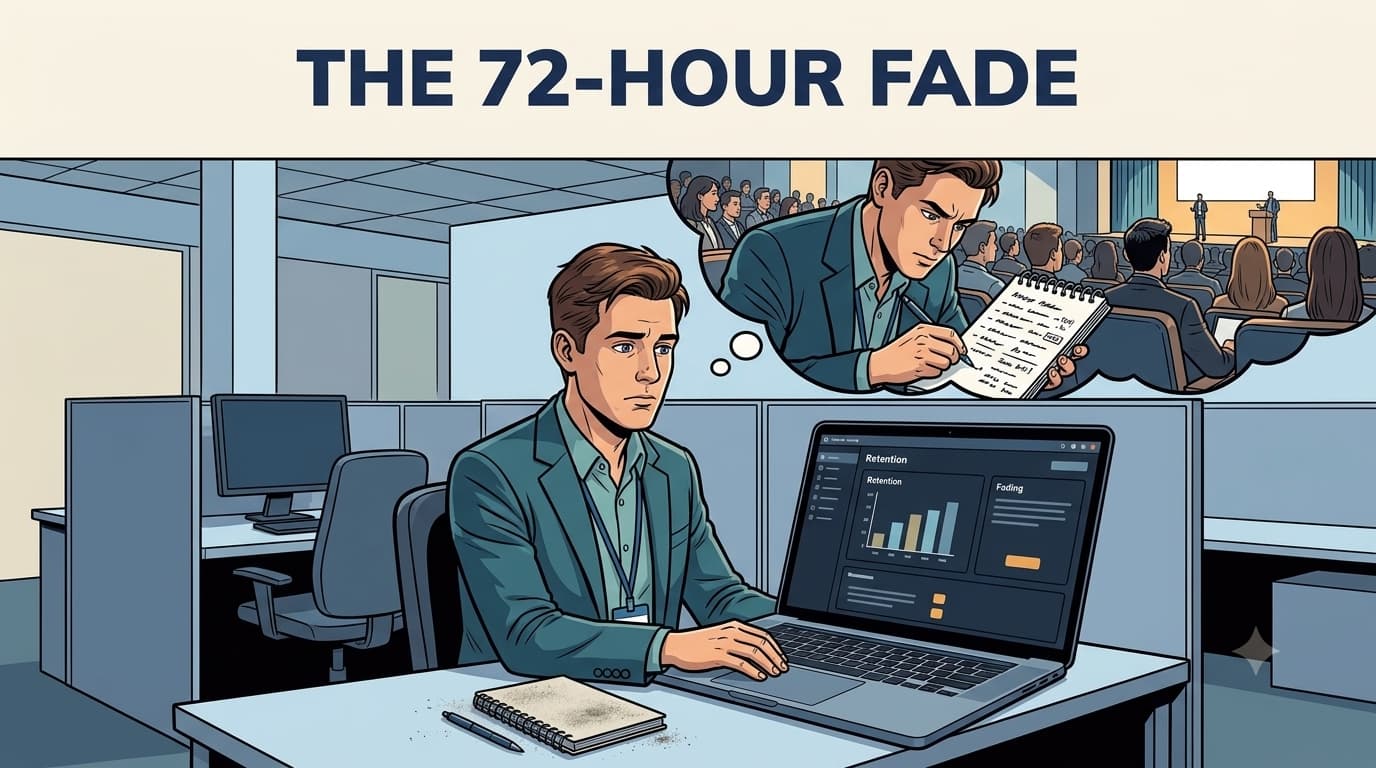
The room gives a standing ovation. The post-event survey comes back glowing. The planning team exhales, marks the event a success, and moves on to the next one. And then, quietly, the investment dissolves.
Within 72 hours, most attendees have returned to their inboxes, their backlogs, and the ordinary demands of work. Within two weeks, the speaker's framework has faded from active vocabulary. Within 30 days, the behavioral change the keynote was designed to catalyze exists only in the memory of the handful of people who were most engaged in the room. The CFO asks the same uncomfortable question they asked last year. The planning team has no better answer than they did before.
This is not a speaker problem. It is a design problem, and it is one of the most expensive and most preventable failures in corporate event planning.
According to the Motivational Speakers Agency 2026 Keynote Speaking Trends Report, 41% of recent speaker briefs now explicitly reference interaction, audience participation, follow-on content, or internal use after the event as part of the booking requirement. Sophisticated buyers have already identified the aftercare gap and are trying to close it at the contract stage. The buyers who have not made that shift yet are still measuring keynote success by applause and satisfaction scores, which are the right metrics for a performance and the wrong metrics for a strategic business investment.
The Applause Trap Is the Most Expensive Measurement Error in Corporate Events
A standing ovation is evidence that the speaker delivered an emotionally resonant experience. It is not evidence that the audience will do anything differently on Monday morning. These are two separate outcomes, and treating the first as a proxy for the second is the measurement error that allows organizations to spend five figures on a keynote and capture none of its organizational value.
The industry data makes this pattern uncomfortably visible. According to Speakers.com 2026, 82% of event organizers prioritize emotional engagement as their top speaker vetting metric. That statistic reveals how thoroughly the industry has optimized for the in-room experience and how systematically it has underinvested in what happens after it. Emotional engagement is the input. Behavioral change is the output. A measurement framework that stops at the input is not measuring the investment.
The downstream consequence shows up in the Vendelux 2026 B2B Events Survey finding that 86% of teams cannot accurately attribute ROI back to events. That is not primarily a data problem. It is a design problem. Organizations that do not plan for post-event measurement before the event happens cannot measure outcomes after it ends, because the baselines, the tracking mechanisms, and the behavioral targets were never defined.
The keynote aftercare phase, the structured 30 to 60 day period following the speaker engagement, is the highest-leverage, lowest-investment opportunity in corporate event planning, and it is almost universally underutilized.
The Four Aftercare Failure Modes That Erase Keynote Value
Understanding why keynote ROI disappears requires naming the specific failure modes that cause it. There are four of them, and each one is a planning failure, not a speaker failure.
The Content Cliff is the most common. The speaker delivers a framework, a vocabulary, and a set of behavioral commitments in a 60-minute session. The audience leaves energized. No one is responsible for reinforcing the framework in the days that follow. Within two weeks, the vocabulary has faded and the behavioral commitments have been overtaken by ordinary work demands. A technology company booked a well-credentialed leadership speaker for their annual sales kickoff. The in-room energy was strong. No post-event resources were distributed. No manager communication kit existed. At 30 days, a pulse survey revealed that fewer than 20% of attendees could recall the speaker's primary framework. The keynote was universally described as inspiring and specifically remembered by almost no one.
The Recording Rights Oversight is the failure that compounds quietly. Most standard agreements in 2026 allow for a 24-hour replay for registered attendees, but long-term internal storage or public distribution requires separate negotiation (Speakers.com, 2026). A healthcare organization booked a nationally recognized speaker for a company-wide leadership event. Post-event, the L&D team identified the keynote recording as the ideal anchor for a six-month manager development series. The speaker's standard contract allowed for a 24-hour replay only. Long-term distribution rights required renegotiation at a cost that had not been budgeted. The recording sat unused. The budget for the development series was reallocated. The keynote's organizational value was permanently capped at the 400 people who were in the room.
The Manager Communication Vacuum is the failure that blocks organizational change at the layer where it matters most. The keynote reaches the audience in the room. It rarely reaches the managers who were not present or the teams whose behavior the keynote was designed to change. A consumer goods company booked a high-profile culture speaker for a 600-person company-wide event. The 200 managers who were not present received no communication about the keynote's framework. Within three weeks, in-room attendees were applying a vocabulary their direct managers had never heard. The organizational change the keynote was designed to catalyze was blocked at the manager layer. A structured manager communication kit would have prevented the disconnect entirely.
The Missing Measurement Baseline is the failure that makes every other failure invisible. A planner who does not define the target behavioral outcome before the event cannot measure whether the keynote produced it after the event. The 30-day pulse survey that asks whether attendees are applying what they heard is not a measurement instrument. It is a satisfaction survey in disguise. A genuine measurement framework requires a pre-event baseline, a defined target, and a tracking mechanism. None of these can be created after the event has ended.
Avenue M Group 2026 research frames the stakes clearly: boards and planners are looking for speakers who can move strategy rather than just energy. A speaker who moves strategy does so over weeks and months, not 60 minutes. The planner who does not design the post-event phase is hiring for strategy and measuring for energy.
The Aftercare Architecture: What a Complete Keynote Engagement Looks Like
The aftercare architecture is the structured sequence of touchpoints that extends the keynote's impact from the stage into the organization's daily operations. The most-booked speakers in 2026 do not just show up, speak, and leave. They offer pre-event customization, post-event resources, follow-on virtual sessions, and workshop components that extend the impact of the engagement (Experts Delivered, 2026). A $10,000 keynote engagement can often be expanded to include a $2,500 to $5,000 workshop component that improves ROI without requiring a separate booking process (Capitol City Speakers Bureau, 2026).
A complete aftercare architecture has five components.
Component 1: Pre-Event Activation. Internal communications sent to the audience in the two weeks before the event introduce the speaker's framework, create anticipation, and establish a shared vocabulary before the keynote begins. The audience arrives primed rather than cold.
Component 2: The Keynote Itself. Designed with post-event application in mind, the session closes with a one-page framework summary the audience can take back to their teams. This is the bridge between the stage and the organization.
Component 3: The 48-Hour Resource Deployment. The speaker's playbook, worksheet, or digital toolkit is distributed to all attendees within two days of the event, when the content is freshest and behavioral commitment is highest. High-caliber contributors often offer follow-up engagement opportunities such as webinars or custom video messages to sustain this momentum (Speakers.com, 2026).
Component 4: The Manager Communication Layer. A structured brief gives managers who were not in the room the language and framework they need to reinforce the keynote's themes in team conversations. This is the component that prevents the manager communication vacuum from forming.
Component 5: The 30 to 60 Day Follow-Up Virtual Session. A structured conversation between the speaker and a subset of the audience revisits the framework after the audience has had time to apply it, surfaces what worked and what did not, and renews organizational commitment to the behavioral targets.
The result of this architecture, applied in practice: an L&D leader at a 500-person financial services firm booked an organizational change specialist with a full aftercare package. The keynote recording was embedded in the firm's new-hire orientation for the following 12 months. At the next budget cycle, the L&D leader presented a dataset showing a 22-percentage-point increase in the target behavior among the leadership population. The speaker budget was increased for the following year.
What to Negotiate Before the Contract Is Signed
The contract negotiation stage is the moment when aftercare architecture is either built into the engagement or permanently excluded from it. A speaker who verbally commits to post-event resources but whose contract makes no reference to those commitments has not committed to them in any legally meaningful sense.
Five elements must be addressed in the contract before signature. Recording and distribution rights, with duration and channel scope specified explicitly. Post-event resource deliverables, with a delivery timeline of within 48 hours. The follow-up virtual session, with format, length, and scheduling window defined. The manager communication kit, with content defined rather than assumed. And pre-event activation materials, with the speaker's obligations clearly stated.
Custom content development typically adds a 10 to 25% premium to the base speaker fee, and exclusivity clauses add another 15 to 30% (M.I.I. Professional Speaking, 2026). The aftercare components that extend the engagement beyond the stage are negotiated within this premium structure. The planner who builds aftercare into the contract is not adding cost. They are directing existing budget toward the components that produce measurable organizational value.
A bureau experienced in structuring complete engagement packages will surface these aftercare elements proactively during the contracting process. A direct-booking process will frequently discover them after the contract is signed, when negotiating leverage is gone.
The signal that separates an aftercare-ready speaker from one who is not: a speaker who responds to aftercare questions with specific process descriptions is a speaker whose post-event commitment is substantive. A speaker who responds with a vague assurance that they are happy to stay connected is a speaker whose aftercare commitment is decorative. Any vagueness in the answer should be treated as a contracting risk.
Building the Measurement Framework Before the Event Begins
Bizzabo 2026 research found that 95% of respondents consider experiential learning important, a standard that a single 60-minute session followed by silence cannot meet. The measurement framework that captures whether the keynote met that standard must be built before the speaker takes the stage.
The four-step pre-event measurement design process works as follows.
First, define the single behavioral target: the one specific behavior the organization wants to see in the 30 days following the event. It must be concrete enough to observe. A manager who has had at least one structured conversation with their team about the keynote's framework is exhibiting the target behavior. A manager who found the keynote interesting is not.
Second, establish the pre-event baseline through a brief survey that captures the current state of the target behavior in the audience population.
Third, define the 30-day measurement mechanism: the pulse survey, behavior tracking tool, or manager-reported observation system that will capture whether the target behavior has increased from the baseline.
Fourth, set the success threshold. A 15-percentage-point increase in the target behavior among 60% of the audience is a defensible success threshold for a $25,000 engagement at a 500-person event. Defining this threshold in advance transforms the post-event conversation from a subjective debate into an objective assessment.
A sales leadership team applied this approach for their annual kickoff keynote. They defined the target behavioral outcome before the speaker was booked: a 25-percentage-point increase in managers conducting structured weekly coaching conversations. A pre-event survey established the baseline at 31%. A 30-day pulse survey found the behavior at 54%. The 23-point increase became the agenda item for the follow-up virtual session. The CFO conversation began with the data.
Event planners who want to start their next speaker search with aftercare architecture built into the recommendation from day one can connect with the [Speak About AI curation team at speakabout.ai](https://speakabout.ai). Every recommendation begins with the event objective and the post-event behavioral target, not the speaker's availability or highlight reel.
Selecting Speakers Who Are Built for Aftercare
Speaker aftercare capability is a distinct selection criterion that most vetting processes do not currently evaluate. A speaker who is excellent on stage and provides no post-event resources, no follow-up engagement, and no manager communication support is a speaker whose organizational impact is structurally capped at the reach of the room.
The aftercare vetting questions that should be standard in every pre-booking conversation: What specific post-event resources do you provide, and within what timeframe? Have you delivered a follow-up virtual session for a comparable audience? Can you provide a reference from a client who can speak specifically to the post-event impact of your engagement, not just the in-room experience?
Format flexibility matters here too. A speaker who has only ever delivered in keynote format and has no experience facilitating a follow-up workshop or structured virtual debrief is not a complete aftercare partner. Format flexibility is about the speaker's ability to serve the organization across the full arc of the engagement, from pre-event activation through the 60-day post-event follow-up.
The Speak About AI curated speaker roster is organized by aftercare capability, audience type, and event objective, giving planners a starting point that reflects the full engagement arc rather than the speaking slot alone.
Allocating the Aftercare Budget Correctly
The standard approach is to allocate the entire speaker budget to the honorarium and treat post-event resources as a cost-free courtesy the speaker provides. The 2026 market reality is that aftercare components are negotiated line items with real cost structures that must be planned for before the contract is signed.
Organizations typically allocate 15 to 25% of the total event budget to the speaker line (Ian Khan, 2026). Within that allocation, aftercare components typically represent 15 to 35% of the total speaker investment depending on the scope of post-event engagement contracted. A $25,000 honorarium paired with a $5,000 follow-up workshop component and $3,000 in recording rights is a $33,000 total speaker investment. The $8,000 in aftercare components is the portion that produces the measurable organizational change that justifies the $25,000 honorarium.
The recording rights budget line deserves specific attention. Most standard agreements in 2026 allow for a 24-hour replay for registered attendees. Long-term internal storage and distribution rights must be negotiated separately and can add meaningful cost to the total engagement. The planner who does not budget for recording rights before the contract is signed frequently discovers them as a post-contract negotiation at a moment when leverage is gone and cost has increased.
The keynote that ends when the speaker walks offstage is not a complete engagement. It is the first chapter of one that was never written. The 30 days after the stage are where keynote ROI is either captured or permanently lost, and the planners who design that phase deliberately are the ones who win the CFO conversation, build the internal case for increased speaker investment, and produce events that compound rather than evaporate.
Event planners who want to build a complete speaker engagement, one that includes aftercare architecture, post-event measurement design, and recording rights negotiated before the contract is signed, can connect with the Speak About AI curation team at speakabout.ai. Every engagement recommendation begins with the event objective, the post-event behavioral target, and the aftercare components that ensure the keynote produces organizational value in the 30 days after the speaker leaves the stage.