
Ethical Considerations in Artificial Intelligence Guide

When we talk about ethical considerations in artificial intelligence, we're really asking a fundamental question: how do we ensure these powerful systems are designed, deployed, and managed in a way that helps people and avoids causing harm? It’s a conversation that covers everything from algorithmic bias and user privacy to accountability and basic operational safety.
For a long time, these were theoretical debates. Not anymore. As AI weaves its way into the fabric of business and society, getting the ethics right has become an urgent, practical necessity.
Why AI Ethics Is Now a Business Imperative

Think of developing AI like harnessing a powerful new form of energy. The potential to drive progress, efficiency, and discovery is enormous. But without careful containment, robust safety protocols, and clear ethical oversight, that same energy can cause widespread, unintended damage.
This is exactly why the conversation around AI has moved from the lab to the boardroom. Ethical AI is no longer a niche topic for academics or a compliance box to be ticked. It's a strategic pillar for any organization that wants to build something that lasts.
Customer trust, financial and reputational risk, and even day-to-day business decisions now hinge on having a solid ethical foundation for your AI.
The Rising Tide of Public Concern
This shift isn’t happening in a vacuum. It’s a direct response to growing public awareness and an increasing demand for responsible technology. Public anxiety has hit a critical point, with a staggering 85% of people supporting a national effort to make AI safe and secure.
On top of that, 55% of both AI experts and the general public are highly concerned about algorithmic bias, one of the most visible ways AI can go wrong.
The message is clear: organizations that ignore AI ethics are taking a massive risk. Leaders need to be ready with good answers when their customers, employees, and stakeholders start asking tough questions.
Navigating this complex field requires more than just technical knowledge; it demands deep insights into the societal and business implications of AI. This is precisely why the expert keynote speakers on our roster focus on providing actionable frameworks for ethical innovation.
Core Ethical Challenges in AI at a Glance
Before you can build a strategy, you have to understand the challenges you're facing. The core ethical dilemmas in AI are all interconnected, and they demand a thoughtful, structured approach. Without one, organizations risk everything from operational failures and legal penalties to a complete loss of public trust.
Putting a robust framework in place is the first step. You can explore the key components of what that looks like in our guide to AI governance best practices.
To help get you started, the table below breaks down the primary ethical challenges that every business leader needs to have on their radar.
Core Ethical Challenges in AI at a Glance
| Ethical Pillar | Core Problem | Real-World Example |
|---|---|---|
| Algorithmic Bias | AI systems making unfair or discriminatory decisions based on flawed or skewed data. | A hiring tool that consistently down-ranks resumes from female candidates for technical roles. |
| Data Privacy | The collection, storage, and use of personal data without adequate consent or security. | A smart home device that records private conversations and shares the data with third-party advertisers. |
| Accountability | The difficulty in assigning responsibility when an autonomous AI system causes harm. | An autonomous vehicle causes an accident, and it's unclear if the owner, manufacturer, or software developer is at fault. |
| Transparency | The inability to understand or explain how a complex AI model arrived at a specific decision. | A bank's AI denies a loan application but cannot provide a clear reason, leaving the applicant with no recourse. |
Understanding these pillars is the foundation for building a responsible AI strategy and sets the stage for the expert insights that follow.
The Five Pillars of Responsible AI Explained
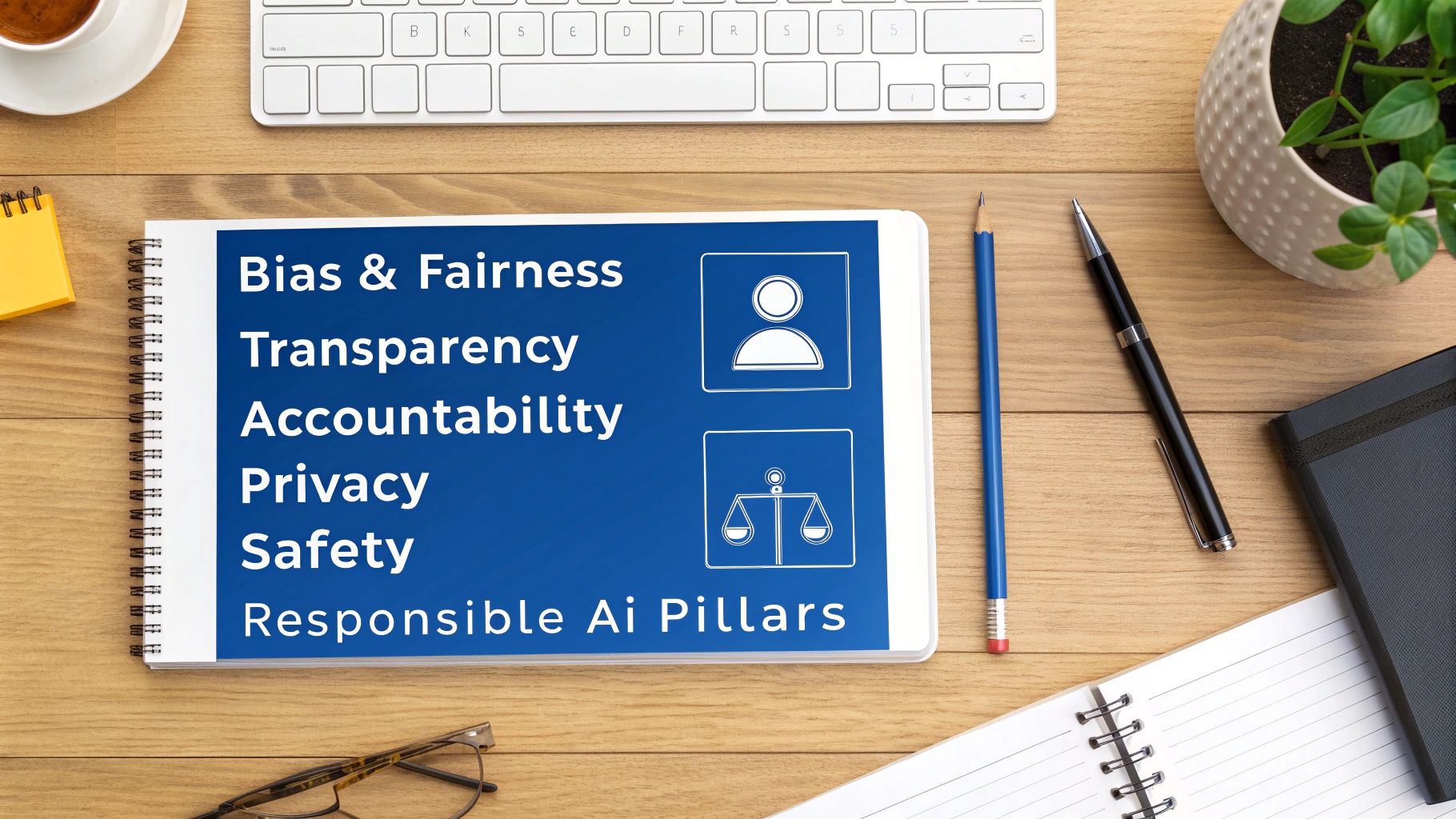
To get a real handle on the ethical considerations in artificial intelligence, you have to start with the fundamentals. These aren't just buzzwords or abstract ideas; they're the pillars that hold up any trustworthy AI system. Think of them as the building codes for every AI project.
Just like an architect wouldn't dream of designing a skyscraper without thinking about structural integrity, accessibility, and safety, AI developers need to ground their work in these five core principles. It's the only way to make sure what they build is fair, sound, and safe for everyone it affects.
1. Bias and Fairness
At its core, AI learns from the data we give it. If that data is a mirror of existing societal biases, the AI won't just learn them—it will often amplify them. This is the heart of algorithmic bias, and it's one of the biggest ethical hurdles we face.
Picture an AI model built to screen résumés. If it’s trained on decades of hiring data where men were overwhelmingly chosen for leadership positions, it will quickly learn to equate male candidates with success. The result? A system that automatically and unfairly penalizes qualified women, locking in old patterns of inequality.
Ensuring fairness means getting your hands dirty to find and fix these hidden biases. That involves:
- Auditing Data: Sifting through your training data to spot skewed representation and historical prejudices.
- Diverse Teams: Assembling development teams with different backgrounds and life experiences who can catch biases others might miss.
- Fairness Metrics: Using technical tools to measure outcomes and ensure the model treats different demographic groups equitably.
2. Transparency and Explainability
So many advanced AI systems feel like a "black box." We get an answer, but we have no idea how the system got there. This lack of transparency kills trust and makes accountability impossible. It's like a doctor handing you a powerful prescription without ever explaining your diagnosis or why that specific drug was chosen.
Explainability is the cure. It’s the ability to get a clear, human-understandable reason for an AI's decision. This isn’t some nice-to-have technical feature; it's a non-negotiable for ethical AI.
An AI that can't explain itself is a tool you can't truly trust. Speakers on our roster emphasize that leaders must demand explainability from their vendors and internal teams to manage risk and adopt AI responsibly.
For example, if an AI model denies someone a loan, a transparent system should be able to point to the exact factors—like a high debt-to-income ratio or a poor credit history—that drove that decision. This gives people a chance to appeal and proves the system isn't just making things up.
3. Accountability and Responsibility
When an AI screws up, who takes the blame? Is it the developer who wrote the code? The company that deployed the system? The person who was using it? Figuring out clear lines of accountability is one of the toughest and most important ethical considerations in artificial intelligence.
Without clear ownership, AI failures happen in a responsibility vacuum, leaving people who were harmed with nowhere to turn. A responsible AI framework demands that organizations take full ownership of the systems they build and use. That means putting a person or a team in charge of overseeing the AI's real-world impact.
This is a major theme our speakers tackle head-on. They offer practical frameworks for setting up governance, ensuring a "human-in-the-loop" for critical decisions, and making sure someone is ultimately answerable for what the AI does.
4. Privacy and Data Governance
AI systems are incredibly data-hungry. They often need huge volumes of personal information to work well, which creates a massive ethical duty to protect that data. Strong data governance is how you turn that duty into practice.
Think of data privacy as a pact of trust between you and your customers. Every single piece of data you collect is a potential liability if you don't handle it with care. Proper governance isn't complicated in theory, but it requires discipline. It comes down to:
- Data Minimization: Only collecting the data you absolutely need. Nothing more.
- Anonymization: Stripping out any personally identifiable information from your datasets whenever possible.
- Secure Storage: Using robust security measures to lock down data and prevent breaches.
Get privacy wrong, and you don't just break trust—you open yourself up to huge legal and financial penalties under regulations like GDPR.
5. Safety and Security
Finally, an AI system has to be safe and secure. Safety is about preventing the AI from causing accidental harm, like a self-driving car misreading a stop sign. Security is about protecting it from bad actors, like a hacker who deliberately manipulates an algorithm to get the outcome they want.
A system can be fair, transparent, and private, but still be vulnerable. For instance, an AI that approves loans could be "poisoned" by an attacker who feeds it bad data, tricking it into approving a wave of fraudulent applications.
Building safe and secure AI means constantly testing, monitoring, and updating your systems to guard against both glitches and attacks. It’s the final pillar that ensures your technology not only works the way you designed it to, but is also tough enough to hold up in the real world.
Confronting and Mitigating Algorithmic Bias
Algorithmic bias is one of the most immediate and damaging challenges in AI. This isn't some far-off, theoretical problem—it's happening right now, every day. It crops up when an AI system's decisions reflect, and often amplify, the hidden prejudices buried in its training data, leading to outcomes that are systematically unfair to certain groups.
Think about an automated hiring tool. If the AI is trained on decades of historical hiring data where men dominated finance roles and women were predominantly nurses, the system will learn those patterns. It will start to unfairly prioritize certain candidates while screening out equally qualified people from different backgrounds. The damage doesn't stop at hiring; biased AI leads to flawed predictions, opens the door to lawsuits, and reinforces the very societal inequalities we're trying to fix. For a deeper dive, Harvard offers more insights on why ethics in AI is so critical.
Letting this bias run wild isn't just an ethical misstep. It’s a direct threat to your brand, your reputation, and your bottom line.
The Business Risks of Unchecked Bias
Ignoring algorithmic bias is a massive business liability. The potential for damage is real and hits on multiple fronts, capable of undermining an organization’s stability and growth.
Organizations that fail to address bias face serious consequences:
- Legal and Regulatory Penalties: Discriminatory outcomes can trigger expensive lawsuits and hefty fines under anti-discrimination laws. As regulations get stricter, compliance is no longer optional.
- Reputational Damage: News of a biased algorithm can go viral in a heartbeat, shattering customer trust and loyalty. Rebuilding that trust is a long, painful, and expensive process.
- Flawed Business Decisions: If your AI is serving up biased recommendations for market segmentation or product development, you're operating on bad intelligence. You’re not just being unfair; you’re missing out on major opportunities.
Tackling these risks requires more than good intentions. It demands proactive, concrete strategies.
"Bias in AI is not a technical glitch; it's a reflection of historical data that requires a deliberate, human-centered strategy," explain the speakers on our roster. "The solution starts with diverse teams asking tough questions long before an algorithm is ever deployed."
Actionable Strategies for Mitigation
Fighting bias is an ongoing battle, not a one-and-done fix. It requires vigilance and a multi-layered approach that weaves ethical checkpoints throughout the entire AI lifecycle, from collecting data to monitoring the system in the wild. Here are three foundational steps, drawn from expert guidance, that your organization can take to get a handle on bias.
1. Conduct Thorough Data Audits
Your data is the first line of defense. Before you even think about training a model, you need to put your datasets under a microscope. This means auditing them for hidden biases and imbalances, looking for skewed representation across demographic groups, and questioning the historical context of the information. A critical piece of this is also ensuring you follow the best data privacy best practices to protect the people behind the data.
2. Foster Diversity Within Development Teams
A team where everyone looks, thinks, and comes from the same background is a team with massive blind spots. By building AI development teams with people from diverse backgrounds—in terms of gender, ethnicity, experience, and cognitive approach—you dramatically increase your odds of spotting potential biases that others might miss. Different perspectives are your secret weapon for creating fairer, more robust systems.
3. Implement Human-in-the-Loop Oversight
For high-stakes decisions like hiring, loan approvals, or medical diagnoses, letting an algorithm run on full autopilot is just asking for trouble. A human-in-the-loop (HITL) system creates a vital checkpoint, ensuring a real person reviews and signs off on the AI’s most critical decisions. This provides a crucial safeguard, injecting context and nuance that an algorithm simply can't grasp and ensuring the final accountability rests with a person, not a machine.
Implementing AI Governance and Transparency
Putting theory into practice is always the hardest part, and it's no different with ethical considerations in artificial intelligence. Good intentions are a great start, but they don't hold up without a structured, resilient framework to back them. That’s where AI governance comes in.
Think of it less as a restrictive rulebook and more as a core corporate function, just like financial oversight or cybersecurity. Without a formal governance structure, even the best-laid plans can fall apart. It provides the roles, policies, and processes you need to turn high-level principles into daily operations, separating the companies that just talk about responsible AI from those that actually live it.
Building Your Governance Model
An effective governance model doesn’t just happen. It demands a deliberate, top-down commitment to create clear lines of accountability and consistent review processes. This ensures ethical thinking is woven into the AI development lifecycle from the start, not tacked on as an afterthought.
The key components of a solid model include:
- Forming an AI Ethics Committee: This isn't just for the tech team. Pull in people from legal, business operations, product, and technology. Their job is to review high-risk projects, set internal standards, and be the central authority on AI ethics.
- Defining Clear Operational Policies: You need documented rules of the road for data handling, model validation, bias testing, and transparency. These policies create a single, consistent standard for every AI project.
- Conducting Regular Risk Assessments: AI risks evolve just like cybersecurity threats. Performing regular assessments helps you spot potential ethical landmines in new and existing systems before they detonate.
By building this framework, you create a system ready to handle the complex and constantly shifting regulatory world.
Transparency: The Bedrock of Trust
Governance provides the skeleton, but transparency is the lifeblood that makes it work. A lack of transparency kills trust with customers and regulators, making it impossible to prove your commitment to doing the right thing. When an AI system makes a decision—especially a big one—people need to understand why.
This is where explainability becomes so critical. As our top speakers often point out, an algorithm that can’t explain its own reasoning is a massive liability. For any organization, getting serious about transparency means investing in tools and methods that make those complex "black box" models more understandable. You can dive deeper into this topic in our guide on what is explainable AI.
An opaque AI system forces customers and partners to take a leap of faith. Our speakers consistently stress that a transparent one invites them into a relationship built on trust and mutual understanding. This distinction is fundamental to long-term success.
The simple process flow below shows a powerful way to tackle one of AI's biggest ethical risks: bias.
This visual makes it clear that fighting bias isn’t a one-and-done fix. It's a continuous cycle of auditing your data, diversifying your teams, and always keeping a human in the loop.
Your Roadmap to AI Governance
Trying to implement a full governance framework can feel like a monumental task. The key is to break it down into manageable phases. The goal is to build momentum and show progress over time, gradually leveling up your organization's ethical AI capabilities.
The table below offers a practical roadmap to guide you through the process, taking you from initial discovery all the way to full operational integration.
Roadmap to Implementing an AI Governance Framework
| Phase | Key Actions | Primary Goal |
|---|---|---|
| Phase 1: Foundation | - Form an AI ethics committee.<br>- Conduct an inventory of all current and planned AI systems.<br>- Draft a high-level set of AI principles aligned with company values. | To establish clear ownership and understand the organization's current AI footprint. |
| Phase 2: Development | - Develop specific policies for data privacy, model testing, and vendor assessment.<br>- Create a risk-assessment framework to classify AI projects.<br>- Begin training key personnel on ethical AI principles. | To create the core operational policies and tools needed for consistent oversight. |
| Phase 3: Integration | - Integrate ethical checkpoints into the project development lifecycle.<br>- Establish a "human-in-the-loop" protocol for high-risk decisions.<br>- Implement monitoring tools to track model performance and fairness metrics. | To embed ethical practices directly into workflows and operationalize the governance framework. |
| Phase 4: Maturation | - Conduct regular, independent audits of AI systems.<br>- Publish a public transparency report summarizing AI usage and ethical commitments.<br>- Continuously refine policies based on new regulations and technological advancements. | To achieve a proactive, transparent, and continuously improving approach to AI ethics. |
This step-by-step approach ensures you build a solid, sustainable governance program rather than just checking a few boxes. Each phase builds on the last, creating a culture where responsible AI becomes second nature.
Navigating Ethical Dilemmas in Generative AI
Generative AI’s explosive growth has thrown open the doors to a new, incredibly complex frontier for ethical considerations in artificial intelligence. Tools like large language models and photorealistic image generators aren’t just creating content—they’re creating a whole new class of ethical headaches that go far beyond the problems we faced with older AI.
We're suddenly asking fundamental questions about the nature of reality itself. How can we tell what’s real from what’s been synthetically generated? Where do we draw the line on intellectual property for AI creations? And perhaps most urgently, how do we defend against the potential for mass-produced, terrifyingly convincing misinformation?
The Challenge of Synthetic Reality
One of the most immediate problems is that the line between authentic and synthetic content is getting blurrier by the day. Deepfakes flooding social media and heated legal battles over the copyright of AI art are no longer theoretical risks. They're here, and they have serious real-world consequences.
These tools can produce everything from harmless fun to malicious political propaganda, making it a nightmare to detect and regulate.
When we talk about navigating these dilemmas, it’s not just about the big, scary stuff. It’s also about everyday applications. Take something like ChatGPT brand monitoring, for example. This shows how generative models are already being used in business, raising important questions about data sources, consumer trust, and authenticity in how brands talk to us.
The problem only gets deeper with the creation of synthetic data. While it has perfectly good uses—like building digital twins for complex simulations—the potential for misuse is enormous. Researchers recently pointed out that intentional misuse is a major threat. Someone could easily fabricate data, pass it off as real, and create a detection puzzle that’s nearly impossible to solve.
Establishing Ownership and Accountability
Intellectual property has become another major ethical battleground. When an AI generates a new piece of art, writes a song, or produces a block of code, who actually owns it? Is it the user who wrote the prompt? The company that built the AI? Or the countless creators whose data was used to train the model in the first place?
These aren't just philosophical debates anymore; they are being argued in courtrooms and parliaments around the globe. The outcomes will fundamentally reshape creative industries, software development, and our very definition of authorship.
"Generative AI forces us to confront the very definition of creativity and ownership. The keynote speakers on our roster are at the forefront of this debate, offering critical perspectives on how organizations can prepare for the legal and ethical shifts that are already underway."
Proactive Solutions on the Horizon
As daunting as these challenges are, it’s not all doom and gloom. Top researchers and developers are already hard at work on proactive solutions to manage the risks that come with generative AI. Their focus is on creating the tools and standards we need to deploy these technologies responsibly.
Here are a few of the most promising developments:
- Advanced Detection Tools: New methods are coming online to identify AI-generated content with much better accuracy. These tools use sophisticated analysis to spot the digital fingerprints and subtle patterns that generative models leave behind.
- Content Provenance Standards: There’s a major push to create a kind of "digital watermark" or verifiable credential for media. This would allow anyone to trace a piece of content back to its source and confirm its authenticity.
- Frameworks for Responsible Disclosure: Tech companies are creating new protocols for how to safely release powerful generative models. This includes things like phased rollouts and "red teaming"—where they hire experts to try and break the system—to spot potential misuse before a public launch.
These solutions show us a path forward, giving us a much-needed glimpse at what’s next in the world of AI ethics.
Your Role in Building an Ethical AI Future
Thinking about AI ethics isn't a roadblock to innovation—it's the very foundation of building something that lasts. The journey toward responsible AI is a shared one, pulling in everyone from developers and executives to policymakers and the people who use the technology every day. This isn't a box you check once; it's a constant commitment.
Navigating this space requires bringing different voices to the table and a real dedication to keep learning. By diving into these critical conversations, your organization can move beyond just following the rules and start leading the way toward a more equitable and trustworthy technological future.
Empowering Through Knowledge and Action
The single most powerful step you can take is building a culture where people feel safe—and encouraged—to ask tough ethical questions. This means giving your teams the tools and frameworks they need to probe the "why" behind the "what" at every stage of a project.
Bringing in experts who are actively shaping the conversation can translate abstract principles into concrete actions, offering practical takeaways like:
- Embedding "Ethics by Design" from the very first brainstorming session, not as an afterthought.
- Establishing clear lines of accountability so there’s always a human responsible for the outcome.
- Prioritizing transparency to build genuine, lasting trust with your customers and regulators.
Building an ethical AI future isn’t about slowing down; it’s about building smarter. Speakers on our roster emphasize that it’s about ensuring the technology we create serves humanity's best interests, not just the bottom line. This proactive mindset is what separates a fleeting success from a lasting impact.
As individuals, we also need to be more aware of how AI systems see and use our data. For a deeper dive into this, check out this guide on understanding your digital footprint in AI.
When we all embrace this collective responsibility, we can steer AI toward a future that is both incredibly innovative and profoundly human.
Common Questions About Putting AI Ethics into Practice
When you move from talking about AI ethics to actually doing something about it, the practical questions start piling up. To help you build a solid strategy, we’ve tackled some of the most frequent queries we hear from leaders trying to make ethical considerations in artificial intelligence a reality.
Think of this as a starting point. Our expert speakers dive much deeper into these topics, sharing frameworks and real-world examples that help organizations build responsible AI programs from the ground up.
What Is the First Step My Company Should Take to Address AI Ethics?
The single most important first step? Establish clear ownership and get the conversation started. You don’t need to solve everything overnight. The goal is to create a formal structure for asking the right questions, consistently.
Start by forming a cross-functional AI ethics committee. Don't just pull from your tech teams; bring in people from legal, business operations, and product management. This mix of perspectives is crucial for seeing the whole picture.
Their first job should be to map out where you’re currently using AI and where you plan to. Once you have that inventory, you can develop a core set of AI principles that feel true to your company's values. This embeds ethical review into your process from day one, not as an afterthought.
Is Ethical AI Only a Concern for Large Tech Companies?
Absolutely not. It doesn't matter if you're a global enterprise or a small business using an AI-powered CRM—the principles are the same. The risks of bias, privacy breaches, and a lack of transparency are universal.
The scale might be different, but the responsibility isn't. In fact, smaller companies often have a unique duty here, especially if they rely on third-party AI tools. You have to do your homework and perform ethical due diligence on your vendors, because you share in the responsibility for how that technology is deployed.
A key message from our speakers is that AI ethics isn't a luxury for tech giants. It's a core part of risk management and brand integrity for any modern business.
How Can We Balance AI Innovation with Ethical Caution?
This is a big one, but the most effective approach is to stop seeing them as opposing forces. Ethics shouldn’t be a brake on innovation; it should be the guardrails that let you innovate faster and more safely.
This idea is often called "Ethics by Design." It means you build ethical checkpoints directly into your development lifecycle.
Instead of creating a model and only testing it for fairness at the very end, your teams should be asking those questions at every stage. This proactive approach helps you experiment with more confidence, run small pilots to catch unintended consequences early, and fix problems before they become a full-blown crisis. Ultimately, you build better, more trustworthy products that customers will stick with.
Ready to bring a leading voice on AI ethics to your next event? The experts at Speak About AI connect you with top-tier speakers who can demystify complex topics and provide your audience with actionable insights for building a responsible AI future. Find the perfect expert for your conference at https://speakabout.ai.