
A Guide to Financial Services Digital Transformation

Financial services digital transformation isn't a forward-thinking strategy anymore—it's a survival tactic. For banks and financial institutions, this means a fundamental rewiring of their entire operation, driven by intense fintech competition and customers who now demand instant, seamless service right from their phones.
Why Digital Transformation Is No Longer Optional
Not long ago, banking was defined by physical branches and established, slow-moving processes. Today, success is all about the speed and personalization of digital interactions. The pressure to change is coming from every direction, leaving institutions with a stark choice: adapt or become irrelevant. This isn't just about launching a mobile app; it's about embedding technology into the very DNA of the company.
The modern customer doesn’t compare their bank to another bank. They compare it to their best digital experiences with Amazon or Google. They expect 24/7 access, instant loan approvals, and personalized financial advice delivered through a clean, intuitive interface. This massive shift in expectations means traditional customer loyalty is incredibly fragile and easily lost to a more agile competitor.
The Rise of Fintech and New Market Pressures
Fintech startups completely changed the game by proving that financial services could be delivered faster, cheaper, and with a far better user experience. These digital-native companies operate without the heavy burden of outdated infrastructure, allowing them to innovate at a blistering pace. To even stand a chance, legacy institutions must move beyond small, incremental updates and commit to a complete operational overhaul. The first step? A clear plan for https://speakabout.ai/blog/legacy-system-modernization-strategies to build a resilient digital foundation.
This competitive heat is turned up even more by evolving regulations like Open Banking, which demand greater transparency and data sharing. These rules open the door for incredible new services, but they also require serious technological agility just to stay compliant.
Digital transformation has shifted from a competitive advantage to a core business imperative. Institutions that fail to invest in modernizing their operations risk losing market share to more nimble, tech-driven players who are redefining customer relationships.
Building a Modern Financial Institution
At its heart, financial services digital transformation is about using technology to make every single part of the business better. This really boils down to three key areas:
- Increasing operational efficiency by automating all those repetitive back-office tasks, freeing up talented people to focus on high-value, strategic work.
- Enhancing data-driven decision-making with real-time analytics to finally understand customer behavior and manage risk effectively.
- Driving digital innovation by launching new products and services that actually meet the needs of a connected, modern customer base.
This change is already happening fast. To see it in action, just look at how some of the leading banks adopting stablecoins and digital assets are actively reshaping the future of finance right now. The journey is complex, for sure, but the stakes are far too high to sit on the sidelines.
The Core Technologies Driving the Financial Revolution
At the heart of financial services' digital shift are a handful of powerful technologies. These aren't just buzzwords; they are the engines powering new business models, sharpening customer experiences, and unlocking massive operational efficiencies. Understanding how they actually work is the first step to seeing their true impact.
Think of these technologies as a specialized crew, each with a critical job, working together to overhaul a complex ship. They aren’t just patching holes. They’re rebuilding the vessel from the ground up, making it faster, safer, and more responsive to the changing seas of the market. The image below shows the external pressures—from fintech rivals, demanding customers, and technology itself—that make this overhaul so urgent.
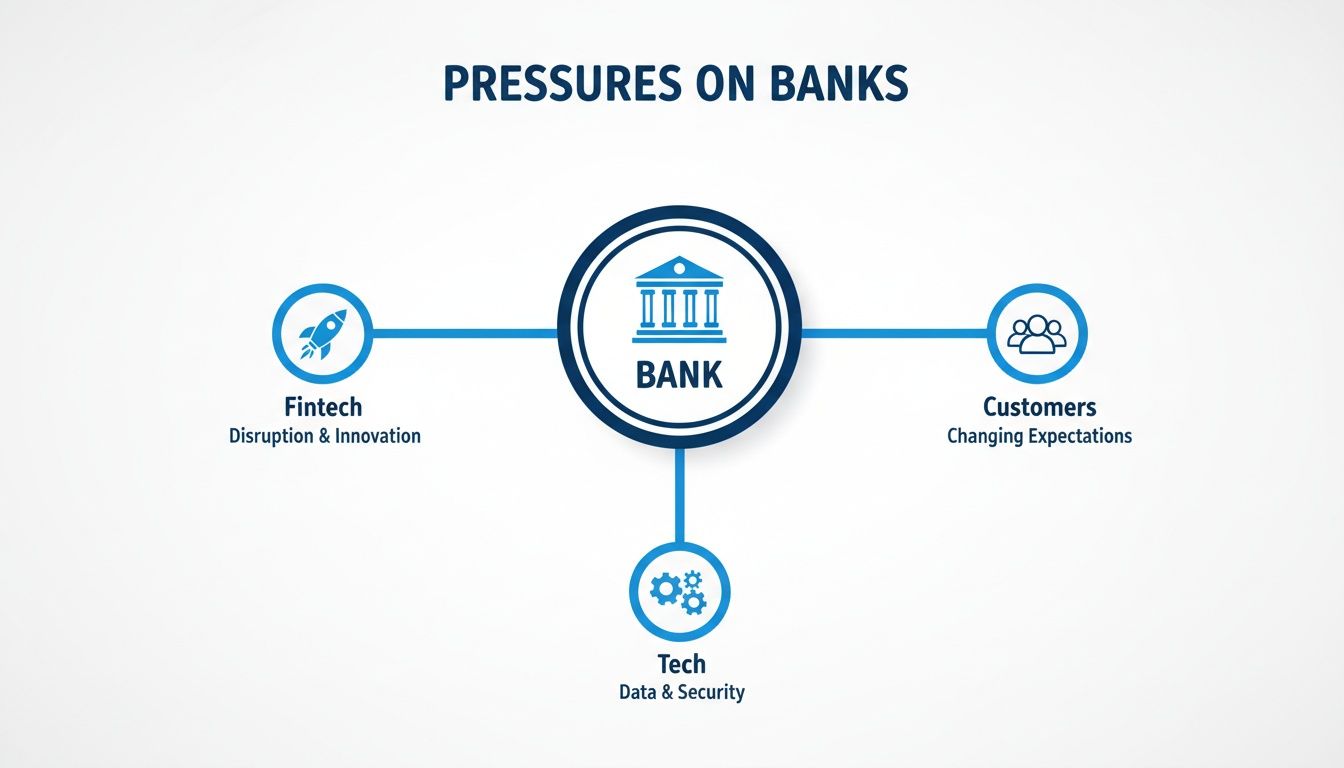
This constant push from nimble fintech competitors, evolving customer expectations, and the sheer pace of new tech is forcing traditional financial institutions to adapt or be left behind.
Artificial Intelligence and Machine Learning
Artificial Intelligence (AI) and Machine Learning (ML) are the "brains" of the modern financial firm. They sift through immense datasets to spot patterns, make predictions, and automate complex decisions that once took teams of people hours to complete. It's the difference between a security guard watching one door and a system that monitors every entry point, window, and hallway simultaneously.
For example, JPMorgan Chase used AI to slash the time its lawyers spent reviewing legal documents from 360,000 hours annually to just a few seconds. That’s not a small improvement; it's a fundamental change in how work gets done.
Pascal Bornet, a globally recognized expert on AI and automation, explains that these technologies augment human abilities, freeing people to focus on high-level strategy and client relationships instead of repetitive tasks.
Cloud Computing
If AI is the brain, then Cloud Computing is the powerful, flexible skeleton supporting it. It delivers on-demand computing power, storage, and software services without the massive upfront cost of building and maintaining physical data centers.
Imagine a bank having to build a giant new branch every time it expected a holiday rush, only for that building to sit empty most of the year. The cloud is like having a branch that can instantly expand or shrink based on real-time customer traffic.
This is the kind of scalability that allowed Goldman Sachs to partner with Amazon Web Services (AWS) to launch a cloud-based financial data platform. It gives their clients instant access to sophisticated market analytics—a service that would have been incredibly expensive and slow to build with old-school infrastructure.
APIs as the Universal Translator
Application Programming Interfaces (APIs) are the unsung heroes of digital finance. They act as secure messengers, allowing different software systems to talk to each other and share data seamlessly. Think of an API as a universal translator that enables a bank’s decades-old mainframe to speak fluently with a brand-new mobile app.
This connectivity is what makes concepts like Open Banking and embedded finance possible. When you link your bank account to a budgeting app like Mint or YNAB, it's an API working behind the scenes to securely shuttle your transaction data back and forth.
"We simply stopped thinking like a bank and started acting like a tech company." - Piyush Gupta, CEO of DBS Bank
That quote perfectly captures the mindset shift that APIs enable. By creating thousands of APIs, DBS Bank transformed itself from a closed institution into an open platform, partnering with other companies to embed its services directly into their apps and websites.
Blockchain and Distributed Ledger Technology
Blockchain is usually tied to cryptocurrencies, but its potential in mainstream finance is much bigger. It provides a shared, unchangeable ledger for recording transactions, which dramatically boosts transparency and security. It’s like having a digital notary that everyone can trust without needing a central bank or clearinghouse to validate every single step.
The technology is perfect for processes that have always been slow, manual, and bogged down by paperwork. Standard Chartered, for example, has used blockchain to digitize trade finance, cutting processing times from days to just a few hours. In a world of global trade where delays cost millions, that’s a huge deal.
David Shrier, a futurist and MIT-affiliated expert, often speaks on how blockchain can create "trustless" systems. His insights show how these systems reduce fraud and counterparty risk in everything from cross-border payments to stock trading, rebuilding finance on a foundation of security and transparency.
To bring it all together, here's a quick look at how these core technologies are making a tangible impact on the financial services industry.
Key Technologies and Their Impact on Financial Services
| Technology | Primary Use Case | Key Business Benefit |
|---|---|---|
| AI / Machine Learning | Fraud detection, credit scoring, algorithmic trading, customer service chatbots | Increased accuracy, operational efficiency, and personalized customer experiences |
| Cloud Computing | Data storage, on-demand analytics, scalable application hosting | Reduced infrastructure costs, improved agility, and faster time-to-market for new products |
| APIs | Open Banking, embedded finance, third-party integrations | Expanded service offerings, new revenue streams, and a seamless, connected customer journey |
| Blockchain | Secure transaction settlement, trade finance, digital identity verification | Enhanced security, greater transparency, and reduced administrative overhead |
Each of these technologies solves a different piece of the puzzle, but when combined, they create a powerful engine for building the future of finance.
Investing in Transformation to Secure Market Leadership
The move toward a fully digital financial world isn’t a tentative experiment anymore. It’s a massive, multi-year investment cycle that’s actively separating the market leaders from the laggards.
Institutions are well past the point of just dipping their toes in the water. They are now committing billions to fundamentally overhaul their operations, understanding that how they spend on technology today will directly drive their profitability and competitive standing tomorrow.
This isn't about finding a little extra in the IT budget. It's a strategic reallocation of capital to survive and thrive. The numbers tell a clear story: spending on financial services digital transformation has exploded. Global investment is on track to hit nearly $4 trillion by 2027, with the financial sector leading the charge.
The industry is upping its tech spending at a compound annual growth rate of about 20.5%, funneling cash into cloud infrastructure, AI, and regulatory tech. You can dig deeper into the scale of this investment on Integrate.io.
The Tangible Returns of Digital Maturity
That level of spending demands a clear return, and the data shows a stark difference between the players. Digitally mature institutions aren't just a bit more efficient; they are substantially more profitable. Analysts estimate that banks now spend around 10% of their revenue on technology—roughly double the average across other industries.
And that aggressive investment is paying off. Study after study shows that institutions that achieve a high level of digital leadership see materially better financial results.
Some reports indicate that digitally advanced financial firms can achieve up to a 30% higher return on equity compared to their less developed peers. This isn't just a marginal gain; it's a decisive competitive edge.
This performance gap highlights a crucial reality. The investment isn't about chasing trends. It's a direct and powerful lever for boosting core financial metrics and locking in a dominant market position for years to come.
Guiding Your Investment Strategy
Navigating such a high-stakes landscape requires more than just capital—it demands expert guidance. A misstep can be incredibly costly, both in wasted resources and lost market opportunities. This is where insights from seasoned industry leaders become invaluable.
One of those experts is Brett King, a world-renowned futurist and bestselling author known as the "King of FinTech." He argues that the future of finance is experiential and AI-driven, a perspective that helps organizations align their spending with long-term customer trends.
Another critical voice is Nichol Bradford, a global expert on the future of work. She brings the essential cultural side of transformation into focus, helping leaders ensure their teams have the skills and mindset to adapt to new technologies.
- Strategic Clarity: Experts like King help leadership teams see where the market is going, ensuring investments are future-proof.
- Cultural Alignment: Innovators like Bradford focus on the human element, which is key to turning technological potential into real-world performance.
- Risk Mitigation: Learning from those who have already led successful transformations helps organizations avoid common and expensive pitfalls.
Ultimately, the leaders in financial services digital transformation are the ones who not only invest heavily but also invest wisely. They get that success requires a balanced approach, combining top-tier technology with a deep understanding of market dynamics and a commitment to building a culture that never stops adapting.
How AI and Automation Reshape Financial Operations
Artificial intelligence and automation are no longer on the experimental fringes of finance—they've moved right into the core of daily operations, unlocking massive cost savings and productivity gains. These aren't just boardroom buzzwords anymore; they are practical tools delivering real results today. From back-office processing to customer-facing interactions, AI is fundamentally changing how finance gets done.
The shift is all about AI's power to handle tasks that are repetitive, data-heavy, and rule-based. By automating these processes, financial institutions can dramatically cut down on errors, speed up service delivery, and, most importantly, free up their people to focus on strategic, high-value work that needs a human touch.

The financial impact of this operational overhaul is huge. Industry analysis points to major cost reductions and significant net cost declines for banks that fully commit to AI.
A detailed 2025 banking review estimates that widespread AI adoption could lead to gross cost reductions of up to 70% in some areas. Once you factor in the new tech expenses, that could still result in a net cost-base decrease of around 15–20%. You can learn more with these financial services insights from McKinsey.
These efficiency gains are coming from automating routine back-office work, accelerating credit decisions, and enabling real-time personalization that keeps customers happy and opens up new cross-selling opportunities.
Practical Applications Driving Real Value
The applications of AI and automation in finance are incredibly diverse, touching almost every part of the business. First, it helps to understand the difference between the two concepts. If you need a primer, check out our guide on what AI automation is.
Here are a few areas where these technologies are making the biggest splash right now:
- Automated Loan Processing: Instead of taking days, AI algorithms can now analyze loan applications, verify applicant data, and assess credit risk in minutes. This is a game-changer for customer experience and frees up loan officers from mountains of paperwork.
- Enhanced Fraud Detection: Machine learning is brilliant at spotting strange patterns in transaction data. It can flag potentially fraudulent activity in real-time with much greater accuracy than a human team, saving institutions millions.
- Personalized Customer Experiences: AI-powered chatbots and virtual assistants handle customer support 24/7, answering common questions and guiding users through simple transactions. Smarter AI can even analyze a customer's banking history to offer personalized product recommendations and financial tips.
- Streamlined Compliance and Reporting: Robotic Process Automation (RPA) can be a lifesaver for compliance teams, automating the tedious collection and consolidation of data for regulatory reports. This ensures accuracy and frees up experts from mind-numbing data entry.
To see what's possible, it's worth exploring the variety of AI automation solutions already transforming financial operations.
Expert Perspectives on the Future of Work
Bringing AI into the fold isn't just about technology; it's a human shift. It forces us to rethink job roles and team structures. The leading experts in this space all agree: the goal isn't to replace people but to augment what they can do.
Pascal Bornet, a global expert on intelligent automation, champions a human-centric view. He argues that automation empowers employees by removing drudgery, letting them focus on complex problem-solving and building client relationships.
Similarly, Nichol Bradford, an expert on the future of work, stresses the need to upskill the workforce. Her insights on training teams to work alongside AI systems are crucial for making sure that massive tech investments deliver their full potential.
By embracing AI and automation, leading financial institutions are doing more than just cutting costs. They are building a smarter, more resilient, and more efficient operational model that sets them up to win in a fiercely competitive market.
The Global Impact of Digital Finance and Inclusion
While AI is busy overhauling internal operations, its impact on the outside world is even more dramatic, rewriting the rules of access and opportunity across the globe. The biggest change is happening right in the palm of our hands. Mobile banking is quickly becoming the world's main way to handle money, bringing hundreds of millions of people into the formal economy for the very first time.
This isn't just about convenience; it's a fundamental power shift. For countless people in developing nations, a simple smartphone now opens the door to savings accounts, credit, and insurance—services that used to be miles away or financially out of reach. We're leapfrogging the need for brick-and-mortar branches, building a more inclusive financial system from the ground up.

Connecting Mobility to Economic Opportunity
You simply can't ignore the link between mobile phones and financial inclusion. As mobile becomes the default channel for banking customers, institutions are finding that users who engage on mobile deliver a much higher lifetime value. This shift is also creating entirely new business models, like embedded finance and open banking APIs, that expand access even further.
If you want to see the data for yourself, explore the World Bank's Global Findex data. It consistently tracks the spread of digital accounts and confirms the critical role mobile plays in this story. This presents a massive opportunity for financial institutions that are paying attention. By designing mobile-first products, they can tap into enormous, underserved markets hungry for modern financial tools.
The rise of digital finance is more than a tech trend; it's a powerful engine for social equity. By knocking down old barriers, mobile banking empowers individuals, fuels small business growth, and helps build stronger local economies.
Navigating the Challenges of Global Expansion
But let's be realistic—this global journey is far from over. Many institutions still struggle to execute when trying to serve these new markets. The challenges are tough, from navigating a maze of different regulations to overcoming cultural and literacy barriers.
- Security and Trust: In places where digital literacy is still catching up, building trust is everything. A single high-profile data breach can set back adoption for years.
- Regulatory Technology (RegTech): Staying compliant with a dozen different international rules for identity verification (KYC) and anti-money laundering (AML) requires smart, adaptable technology.
- Infrastructure Gaps: While nearly everyone has a phone, reliable internet access can still be a major hurdle in rural areas, limiting the reach of more sophisticated digital services.
Tackling these issues demands more than a one-size-fits-all strategy. You can't just export existing models; you have to build solutions with local communities, not just for them.
The Role of Expert Guidance in a Global Context
Getting this right requires a deep understanding of both technology and socio-economic dynamics. Leaders need to know how to build systems that are not only secure and compliant but also culturally relevant and easy to use.
This is where guidance from global thinkers becomes essential. David Shrier, a futurist and MIT professor, offers an incredible perspective on how technologies like blockchain can create secure, transparent systems for digital identity—a cornerstone of true financial inclusion.
Similarly, Brett King, a renowned fintech futurist, paints a vivid picture of how banking will become embedded in our daily lives through mobile platforms. His vision helps financial leaders design services that meet customers where they already are, ensuring the products are relevant and widely adopted in diverse markets.
By pairing smart technology with expert strategic guidance, the financial services industry can make sure this global shift isn't just profitable, but equitable for everyone involved.
Finding the Right Experts for Your Transformation Journey
Embarking on a complex digital shift without an experienced guide is like trying to navigate a storm without a compass. While you have the tools—the technology—it’s the strategic clarity from people who’ve already weathered that storm that makes all the difference. Learning from seasoned industry leaders and keynote speakers gives you the roadmap and, just as importantly, the inspiration to lead your team forward.
This isn’t about high-level, fluffy advice. It’s about finding a partner who can help you sidestep the landmines hidden in AI implementation or cultural change management. The right expert brings real-world case studies and practical insights that transform abstract goals into things you can actually do, speeding up your journey and dramatically increasing your odds of success.
Why Expert Guidance Is Non-Negotiable
A successful financial services digital transformation lives or dies on buy-in. You need everyone on board, from the C-suite to the front lines. This is where keynote speakers and industry innovators shine. They are masters at communicating the "why" behind the change, framing it not as a top-down mandate but as a collective opportunity for everyone to grow.
They bring a crucial outside perspective that can break through internal resistance and challenge those "we've always done it this way" assumptions. By sharing candid stories of both wins and failures, they paint a realistic picture of the road ahead, preparing your teams for the hurdles they’re bound to face.
Getting insights from a seasoned expert isn't a luxury; it's a strategic investment in risk mitigation. Their experience helps you avoid costly mistakes, align your teams around a unified vision, and build the momentum needed to sustain a multi-year transformation effort.
Highlighting Key Voices in Financial Innovation
To steer your organization in the right direction, you need to hear from credible, experienced leaders. We've gathered some of the most influential thinkers who are actively shaping what's next in finance. For a deeper dive, explore our curated list of top keynote speakers on finance and its future.
Here are just a few of the experts who can offer invaluable guidance:
- Brett King A world-renowned futurist and the undisputed "King of FinTech." Brett delivers incredible insights into how technology is rewriting the rulebook for banking, helping organizations shift their focus to building AI-driven, experience-first services.
- Pascal Bornet As a global expert on AI and automation, Pascal provides practical, hands-on frameworks for weaving intelligent systems into your operations. His focus is on driving efficiency while empowering employees, making sure technology serves the human side of the business.
- Nichol Bradford An expert on the future of work, Nichol zeroes in on the critical cultural and talent challenges of transformation. She helps leaders build resilient, adaptable teams that are ready for continuous change.
- David Shrier A futurist and MIT professor, David’s deep expertise in blockchain and fintech helps organizations understand how to build secure, transparent systems that create genuine trust in a digital-first world.
Bringing in these kinds of experts gives your teams direct access to the knowledge and foresight they need to lead a successful transformation from the inside out.
Frequently Asked Questions
When it comes to digital transformation in financial services, a lot of questions come up. We’ve tackled some of the most common ones here to give you clear, straightforward answers and help you map out your next move.
What Is the Biggest Challenge in Digital Transformation?
You might think the biggest hurdles are technical, like wrestling with old legacy systems. But the truth is, the greatest challenge is almost always cultural.
Real transformation isn't just about new software; it's about fundamentally changing how your organization thinks and operates. It means shifting from rigid, siloed departments to a nimble, collaborative, and data-first mindset. Getting buy-in from every level of the company and retraining teams to work with new technology is a far heavier lift than the tech implementation itself. If you don't address the human side of the equation, even the most expensive tech investments will fall flat.
How Does Digital Transformation Benefit Customers?
For customers, the biggest win is the move from clunky, transactional banking to a truly personalized and convenient experience. Instead of forcing their lives to fit around branch hours, they get 24/7 access to everything they need on intuitive mobile apps and websites.
This shift delivers real-world value:
- Speed and Convenience: Think instant loan approvals, real-time fraud alerts, and immediate access to customer support.
- True Personalization: AI-driven insights offer up tailored financial advice and product suggestions that actually solve a customer's problems.
- Greater Accessibility: Digital channels open up banking services to a much wider audience, which is a huge step forward for financial inclusion worldwide.
The ultimate goal is to make managing money so seamless that it just fits into a customer's daily life, rather than being a chore they have to deal with.
What Is the First Step an Institution Should Take?
Before you spend a single dollar on new tech, the most critical first step is to lock in a clear, unified vision, with enthusiastic backing from senior leadership. Everyone in the organization needs to understand why this change is happening and what the future is supposed to look like.
This means taking an honest look at where you are now, pinpointing the biggest frustrations for both employees and customers, and defining concrete, measurable goals. This strategic foundation is what keeps your technology investments focused and purposeful. Without it, you end up with scattered efforts and wasted money. Starting with a powerful "why" is the bedrock of any successful transformation.
Ready to bring world-class expertise to your next event? At Speak About AI, we connect you with leading voices who can demystify complex topics and inspire your team to drive meaningful change. Find the perfect speaker to guide your financial services digital transformation journey at Speak About AI.