
What Is AI Automation? Your Guide to Real-World Impact
Let's be honest, the term "AI automation" gets thrown around a lot. It sounds futuristic, complicated, and maybe a little intimidating. But when you cut through the noise, the concept is actually pretty straightforward.
AI automation is what happens when you give traditional, rules-based automation a brain. It’s the powerful blend of "doing" with "thinking," creating systems that don't just follow a script but can actually learn, adapt, and make decisions on their own.
Understanding AI Automation Beyond the Buzzwords
Think of traditional automation as a very diligent but very literal assistant. You give it a precise checklist—like "copy the data from Column A in this spreadsheet to Column B in that one"—and it will do it perfectly, thousands of times without a single complaint. It’s a game-changer for simple, repetitive workflows.
But what happens when something unexpected pops up? An oddly formatted invoice, a customer email filled with slang, or a new type of data it hasn't seen before? The literal assistant freezes. It doesn't know what to do next.
AI automation, on the other hand, is like upgrading that assistant with critical thinking skills. It can look at that messy invoice, understand its context, figure out what information matters, and then act on it—all without needing a human to step in.
The Leap From Rules to Reasoning
This is the real magic. The core difference is the shift from just doing tasks to actually thinking about them. While basic automation is stuck in a world of "if this, then that," AI automation uses sophisticated technologies to see the bigger picture.
Two of the most important are:
- Machine Learning (ML): This is the "learning" part of the equation. ML algorithms sift through massive amounts of data to spot patterns, make surprisingly accurate predictions, and get smarter over time. It doesn't need to be reprogrammed for every new scenario because it learns from experience.
- Natural Language Processing (NLP): This gives the system the incredible ability to understand human language, both written and spoken. It's the technology that allows a bot to read an angry customer email, grasp the sentiment behind the words, and instantly route it to a senior support agent.
These technologies are central to what is often called intelligent automation. To really get a handle on this, it helps to understand What is Intelligent Automation and how it layers AI onto other automation tools. This combination is what finally allows businesses to tackle those messy, complex processes that were always "too human" to automate.
"AI automation is about augmenting human potential, not just replacing manual clicks. It’s about empowering teams to focus on strategy and creativity while intelligent systems handle the complex, data-driven work."
Seeing the Difference Clearly
Knowing the distinction between these two types of automation is crucial for spotting the right opportunities in your own business. One is about doing simple things faster; the other is about handling complexity with intelligence. One is built for the predictable, while the other thrives on the unpredictable.
Many of our expert speakers emphasize this exact point in their keynotes. They guide business leaders to move beyond simple scripts and build intelligent systems that truly learn and adapt, creating a powerful competitive advantage.
The table below breaks it down.
Traditional Automation vs AI Automation at a Glance
To make it even clearer, here’s a side-by-side comparison of where each type of automation shines—and where it falls short.
| Feature | Traditional Automation | AI Automation |
|---|---|---|
| Task Type | Repetitive, rule-based, and structured | Complex, dynamic, and requires judgment |
| Data Handling | Works only with structured, predictable data | Can process unstructured data (emails, images) |
| Decision-Making | Follows pre-defined "if-then" logic | Makes data-driven decisions and predictions |
| Adaptability | Requires manual reprogramming for changes | Learns from data and adapts over time |
| Core Technology | Scripting and Robotic Process Automation (RPA) | Machine Learning, NLP, and Computer Vision |
As you can see, it's not about one being "better" than the other. It's about using the right tool for the right job. Simple, stable processes are perfect for traditional automation, but as soon as things get messy and unpredictable, you need the intelligence of AI.
The Core Technologies Driving Intelligent Automation
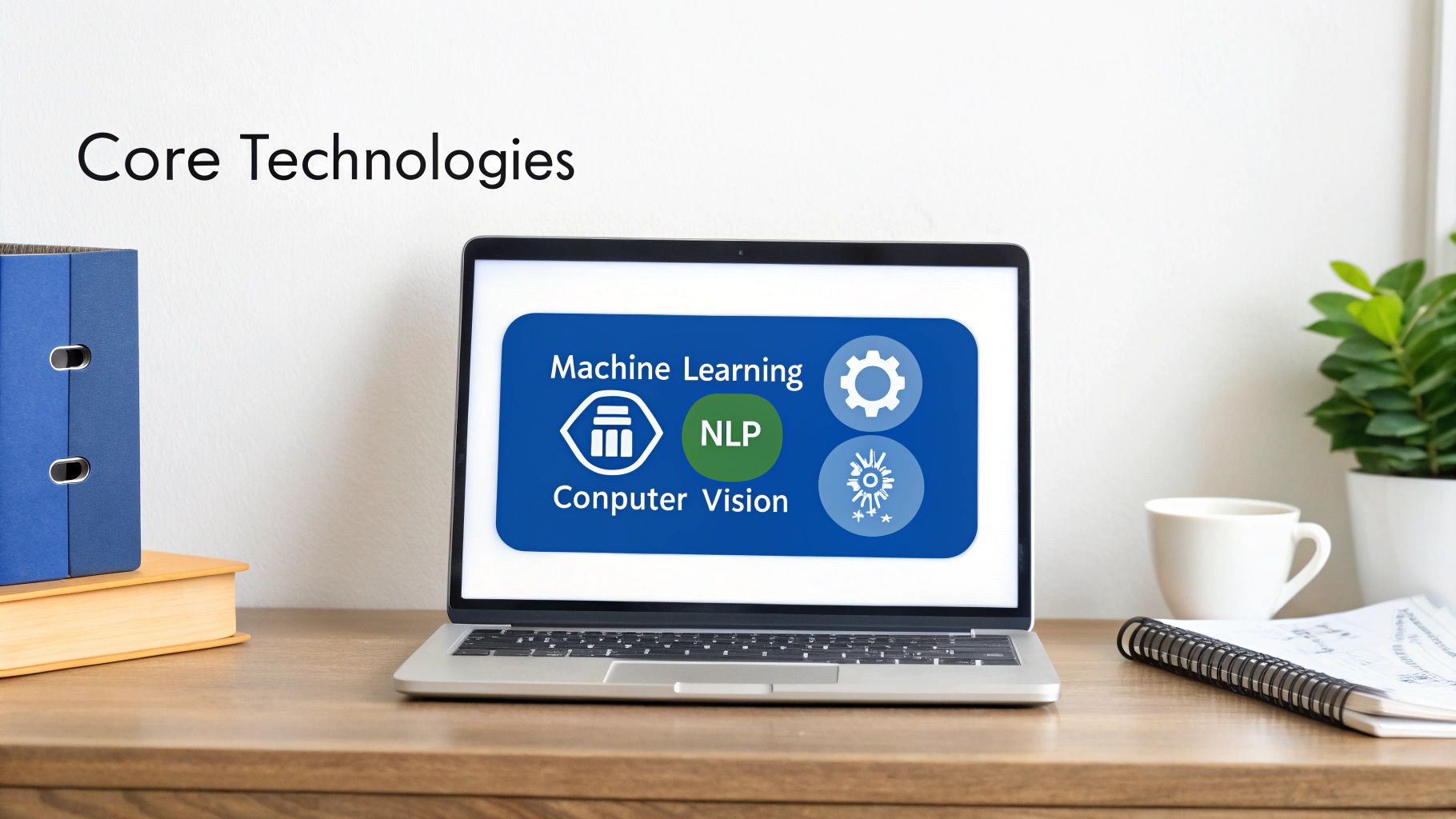
To really get what AI automation is, you have to look under the hood at the engines making it all work. These aren’t just abstract ideas; they're the functional pieces that let a system learn, understand, and see the world in ways that old-school software just can't.
Think of AI automation as a highly skilled digital employee. For this employee to be any good, it needs a brain to think, ears and a voice to communicate, and eyes to see. These core technologies are what provide those capabilities, turning simple automation into a smart, adaptive force for your business.
Let’s break down the three pillars that make it all happen.
Machine Learning: The Brain of Automation
At the heart of almost every AI automation setup is Machine Learning (ML). This is the "brain" that lets software learn from data, spot patterns, and make decisions with very little human input. Instead of being programmed for every single possibility, ML models are trained on huge datasets, allowing them to figure out connections and predict what will happen next.
Imagine a fraud detection system for an e-commerce site. A basic, rule-based system might just flag any purchase over $1,000 from a new location. But what if a real customer is just on vacation? That's where ML comes in. It analyzes thousands of past transactions to learn the subtle, complex fingerprints of fraud—like weird purchase times, a bunch of orders in a row, or strange shipping addresses—and flags suspicious activity with much better accuracy.
To go a bit deeper, check out our guide on **what machine learning algorithms** are and how they actually work.
"Machine Learning gives automation the power of experience. It's the difference between a tool that follows a map and one that learns the terrain, finding better routes on its own over time."
This ability to learn is the main reason the AI market is exploding. The global artificial intelligence market was valued at around USD 638 billion in 2024 and is expected to hit nearly USD 3.68 trillion by 2034. Machine learning is the heavyweight in this space, holding a 36.7% share in 2024, which shows just how critical it is. (You can dig into more AI market data at Precedence Research).
Natural Language Processing: The Ears and Voice
Next up is Natural Language Processing (NLP), which acts as the system’s ears and voice. NLP is what gives machines the ability to understand, interpret, and generate human language, whether it's spoken or written. This is huge, because so much of business data isn’t in a neat spreadsheet—it’s in emails, support tickets, customer reviews, and social media posts.
Picture a customer service team drowning in emails. NLP-powered automation can jump in and:
- Read and understand what each incoming email is about.
- Figure out the sentiment—is the customer happy, annoyed, or furious?
- Categorize the problem (e.g., billing, tech support, feedback).
- Route the ticket to the right person or department, automatically.
This is way more advanced than just matching keywords. NLP gets the context, nuance, and intent, letting automation handle communication workflows that used to require a human.
Computer Vision: The Eyes of the System
Finally, Computer Vision gives AI automation its "eyes." It allows systems to interpret and act on visual information from the real world, just like we do. It can analyze images, videos, and live camera feeds to identify objects, read text, and spot anything out of the ordinary.
A great real-world example is quality control in manufacturing. An AI-powered camera on an assembly line can inspect thousands of products a minute, catching microscopic defects invisible to the human eye. This leads to higher-quality products, less waste, and frees up human workers to focus on more complex problems.
How AI Automation Is Transforming Industries Today
The real power of AI automation isn’t some far-off theory; it’s happening right now, delivering tangible results every day. Across major industries, this technology is creating a clear "before and after" story for businesses that get it right. From improving patient care to securing financial transactions, the applications are concrete, practical, and already reshaping how work gets done.
This isn't just a regional trend. AI automation is fundamentally rewiring business workflows on a global scale. The market covers everything from cognitive analysis to agentic automation, integrated into core functions like finance, marketing, and operations. While North America currently leads the charge, thanks to strong IT infrastructure and early adoption, the movement is worldwide. For a closer look at the numbers, you can learn more about AI automation market trends from MarketsandMarkets.
Revolutionizing Patient Care in Healthcare
In healthcare, where speed and accuracy can literally save lives, AI automation is making a profound difference. Not long ago, tasks like analyzing medical records or interpreting diagnostic scans were entirely manual. This placed a massive burden on medical professionals and opened the door to delays and human error.
Now, AI automation acts as a powerful partner. AI algorithms can sift through millions of patient records in seconds to spot at-risk individuals or predict disease outbreaks. In radiology, computer vision models analyze MRIs and X-rays, flagging subtle anomalies the human eye might miss, helping doctors make faster, more confident diagnoses.
"AI automation isn't replacing doctors; it's empowering them with superhuman analytical abilities. It handles the immense data-sifting tasks, freeing up clinicians to focus on what matters most—direct patient care and complex decision-making."
The "after" picture is a healthcare system that’s more proactive than reactive. Administrative headaches like appointment scheduling and medical billing are streamlined, cutting down on operational friction and creating a better experience for everyone involved.
Securing and Streamlining Modern Finance
The financial services industry runs on data, speed, and trust—three areas where AI automation truly shines. Historically, fraud detection relied on rigid, rule-based systems that couldn't keep up with new threats. Getting a loan meant wading through mountains of paperwork, causing long, frustrating delays for customers.
Today, AI-powered systems have completely changed the game. Machine learning algorithms now monitor millions of transactions in real-time, identifying complex patterns of fraudulent activity that would be impossible for a human analyst to spot. This proactive defense stops financial crime before it happens.
The loan application process is also being redefined:
- Intelligent Document Processing: AI systems automatically pull and verify information from application forms, pay stubs, and bank statements.
- AI-Powered Risk Assessment: Advanced models analyze thousands of data points to assess creditworthiness with greater accuracy and fairness.
- Automated Approvals: Simple, low-risk loan applications can get the green light in minutes instead of days, a massive win for customer satisfaction.
This shift frees up financial professionals from tedious data entry, allowing them to step into more strategic advisory roles where they can offer real value to clients.
Building Resilient IT and Cybersecurity Operations
In the world of IT, the sheer volume of data and system alerts is overwhelming. Before AI, IT teams spent their days manually combing through server logs, patching systems, and chasing down security alerts—many of which were false alarms. It was a purely reactive approach that left organizations vulnerable.
AI automation introduces a proactive, intelligent layer of management. AIOps (AI for IT Operations) platforms can analyze system performance data to predict potential outages before they occur, automatically shifting resources to prevent downtime. It’s a game-changer.
The impact on cybersecurity is even more critical. AI-driven security tools can:
- Analyze network traffic to detect brand-new cyber threats in real time.
- Automate the response to security incidents, isolating affected systems in milliseconds.
- Proactively hunt for vulnerabilities across the entire digital infrastructure.
By handling the high-volume work of monitoring and initial response, AI automation lets IT and security experts focus on high-level threat analysis and strategic defense. Many of the most impactful AI use cases by industry are popping up here, creating more resilient and secure businesses.
Optimizing Manufacturing and Supply Chains
The manufacturing floor and global supply chains are incredibly complex ecosystems. Success used to depend on manual inspections for quality control and reacting to machinery failures, which led to costly production shutdowns and delays.
AI automation brings predictive intelligence into the mix. On the assembly line, computer vision systems can spot microscopic defects with near-perfect accuracy, ensuring a higher quality product. Better yet, predictive maintenance uses sensors and machine learning models to analyze equipment performance, forecasting potential failures before they happen. This means maintenance can be scheduled during planned downtime, keeping productivity high.
Our speakers, who are experts in digital transformation, often point out how this intelligence stretches across the entire supply chain. AI can optimize inventory levels, forecast demand with stunning accuracy, and even reroute shipments in real-time to avoid logistical jams. It's creating a smarter, more resilient operational backbone for the global economy.
Measuring the Business Impact of AI Automation
Let’s be honest: adopting any new technology comes down to one question. Why should we do this? For AI automation, the answer has to go beyond buzzwords and point to real, measurable improvements across the business. The case for AI isn't theoretical—it’s built on tangible outcomes that directly impact your bottom line and sharpen your competitive edge.
The first place you'll likely see an impact is in significant cost savings. When you automate high-volume, repetitive tasks—think data entry, invoice processing, or even frontline customer service queries—you cut down on thousands of hours of manual work. This isn't just about reducing labor costs. It’s about freeing up your best people to focus on the strategic work that actually drives growth and innovation.
Boosting Operational Speed and Precision
Beyond saving money, AI automation injects a serious dose of velocity into your operations. Processes that used to take days, or even weeks, can now be finished in minutes. Picture a financial institution processing loan applications. AI can verify the data, assess the risk, and deliver a decision in a fraction of the time it takes a human, which completely changes the customer experience for the better.
At the same time, it brings accuracy to a near-perfect level. Human error is just a fact of life in any manual workflow, but it can lead to expensive mistakes, compliance headaches, and frustrated customers. AI systems, on the other hand, execute tasks with unwavering precision. Every time. That reliability builds a much more stable and trustworthy foundation for your entire operation.
"The true ROI of AI automation isn't just in the tasks it completes, but in the human potential it unlocks. When you remove the friction of repetitive work, you create space for creativity, strategic thinking, and deeper customer engagement."
Quantifying the Return on Investment
To get buy-in from leadership, you have to connect these benefits to specific, hard numbers. Vague promises of "improvement" just don't cut it. Leaders need to see a clear path to a return on investment (ROI), and that’s where Key Performance Indicators (KPIs) become your best friend.
Our roster of expert speakers often guides organizations in picking the right metrics to track from the start. They always stress that a successful AI automation strategy is a measurable one. When you focus on concrete data, you can clearly show the value of your investment and make smarter decisions about what to tackle next.
Key Benefits of AI Automation and How to Measure Them
The table below breaks down the core business benefits of AI automation and connects them to the real-world KPIs you can use to measure them. This gives you a practical framework for building your own business case.
| Business Benefit | Key Performance Indicator (KPI) | Example Metric |
|---|---|---|
| Cost Reduction | Reduction in Operational Costs | 25% decrease in cost-per-transaction after automating invoice processing. |
| Increased Efficiency | Process Cycle Time Reduction | Loan approval time reduced from 5 days to 2 hours. |
| Improved Accuracy | Error Rate Reduction | 99.5% accuracy in data entry, up from 88% with manual methods. |
| Enhanced Productivity | Employee Productivity Gains | 40% increase in tasks completed per employee per day in the support team. |
| Better Customer Experience | Customer Satisfaction (CSAT) Score | 15-point increase in CSAT scores due to 24/7 AI chatbot support. |
Business Benefit | Key Performance Indicator (KPI) | Example Metric
By tracking these kinds of KPIs, you shift the conversation about AI automation from a technical discussion to a strategic one. You can prove that it's not just another tool—it's a powerful engine for hitting your core business goals and building a more resilient, efficient, and intelligent organization.
Your Roadmap for Implementing AI Automation
Getting started with AI automation can feel like a huge undertaking, but having a clear roadmap makes all the difference. It breaks the journey down into manageable, step-by-step pieces. A successful strategy doesn't start with the tech—it starts by finding the right opportunities.
The best places to begin are often the high-volume, data-heavy tasks that eat up your team's day. Look for workflows that are stuck in a loop of repetitive actions or bogged down by complex, rule-based decisions. These are your low-hanging fruit, the areas where AI can deliver an immediate and noticeable impact.
Once you’ve picked a target, the next step is getting your data in order. An AI is only as smart as the information it learns from. Clean, organized, and accessible data is the foundation of any successful automation project.
Choosing Your Tools and Launching a Pilot
With a clear goal and clean data, you can start looking at tools. The market is crowded, but if you stay focused on the specific problem you're solving, you can cut through the noise. It doesn't matter if you pick an off-the-shelf solution or build something custom. The key is to start small.
A pilot project is non-negotiable. It's your chance to test your approach on a limited scale, iron out the kinks, and prove the value without turning the whole company upside down. A successful pilot builds momentum and gives you critical insights for a wider rollout. For a deeper dive into these early stages, our guide on how to implement AI in business walks through the process in more detail.
Successfully implementing AI automation is less about a single "big bang" launch and more about a series of well-planned, incremental wins. Each pilot project builds confidence, refines your strategy, and proves the business case for the next phase.
Expert Guidance for a Strategic Journey
Every step on this roadmap—from picking the right tech to managing the change within your team—involves critical decisions. This is where having an expert in your corner becomes invaluable. Many of our speakers specialize in technology strategy, helping leadership teams make these choices with clarity and confidence.
They bring the outside perspective needed to ensure your AI initiatives are tied directly to your core business goals. That alignment is what turns a tech project into a real business advantage, ensuring your investment delivers tangible returns.
This kind of strategic planning is vital in a market that's exploding. The global AI in industrial automation market was pegged at USD 20.2 billion in 2024 and is expected to hit USD 111.8 billion by 2034. That growth is being driven by AI's power to enable real-time decision-making, slash defects, and boost efficiency across the board. You can discover more insights about industrial AI market growth to see why a solid plan is so critical.
The visual below breaks down how to think about the return on your AI investment.
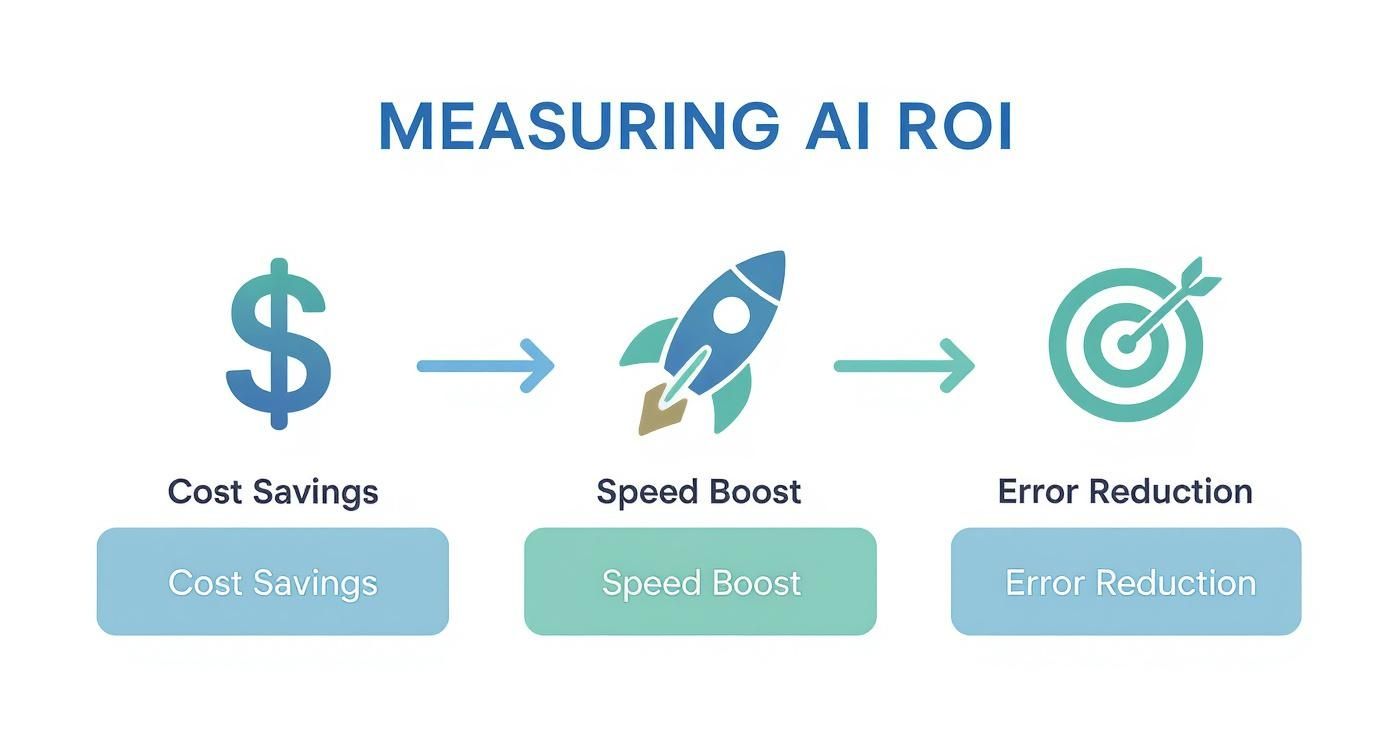
As the graphic shows, the value of AI automation isn't just theoretical. It’s measured in concrete outcomes like direct cost savings, faster operations, and a sharp drop in expensive human errors.
Navigating the Future of Work with AI

Any real conversation about AI automation has to circle back to its most important component: people. As we fold these powerful tools into our daily work, we're forced to confront critical questions around data privacy, fairness, and algorithmic bias. For any organization, building transparent AI systems and maintaining clear accountability isn't just good ethics—it's good business.
This isn't about replacing people. It's about creating a powerful partnership between human and machine. This concept is often called the human-in-the-loop (HITL) model, where AI systems do the heavy lifting—analyzing massive datasets and handling repetitive tasks—while human experts provide the final oversight, judgment, and crucial context.
AI is here to empower your team, not eliminate it.
This approach ensures human feedback becomes a vital input that constantly tunes and improves the AI model, keeping it sharp, accurate, and aligned with what’s actually happening on the ground.
Redefining Roles and Reskilling Teams
This shift is fundamentally changing the nature of work itself. The conversation is finally moving away from job loss and toward job evolution. AI automation is augmenting human roles, creating new opportunities, and putting a premium on the skills machines just can’t replicate: critical thinking, emotional intelligence, complex problem-solving, and creativity.
The new workforce needs people who can manage, interpret, and strategically direct AI systems. Getting your team ready for this isn't just an option; it's a requirement for staying competitive.
"The goal is to prepare your people not just for the next quarter, but for the next decade of work. Strategic reskilling and upskilling are the bridges that will carry your team from where they are today to where they need to be in an AI-powered future."
One of our leading speakers, an expert in workforce transformation, frames this perfectly. They champion a culture of continuous learning where employees are encouraged and empowered to build new skills right alongside the AI tools they use.
This takes a smart, strategic approach to training and development:
- Identify Future Skills: Get ahead of the curve by figuring out exactly what abilities your team will need to work effectively with AI automation.
- Invest in Training: Roll out targeted upskilling programs focused on AI management, data literacy, and strategic thinking—not just technical skills.
- Promote Adaptability: Nurture a company mindset that embraces change and views AI as a collaborative partner for innovation, not a threat.
By investing in your people, you ensure they aren't just reacting to the future of work. They'll be the ones building it.
Common Questions About AI Automation
Even with a solid grasp of the basics, some practical questions always pop up when you start thinking about bringing AI automation into your world. Let's tackle a few of the most common ones to clear things up.
What’s the Real Difference Between AI Automation and RPA?
This is easily the most frequent point of confusion, but the distinction is pretty straightforward.
Think of Robotic Process Automation (RPA) as a highly obedient digital assistant. You give it a very specific, step-by-step script—like "copy the data from this cell in Excel and paste it into that field in Salesforce"—and it will execute that exact task perfectly, thousands of times. It’s brilliant for repetitive, rule-based work involving structured data.
AI automation is the next generation. It doesn't just follow a script; it learns, adapts, and makes decisions. It can read an unstructured email, understand the customer's sentiment, and decide whether to route it to sales or support.
In short: RPA mimics human *actions*, while AI automation replicates human *intelligence*.
Which Business Functions Get the Biggest Lift From AI Automation?
While you can find uses for AI automation in almost any department, the most dramatic wins usually happen where your teams are drowning in high-volume, data-heavy tasks.
- Finance: A classic use case. Think automated invoice processing, expense approvals, and incredibly sophisticated fraud detection that spots patterns humans would miss.
- Customer Service: This is a huge one. We're talking intelligent chatbots that actually solve problems, automated ticket routing to the right expert, and analyzing customer feedback for sentiment at scale.
- Human Resources: Imagine instantly screening thousands of resumes to find the top 5 candidates or automating all the tedious onboarding paperwork. It frees up HR to focus on people, not paper.
- Supply Chain & Logistics: This is where AI excels at complex problems like demand forecasting, optimizing inventory levels across multiple warehouses, and planning the most efficient delivery routes.
Basically, any area where your people are bogged down by repetitive, data-driven work is a goldmine for intelligent automation. Many of our speakers specialize in finding these high-ROI opportunities in specific industries.
How Can a Small Business Get Started Without a Huge Budget?
This is a great question. The key for a small business is to start small and focused. Don't try to boil the ocean with a massive, company-wide overhaul.
Instead, pick one specific, nagging bottleneck. Find that one manual process that everyone hates, that's time-consuming, and that's prone to human error.
"The smartest entry point for a small business is a small, focused pilot project. Prove the value on one well-defined process, learn from the experience, and then build momentum from that success."
Look for accessible, cloud-based AI tools that have pay-as-you-go or scalable pricing models. There are fantastic, affordable platforms out there for automating email marketing, customer support, or social media management. This approach lets you see a tangible return and learn the ropes before you make a bigger commitment, making the journey much more manageable.
Ready to bring this level of insight to your next event? The experts at Speak About AI can connect you with leading keynote speakers who demystify complex topics and provide actionable strategies for your organization. Explore our roster of AI visionaries today at https://speakabout.ai.