

Understanding what is cognitive computing: a concise guide
Imagine a system that doesn't just run on code, but actually thinks. That’s the big idea behind cognitive computing. We're talking about a collection of technologies built to simulate human thought processes, helping us tackle incredibly complex problems.
The key takeaway? These systems are designed to augment our own intelligence, not replace it.
The Foundations: Thinking Beyond the Code
Cognitive computing is a major departure from traditional programming. A standard computer needs clean, structured data and a rigid set of rules to get anything done. But cognitive systems are built for the messy stuff—the ambiguous, unstructured information we deal with every single day, like spoken language, images, and social media chatter.
Think of it like teaching a child versus programming a robot. A child learns through experience, context, and interaction. They spot patterns, ask questions when something doesn't make sense, and get smarter over time. Cognitive systems work on a similar principle, which is why they’re so good at solving problems that used to be strictly for humans.
How it Simulates Human Thought
At its core, the goal is to build systems that can:
- Understand: They can interpret messy, real-world data, like figuring out the sentiment in a customer review or identifying a specific product in a photo.
- Reason: This goes way beyond just fetching data. These systems can form hypotheses, weigh different arguments, and make judgments, even when they don't have all the facts.
- Learn: They continuously get better with new data and interactions, all without needing a developer to manually recode them for every new situation.
This approach is changing how we interact with technology, and its economic impact is impossible to ignore. The global cognitive computing market is projected to grow from around $71 billion in 2025 to over $245 billion by 2030. That kind of growth shows a massive industry bet on systems that can think more like we do. You can find more details on this market growth at Mordor Intelligence.
"Cognitive computing helps us make smarter decisions on our own leveraging machines. Whereas, AI is rooted in the idea that machines can make better decisions on our behalf."
Ultimately, the real power here is collaboration. A cognitive system acts like an intelligent partner, digging through mountains of complex information to pull out the insights that sharpen human decision-making. When you grasp these core principles—understanding, reasoning, and learning—you start to see how this technology isn't just a buzzword, but a practical tool for amplifying human expertise. This is a common theme you'll hear from leading speakers on the topic; they emphasize this human-machine partnership as the key to solving problems we once thought were unsolvable.
The Three Pillars of Cognitive Systems
To really get what cognitive computing is all about, we have to look under the hood. At its core, this technology stands on three powerful pillars that let it mimic how we think: understanding, reasoning, and learning. Think of them as interconnected skills that, when combined, create a powerful partner to boost our own intelligence. Our speakers often explain these concepts to show why cognitive computing is a hot topic in just about every industry.
The diagram below gives you a bird's-eye view, showing how cognitive computing simulates our thought processes to help us think better.
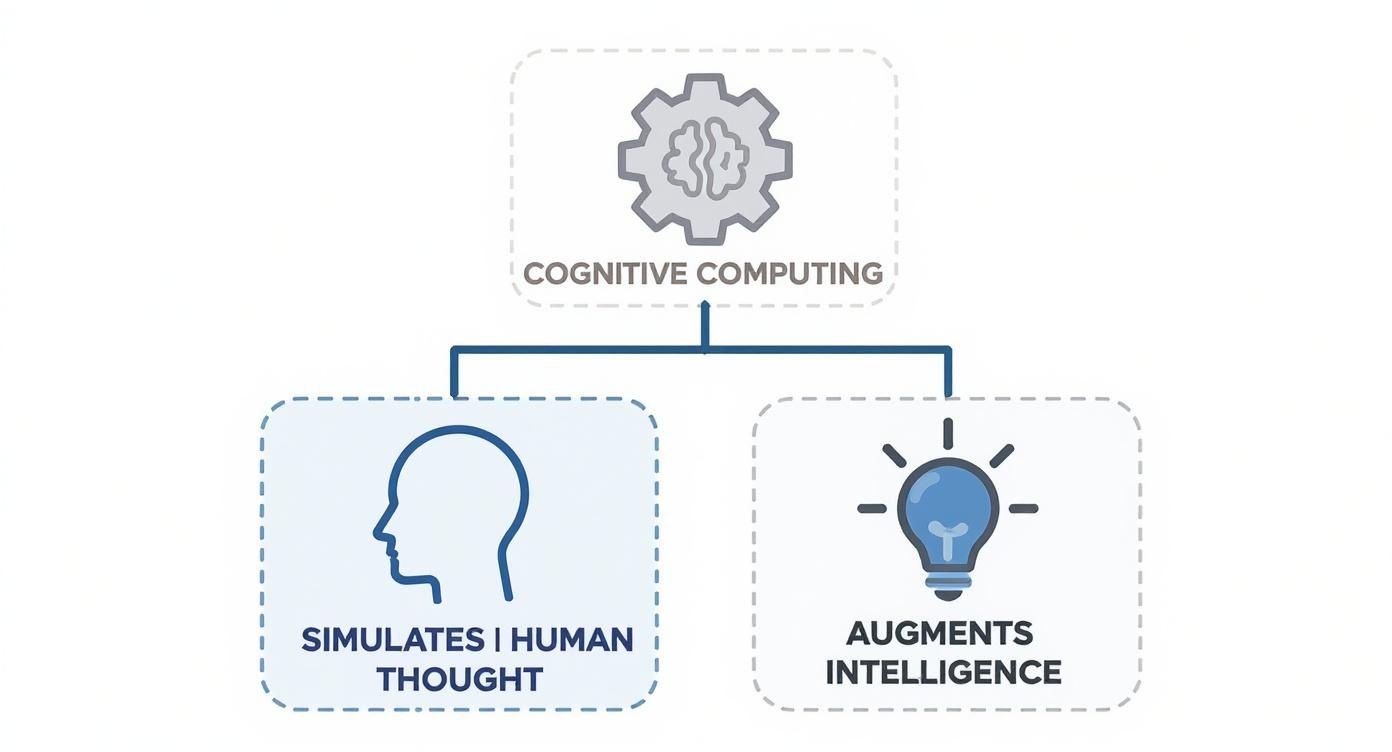
This visual drives home a key point: the goal isn’t to replace people. It’s to give us a thinking partner that can chew through massive amounts of information we never could on our own.
Understanding Unstructured Information
The first pillar is all about understanding. Old-school computers need data served up on a silver platter—neatly organized in rows and columns. Cognitive systems, on the other hand, thrive on the messy, unstructured stuff that makes up over 80% of the world’s data. We’re talking about everything from the human language in emails and reports to the visual chaos in photos and videos.
This is made possible by tech like Natural Language Processing (NLP) and image recognition. Picture a cognitive system as an analyst who can read thousands of customer reviews in minutes. It doesn't just count keywords; it actually gets the sentiment, context, and intent behind the words. It's the difference between seeing data and knowing what it means.
A cognitive system doesn't just process words; it grasps context. It can differentiate between "I'm fine" as a genuine response and "I'm fine" as a sign of frustration, a nuance that traditional software would completely miss.
Reasoning Through Ambiguity
The second pillar is reasoning. This is where the system goes from just processing information to actually thinking about it. Reasoning allows a cognitive system to connect the dots between seemingly unrelated pieces of data, form educated guesses, weigh arguments, and make judgments—even when the information is incomplete or contradictory.
Think about how a doctor diagnoses a rare disease. They aren't just matching symptoms to a list in a textbook. They're pulling together patient history, lab results, and the latest medical journals to build a probable diagnosis. A cognitive system works in a similar way. It can sift through thousands of sources to suggest potential diagnoses or treatment options, even providing a confidence score for each one. This ability to think in shades of gray is what sets cognitive computing apart from a simple database search.
Learning and Adapting Continuously
Finally, we have the third pillar: learning. This might be the most important piece of the puzzle. It allows the system to get better over time without someone having to manually reprogram it for every new situation. Cognitive systems aren't static; they learn from new data, the results of their past decisions, and feedback from human experts.
This process, usually powered by machine learning algorithms, is a lot like human experience. Just as a seasoned professional gets sharper with time, a cognitive system becomes more accurate and insightful with every single interaction.
For example, a fraud detection system learns from every transaction it sees:
- It spots new patterns that might signal fraud.
- It refines its understanding of what normal customer behavior looks like.
- It adapts to new tricks used by criminals, making it tougher to fool over time.
To wrap it all up, let's look at how these pillars work together.
Core Capabilities of Cognitive Computing
This table breaks down the three pillars, showing the function, the tech that makes it happen, and a real-world example of each one in action.
| Pillar | Core Function | Key Technologies | Example in Action |
|---|---|---|---|
| Understanding | Interprets unstructured data like text, speech, and images to grasp context and meaning. | Natural Language Processing (NLP), Computer Vision, Speech Recognition | A system analyzing customer service calls to identify sentiment and recurring issues without human review. |
| Reasoning | Forms hypotheses, evaluates arguments, and makes judgments based on available evidence, even if it's incomplete. | Probabilistic logic, knowledge graphs, inference engines | A financial advisor tool suggesting personalized investment strategies by weighing market trends and a client's risk profile. |
| Learning | Continuously improves its performance by adapting to new data, outcomes, and user feedback. | Machine Learning, Deep Learning, Neural Networks | A medical imaging system that gets better at detecting anomalies in X-rays with every new scan it analyzes. |
Together, these three pillars—understanding, reasoning, and learning—create a system that doesn't just compute, but thinks. As speakers from our roster often point out, it’s this synergy that allows cognitive computing to tackle complex, ambiguous problems and become such a powerful collaborator in human decision-making.
Cognitive Computing vs Artificial Intelligence
In the fast-moving world of tech, it’s easy to get tangled in the jargon. People often toss around "cognitive computing" and "artificial intelligence" like they're the same thing, but they’re not. Nailing down the difference is the first step to really understanding what makes cognitive computing so special.
Think of Artificial Intelligence (AI) as the whole universe of making machines smart. It’s the broad discipline, covering everything from a robot that plays chess to one that drives a car. AI is about getting a machine to show any kind of human-like intelligence.
Cognitive computing, however, is a very specific star within that universe. It’s a specialized subset of AI with a singular mission.
The core goal of cognitive computing is to simulate human thought processes to enhance our own intelligence. It isn't about building a machine that thinks for us. It’s about creating a collaborative partner—a highly sophisticated assistant built to help us sort through complexity and make better, more informed decisions ourselves.
Clarifying the Core Mission
The real difference comes down to their purpose. AI is often aimed at automating tasks and, in many cases, making decisions on its own. A typical AI system might scan market data and automatically execute stock trades based on its predictions.
A cognitive system, on the other hand, is more like a trusted advisor. It would analyze that same market data, but instead of acting alone, it would identify patterns, weigh contradictory evidence, and present a few well-reasoned investment strategies to a human analyst. It’s designed to fill in our blind spots, not replace our judgment.
A cognitive assistant might suggest several career paths to a job seeker, providing critical details like salary benchmarks and educational requirements. But the final decision always rests with the person.
This human-machine partnership is a theme many of our keynote speakers explore. They often highlight how cognitive computing's true power lies in amplifying human expertise, not making it obsolete.
Interaction with Data and Humans
The way these two technologies handle information and interact with people also sets them apart. While both draw from the same well of technologies—you can learn more in our guide to what machine learning algorithms are—their methods diverge significantly.
- Artificial Intelligence: Usually crunches structured, organized data to find patterns and make a call. The interaction is often transactional: you give it an input, and it gives you a final output or takes a specific action.
- Cognitive Computing: Is built from the ground up to deal with messy, unstructured data like natural language, images, and journals. It engages in a conversation with users, asking questions to clarify context and showing its work by presenting the evidence behind its conclusions.
To see this in action, check out how Cognitive AI's role in enhancing understanding and usability is pushing the boundaries of what’s possible in human-computer collaboration.
A Simple Comparison
The clearest way to frame the difference is to look at their goals and their relationship with us. This table breaks it down.
| Feature | Cognitive Computing | Artificial Intelligence |
|---|---|---|
| Primary Goal | Augment human intelligence and assist in decision-making. | Automate processes and perform tasks autonomously. |
| Relationship with Humans | Collaborative partner; provides evidence and suggestions. | Tool or autonomous agent; often makes decisions independently. |
| Data Interaction | Thrives on unstructured, ambiguous, and contextual data. | Often relies on structured data to learn patterns and predict outcomes. |
| Decision-Making | Supports human decisions by presenting options and insights. | Makes the decision on behalf of the human. |
Ultimately, AI is the broader science of making machines intelligent. Cognitive computing is a specialized field focused on collaboration. It’s all about creating systems that think with us, helping us navigate a world of overwhelming information to arrive at smarter conclusions. That collaborative spirit is what cognitive computing is all about.
How Cognitive Computing Is Changing the Game Across Industries
While the theory is fascinating, cognitive computing's real power snaps into focus when you see it at work. Across major sectors, these systems are no longer just abstract concepts. They're becoming practical tools that augment human experts and solve tangible problems in ways we couldn't before.
From diagnosing diseases to personalizing education, cognitive computing is making a measurable difference. Each industry’s application reveals a different side of its potential, giving us a ton of real-world examples that our expert speakers love to dig into. These stories show not just what the tech can do, but how it opens up new avenues for growth and efficiency.
Revolutionizing Healthcare Diagnostics and Treatment
Healthcare is probably one of the most profoundly affected fields. Here, cognitive systems act as a powerful co-pilot for medical professionals, sifting through mountains of unstructured data—patient histories, medical journals, diagnostic images—at a speed no human could ever hope to match. This helps clinicians connect the dots and spot potential diagnoses that might have otherwise been missed.
Think about a radiologist reviewing an MRI. A cognitive system can analyze the scan, instantly cross-reference it with thousands of similar cases, and highlight subtle anomalies that hint at a rare condition. It doesn't replace the doctor. Instead, it serves up evidence-based insights so the radiologist can make a faster, more confident decision.
This area is seeing massive investment for a reason. The healthcare cognitive computing market is expected to hit around USD 6.55 billion in 2025 and is projected to skyrocket to over USD 58.6 billion by 2037. This boom is fueled by the demand for smarter diagnostics and personalized medicine, with diagnostic APIs already commanding a dominant 42.7% market share.
Securing and Personalizing the Financial Sector
In finance, where speed and accuracy are everything, cognitive computing is a game-changer. It’s tackling everything from fraud detection to customer service. These systems can monitor millions of transactions in real-time, learning the unique financial fingerprint of each customer. The moment a transaction deviates from the norm, it's flagged for review, stopping fraud in its tracks.
But it’s not just about security. Cognitive computing is also making financial advice deeply personal. By analyzing a client’s spending habits, risk tolerance, and long-term goals, a cognitive "robo-advisor" can suggest tailored investment strategies or budget plans. It equips the human advisor with rich, data-driven insights, freeing them up to provide more strategic and personalized guidance.
Creating Adaptive Learning Experiences in Education
Education is another industry ripe for a shake-up. The traditional one-size-fits-all model inevitably leaves some students behind while boring others. Cognitive computing is the engine behind adaptive learning platforms that mold the educational experience to each student's unique pace and style.
Here’s how these platforms work their magic:
- Assessing Strengths and Weaknesses: The system analyzes a student's answers to pinpoint which concepts they've mastered and where they're hitting a wall.
- Personalizing Content: It then adjusts the curriculum on the fly, offering extra help on tough topics or presenting more advanced material to those who are ready to fly.
- Providing Instant Feedback: Students get immediate, constructive feedback that helps them learn from mistakes and stay locked in.
This approach creates a dynamic and personalized learning journey, making sure every student gets the support they need to thrive. The data gathered also gives educators a bird's-eye view of class-wide trends so they can refine their teaching strategies.
By understanding the unique learning path of each student, cognitive systems can help educators transition from lecturers to mentors, focusing their time on providing targeted support where it's needed most.
Enhancing Enterprise Operations and Customer Service
Across the business world, cognitive systems are smoothing out operations and completely redefining customer interactions. Take intelligent chatbots and virtual assistants—they’re lightyears beyond simple FAQ bots. Fueled by natural language processing, they can grasp customer intent, handle complex questions, and seamlessly escalate issues to a human agent with full context.
This frees up human agents to tackle the more complex, high-value conversations. Internally, cognitive tools automate routine tasks, analyze supply chain data to predict disruptions, and even assist with public relations. The rise of tools like AI Press Release Generators is a perfect example of how this technology is reshaping traditional business functions. You can explore a wide variety of these applications in our guide to AI use cases by industry.
Navigating the Challenges and Ethical Questions

Like any powerful technology, the road to adopting cognitive computing is paved with practical hurdles and some serious ethical questions. For any organization looking to use these systems responsibly, getting a handle on these challenges is non-negotiable.
Speakers on our roster often drive home the point that the "how" is just as important as the "what." The real goal is building systems that aren't just smart, but also fair, transparent, and secure. This conversation has to go beyond technical specs to get at the real-world impact on people and society. It means taking a balanced view—seeing the incredible potential while proactively managing the risks.
The Practical Hurdles of Implementation
Before we get into the ethical deep end, let's talk about the significant operational challenges. Cognitive systems aren't plug-and-play solutions; they demand a serious investment of both capital and expertise.
One of the biggest roadblocks is the need for massive amounts of high-quality data. These systems learn from what you feed them. If that data is sparse, messy, or biased, the system’s output will be fundamentally flawed from the start.
This brings up another problem: the talent gap. Finding data scientists, AI specialists, and domain experts who can actually build, train, and maintain these complex systems is a huge struggle for many companies.
The initial price tag for cognitive computing can be pretty steep. You're not just paying for software licenses—you have to factor in infrastructure upgrades, the massive effort of data preparation, and hiring specialized talent. A clear ROI roadmap isn't just nice to have; it's essential.
Addressing the Black Box Problem
One of the stickiest ethical issues in cognitive computing is the "black box" problem. This is what happens when a system gives you an answer or makes a decision, but its internal logic is so complex that even its creators can't fully explain how it got there.
This lack of transparency is a massive problem, especially in high-stakes fields like healthcare and finance. If a cognitive system recommends a specific medical treatment or denies someone a loan, you absolutely have to understand the "why" behind it. Without that, you can't be sure the decision is fair, accurate, or free from hidden errors. An unexplainable decision completely erodes trust and makes accountability impossible.
Algorithmic Bias and Data Privacy
Here's a hard truth: cognitive systems are only as unbiased as the data they're trained on. If historical data reflects existing societal biases—whether it’s about race, gender, or income level—the system will learn and amplify those prejudices. This can lead to seriously discriminatory outcomes, like a hiring tool that consistently filters out qualified candidates from a certain demographic.
To fight this, organizations have to actively hunt for and root out bias in their datasets and algorithms. For a much deeper look at this, check out our guide on the ethical considerations in artificial intelligence.
On top of that, these systems need to process huge volumes of sensitive personal information, which throws up some major red flags around data privacy. Every project must answer these questions:
- Data Security: How is personal data being shielded from breaches and prying eyes?
- User Consent: Are people clearly informed about how their data is being used, and have they actually agreed to it?
- Anonymization: What steps are being taken to de-identify data so individual privacy is protected?
Ultimately, building cognitive systems people can trust requires a proactive, heads-up approach to both the practical and ethical minefields. It’s a constant process of questioning, refining, and making sure these powerful tools are used to enhance human intelligence in a way that's responsible and equitable for everyone.
Making Cognitive Computing a Highlight at Your Next Event
Cognitive computing is one of those topics that can really pull a crowd. But let's be honest, it can also sound dense and academic. The trick is framing it right. You need to connect this powerful technology directly to the real-world challenges and opportunities your attendees are grappling with every single day.
That’s where bringing in an expert speaker makes all the difference. A true thought leader can translate the abstract concepts behind what is cognitive computing into tangible, industry-specific insights. They demystify the tech, ensuring your audience leaves not just with a head full of facts, but with genuine inspiration to act. It stops being a lecture and becomes a strategic conversation.
Crafting Talk Titles That Actually Work
A great session starts with a title that sparks curiosity and promises real value. Generic, buzzword-filled titles just get lost in the noise. The key is to focus on outcomes and hit on the specific pain points of your industry.
Here are a few examples our speakers often adapt to nail the audience's needs:
- The Future of Work in the Cognitive Era: This works perfectly for a general business audience. It immediately taps into the common anxieties and big opportunities around automation and human-machine collaboration.
- How Cognitive AI Is Reshaping [Your Industry]: This is the go-to for targeted events. By dropping in a specific sector like healthcare or finance, you're promising tailored insights and relevant case studies, not just theory.
- Beyond the Buzzwords: A Practical Guide to Implementing Cognitive Solutions: This one hits home with a more technical or leadership-focused crowd. It signals a shift from "what" to "how," focusing on actionable steps and real-world deployment.
Key Questions to Ask Potential Speakers
To make sure a speaker can deliver the deep, relevant insights your audience deserves, you have to ask the right questions. Think of vetting a speaker as a collaborative process to find the perfect fit.
Here are four essential questions to guide that conversation:
- Can you share some recent, real-world examples of cognitive computing in our specific industry? This question cuts right through the theory. Practical application is what makes the concepts stick and proves the speaker knows their stuff.
- How do you explain the difference between cognitive computing and general AI to a non-technical audience? A great speaker makes complex topics feel simple without dumbing them down. Their answer here will reveal their communication style.
- What's your take on the ethical challenges and implementation hurdles we should be aware of? You want a balanced perspective. A speaker who only talks about the positives isn't giving the full picture. Acknowledging the risks adds a ton of credibility.
- What are the top three takeaways you want our audience to leave with? This is crucial for aligning the speaker's content with your event goals. It ensures the session is memorable and delivers a clear, impactful message.
By focusing on these questions, you’ll find speakers who do more than just present information. You find storytellers and strategists who connect with an audience on a practical level, making sure they walk away with a clear grasp of the business applications and a vision for what’s next.
Unpacking the Fine Print: Your Cognitive Computing Questions Answered
As we dive deeper into cognitive computing, a few key questions always seem to pop up. Let's tackle them head-on to clear up any lingering confusion and solidify your understanding of this fascinating field.
Can a Cognitive System Actually Feel Anything?
In a word, no. Cognitive systems don't have emotions, consciousness, or self-awareness. While they are masterfully designed to simulate and interpret human thought patterns, their abilities are rooted in algorithms, data processing, and pattern recognition—not genuine feelings.
For instance, a system might use sentiment analysis to recognize frustration in a customer service chat and respond with an appropriately empathetic message. But it's just interpreting data patterns it has learned are associated with frustration. It isn't experiencing the emotion itself. It’s a crucial distinction our top experts always make: the goal is to build systems that understand human context, not replicate human consciousness.
What's Under the Hood? The Programming Languages of Cognitive Tech
There's no single "cognitive computing language." Instead, developers pull from a diverse toolbox of languages, each suited for different parts of the AI and data science puzzle.
- Python: The undisputed champion in this space, thanks to its massive ecosystem of libraries like TensorFlow and PyTorch that make machine learning development much more accessible.
- R: When it comes to heavy-duty statistical computing and data visualization, R is a powerhouse. It's essential for making sense of the enormous datasets that these systems learn from.
- Java and C++: These are the workhorses. Known for their sheer speed and scalability, they're often used to build the high-performance, enterprise-grade infrastructure that cognitive applications run on.
- Lisp and Prolog: While older, these languages have a rich history in AI research and are still valuable for specific tasks that require symbolic reasoning and logic programming.
How Can a Small Business Get in on This?
Cognitive computing isn't just a game for global corporations. Smaller businesses can absolutely tap into these tools to gain a serious competitive edge.
Think about a small e-commerce shop. It could deploy an intelligent chatbot to handle 24/7 customer support, instantly answering common questions and freeing up the human team to tackle more complex, high-value problems. Or, a lean marketing team could use a cognitive tool to analyze thousands of social media comments, getting a crystal-clear picture of market sentiment without needing a dedicated analytics department.
The secret is to start small and be strategic. Pinpoint a specific, nagging pain point in your business—like customer response times or sifting through feedback—where an intelligent system can deliver real, measurable value. It’s not about outspending the competition; it’s about out-thinking them.
Ready to bring a leading voice on cognitive computing to your next event? At Speak About AI, we connect you with top-tier experts who can demystify complex topics and deliver actionable insights for your audience. Explore our roster of speakers at https://speakabout.ai and find the perfect mind to inspire your team.